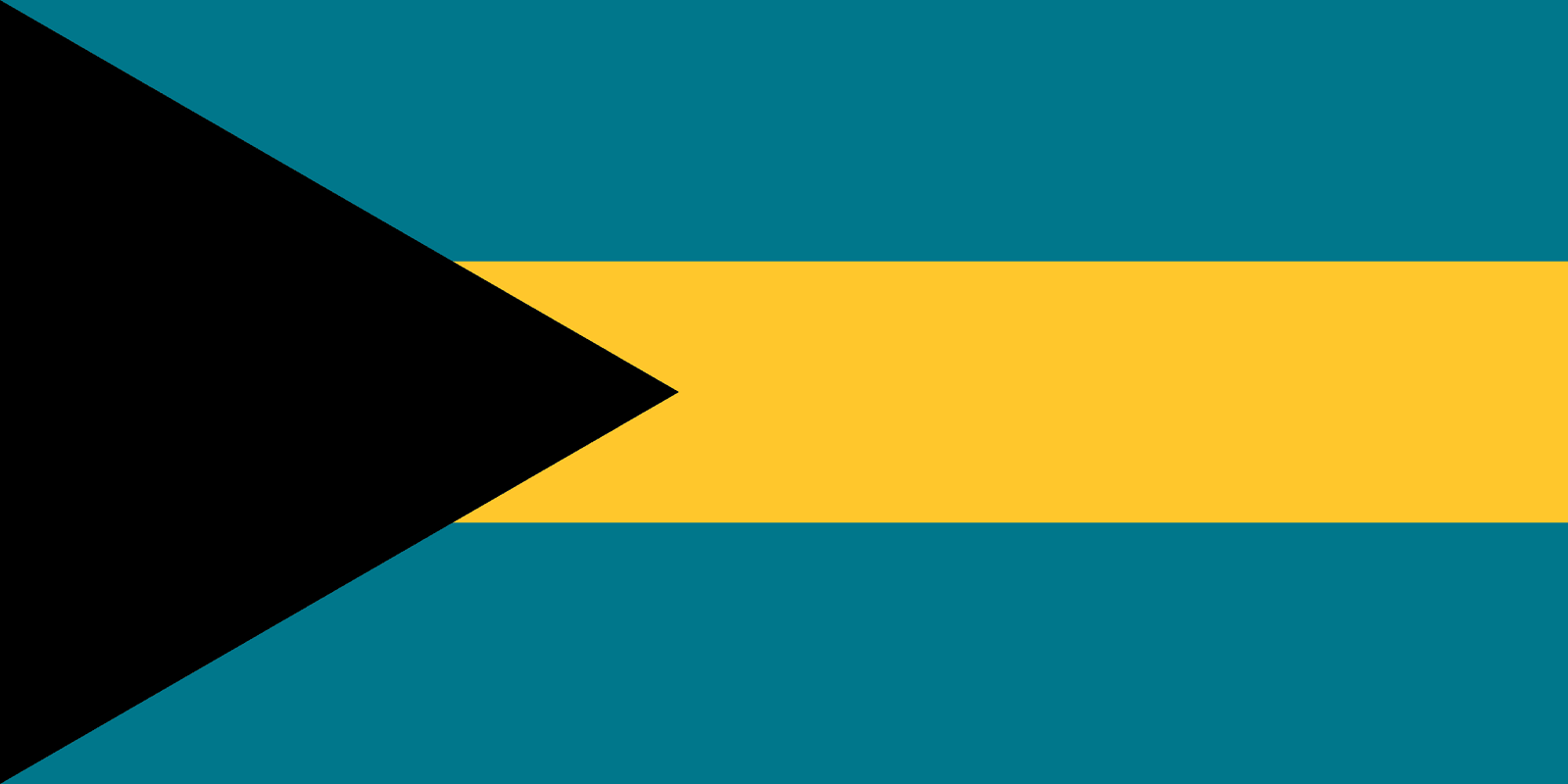
Flag of Bahamas
| Legal Name | Commonwealth of The Bahamas |
|---|---|
| Flag |
|
| Capital City |
Nassau |
| Total Area | ~13,943 km² |
| Land Area | ~10,010 km² |
| Water Area | ~3,933 km² |
| Population | ~410,000 |
| Major Cities | Nassau (275K), Freeport (55K), West End (15K), Marsh Harbour (7K) |
| Currency | Bahamian Dollar (BSD) |
| GDP | ~USD 14 billion |
| GDP Per Capita | ~USD 34,000 (nominal) |
About of Bahamas
The Bahamas is an island nation located in the Atlantic Ocean, southeast of the United States state of Florida and north of Cuba and the Caribbean Sea. It consists of an extensive archipelago of more than 700 islands and cays, although only about 30 are inhabited. The country occupies a strategic maritime position between North America and the Caribbean, making it historically important for shipping, tourism, and regional trade.
There are no direct land borders due to its insular geography, but the Bahamas shares maritime boundaries with the United States, Cuba, Haiti, and the Turks and Caicos Islands. The capital city, Nassau, is located on New Providence Island and serves as the political, economic, and cultural hub of the nation. Freeport, situated on Grand Bahama Island, is the second-largest urban center and an important industrial and commercial zone.
The Bahamas is internationally recognized as a sovereign state and a member of the United Nations, the Commonwealth of Nations, the Caribbean Community (CARICOM), and other global organizations. Its geopolitical significance lies in tourism, offshore financial services, and maritime routes. The country also plays a notable role in regional environmental and oceanic conservation initiatives.
3. Etymology
The name “Bahamas” is generally believed to derive from the Spanish phrase “baja mar,” meaning “shallow sea,” a reference to the region’s clear, shallow waters and extensive coral reefs. Early European explorers used variations of this term when navigating the archipelago’s surrounding waters. Over time, linguistic evolution and anglicization transformed the phrase into the modern name “Bahamas,” which came into formal use during the colonial period.
4. History
Prior to European arrival, the islands were inhabited by the Lucayan people, a branch of the Taíno indigenous group who migrated from the Caribbean. These early inhabitants lived in small communities sustained by fishing and agriculture. In 1492, Christopher Columbus made his first landfall in the New World on an island in the Bahamas, marking the beginning of European contact and subsequent colonization.
During the 17th century, the islands became a haven for pirates and privateers due to their scattered geography and limited colonial oversight. British control was gradually established, and the Bahamas officially became a British colony in 1718. The colonial era saw the introduction of plantation systems and the transatlantic slave trade, shaping the demographic and cultural foundations of modern Bahamian society.
The movement toward self-governance gained strength in the 20th century, culminating in full independence from the United Kingdom in 1973 while retaining membership in the Commonwealth. Since independence, the Bahamas has developed a stable parliamentary democracy and a tourism-driven economy. Modern political developments focus on economic diversification, environmental sustainability, and strengthening financial regulation.
5. Government and Politics
The Bahamas operates as a constitutional parliamentary democracy and a Commonwealth realm, recognizing the British monarch as the ceremonial head of state represented locally by a Governor-General. Executive authority is exercised by the Prime Minister and Cabinet, who are drawn from the elected legislature.
The Constitution establishes the legal framework and guarantees civil liberties and democratic governance. The legislative branch consists of a bicameral Parliament comprising the House of Assembly and the Senate. The judicial branch is independent, with the Supreme Court and Court of Appeal serving as the highest national courts.
Administratively, the country is divided into districts across its inhabited islands. The Bahamas maintains diplomatic relations worldwide and is active in regional organizations such as CARICOM and the Organization of American States. National defense responsibilities are primarily handled by the Royal Bahamas Defence Force, which focuses on maritime security, border control, and disaster response rather than large-scale military operations.
6. Economy
The Bahamian economy is classified as a high-income developing economy heavily dependent on tourism and financial services. Tourism accounts for a significant share of GDP and employment, driven by cruise tourism, luxury resorts, and marine recreation. Offshore banking and international financial services form another major pillar of economic activity.
Agriculture and manufacturing are relatively small sectors due to limited arable land and natural resources. The country imports a large portion of its food and consumer goods. Key exports include financial services, tourism-related services, and small quantities of seafood and salt products.
Economic challenges include vulnerability to global economic cycles, hurricanes, and climate change impacts such as sea-level rise. Long-term strategies emphasize economic diversification, renewable energy investment, digital finance, and sustainable tourism development.
7. Demographics
The population of the Bahamas is predominantly of African descent, reflecting the legacy of the transatlantic slave trade and colonial settlement. Minority communities include people of European, Asian, and mixed heritage. English is the official language, while Bahamian Creole English is widely spoken in everyday communication.
Christianity is the dominant religion, with Baptist, Anglican, Catholic, and Pentecostal denominations being common. The population is largely urban, with most residents concentrated on New Providence and Grand Bahama islands. Population growth is moderate, supported by migration and natural increase.
8. Culture and Society
Bahamian culture blends African, British, and Caribbean influences, producing a vibrant national identity expressed through music, dance, and festivals. Junkanoo, a colorful street parade featuring elaborate costumes, rhythmic drumming, and brass bands, is one of the country’s most distinctive cultural traditions.
Cuisine emphasizes seafood, tropical fruits, and spices, with dishes such as conch salad, cracked conch, and peas and rice forming staples of local gastronomy. Social customs emphasize hospitality, community gatherings, and strong family ties. Sports such as athletics, sailing, and basketball are widely enjoyed, while beach recreation and water sports play a central role in leisure activities.
9. Education and Healthcare
The education system in the Bahamas includes primary, secondary, and tertiary levels, with compulsory schooling for children. Literacy rates are high, and institutions such as the University of The Bahamas provide higher education opportunities in various academic fields.
Healthcare services are delivered through a mix of public hospitals and private clinics. Government initiatives focus on improving access to care, preventive medicine, and public health awareness. Ongoing challenges include managing non-communicable diseases and ensuring healthcare accessibility across dispersed islands.
10. Geography and Climate
The Bahamas is composed primarily of low-lying limestone islands, coral reefs, and sandy beaches. There are no mountains or major rivers due to the flat topography. The surrounding waters are among the clearest in the world, supporting extensive marine ecosystems.
The climate is tropical marine, characterized by warm temperatures year-round and distinct wet and dry seasons. Hurricanes and tropical storms represent the primary natural hazards, particularly between June and November. Environmental concerns include coastal erosion, coral reef degradation, and vulnerability to climate change and rising sea levels.
11. Flora and Fauna
Despite limited land area, the Bahamas hosts diverse marine and coastal biodiversity. Native vegetation includes pine forests, mangroves, and tropical shrubs. Wildlife features bird species such as flamingos, parrots, and migratory seabirds, as well as marine life including dolphins, sea turtles, and coral reef fish.
National parks and protected marine areas play a critical role in conservation efforts. Environmental organizations and government agencies collaborate to preserve coral reefs, protect endangered species, and promote sustainable fishing practices.
Map of Bahamas
National symbols of the Bahamas include its distinctive tricolor flag, the Coat of Arms featuring a shield supported by a marlin and flamingo, and the national anthem “March On, Bahamaland.” The flamingo and blue marlin are often recognized as national animals, representing the country’s rich marine and coastal heritage.
National Flag (Detailed Section)
The national flag of the Bahamas consists of three horizontal stripes: aquamarine at the top and bottom with a gold stripe in the center. At the hoist side is a black equilateral triangle pointing toward the center of the flag. The aquamarine stripes symbolize the surrounding ocean waters, the gold stripe represents the sandy beaches, and the black triangle signifies the strength and unity of the Bahamian people.
The flag was officially adopted on 10 July 1973, the day the Bahamas achieved independence. It is flown on government buildings, national celebrations, and international events. Proper protocol dictates respectful display, including half-mast positioning during national mourning periods.
Flag flying days
| Date | Flag Position | Occasion / Reason |
|---|---|---|
| 10 July | Full-mast | Independence Day |
| First Monday in August | Full-mast | Emancipation Day |
| 25 December | Full-mast | Christmas Day |
| 1 January | Full-mast | New Year’s Day |
| Good Friday (Varies) | Half-mast | National observance and reflection |
| State Funerals / National Mourning | Half-mast | Official mourning periods |