Flag of Panama
| Legal Name | Republic of Panama |
|---|---|
| Flag |
|
| Capital City |
Panama City |
| Total Area | 75,420 km² |
| Land Area | 74,340 km² |
| Water Area | 1,080 km² |
| Population | Approximately 4.5 million |
| Major Cities | Panama City (~1.5 million), Colón (~250,000), David (~150,000), Santiago (~100,000) |
| Currency | Balboa (PAB) and United States Dollar (USD) |
| GDP | USD 78 billion |
| GDP Per Capita | USD 27,000 (PPP) |
About of Panama
Panama is a Central American nation located on the Isthmus of Panama, a narrow land bridge connecting North and South America. It is bordered by Costa Rica to the west and Colombia to the southeast, with coastlines along both the Caribbean Sea and the Pacific Ocean. This strategic location has historically made Panama a critical hub for trade, transport, and international commerce.
The capital, Panama City, is a modern urban center and the largest city, hosting the headquarters of the Panama Canal Authority and a major financial district. Colón and David are significant urban and industrial centers. The population is ethnically diverse, predominantly mestizo, with African, Indigenous, and European heritage. Panama enjoys wide international recognition, being a member of the United Nations, Organization of American States, and World Trade Organization. Its strategic importance is anchored in the Panama Canal, one of the most vital maritime trade routes in the world, linking the Atlantic and Pacific Oceans.
Etymology
The name “Panama” is believed to derive from an Indigenous term meaning “abundance of fish” or “place of many butterflies,” reflecting the country’s rich natural environment. Early explorers in the 16th century adopted the name, which has persisted through colonial, independence, and modern periods.
History
Prehistoric and Ancient Civilizations
Indigenous peoples inhabited Panama for thousands of years, developing agriculture, fishing, and trade networks. Notable early groups include the Ngäbe, Kuna, and Emberá.
Colonial Period
In 1501, Spanish explorers arrived, and Panama became part of the Spanish Empire, serving as a transit route between the Pacific and Atlantic for gold and silver from South America. The construction of the Camino Real and later colonial towns such as Panama City cemented its strategic importance.
Independence Movements
Panama declared independence from Spain in 1821, joining Gran Colombia. It became a separate nation in 1903, with support from the United States to enable construction and control of the Panama Canal.
Key Post-Independence Events
The Panama Canal, completed in 1914, became a cornerstone of the economy and global trade. The canal was transferred from U.S. control to Panama in 1999. Panama experienced periods of political instability and military rule in the 20th century, but democracy was restored in 1989 following the U.S. intervention that ousted Manuel Noriega.
Modern Political Developments
Panama has since developed a stable democratic government, a robust financial sector, and significant infrastructure projects, including expansions of the Panama Canal.
Government and Politics
Panama is a constitutional democracy:
Executive: President is both head of state and government, elected for a five-year term.
Legislative: Unicameral National Assembly with 71 members.
Judiciary: Independent court system including the Supreme Court of Justice.
Administrative Divisions: 10 provinces and 5 indigenous comarcas.
Foreign Relations: Strong ties with the U.S., Latin America, and global trade organizations; member of UN, OAS, WTO.
Defense: No standing army; security is managed by Panama Public Forces, including police and border patrol.
Economy
Panama has a high-income, service-oriented economy:
Major Industries: Banking, logistics, shipping, and tourism.
Agriculture: Bananas, sugar, coffee, rice, and livestock.
Manufacturing: Food processing, cement, chemicals, and consumer goods.
Natural Resources: Some minerals, forests, and fisheries; limited compared to other Central American countries.
Trade Partners: United States, China, EU countries, and Latin America.
Economic Challenges: Dependence on canal revenue, income inequality, and vulnerability to global trade shifts.
Future Outlook: Expansion of logistics, digital economy, and tourism supports sustained growth.
Demographics
Population Composition: Predominantly mestizo (~70%), Afro-Panamanian (~14%), Indigenous (~12%), European (~4%).
Languages: Spanish (official), English widely used in business and government.
Religions: Predominantly Roman Catholic (~80%), Protestant and other Christian denominations.
Urban vs Rural: Majority urban (~70%), concentrated in Panama City, Colón, and David.
Population Growth Trends: Moderate growth, with increasing urbanization.
Culture and Society
Panama has a rich cultural heritage blending Indigenous, Spanish, and African traditions:
Arts: Traditional crafts, molas (textiles), and folk art.
Music & Dance: Salsa, tamborito, and folkloric dances.
Cuisine: Seafood, rice, corn, plantains, and tropical fruits.
Social Norms: Family-centered, community-oriented, and hospitality-focused.
Festivals: Carnival in Panama City, Festival de la Mejorana, Independence Day celebrations.
Sports: Baseball and soccer are widely popular; basketball and boxing have growing followings.
Education and Healthcare
Education System: Primary (6 years), secondary (6 years), tertiary universities in urban centers.
Literacy Rate: Approximately 95%.
Healthcare: Public and private systems; strong focus on preventive care and maternal health.
Public Health Achievements: Expanded immunizations, reduction in infectious diseases, and improved maternal mortality rates.
Geography and Climate
Physical Geography: Narrow isthmus with mountains, plains, rivers, and Caribbean/Pacific coastlines.
Climate Zones: Tropical maritime climate with wet and dry seasons; high humidity.
Natural Hazards: Flooding, hurricanes on Caribbean coast, and occasional earthquakes.
Environmental Concerns: Deforestation, pollution, habitat loss, and coastal erosion.
Flora and Fauna
Biodiversity: Tropical rainforests, mangroves, and coral reefs support rich biodiversity.
Native Plant Species: Mahogany, ceiba, tropical orchids, and bromeliads.
Wildlife: Jaguars, sloths, toucans, howler monkeys, and sea turtles.
National Parks and Conservation: Coiba National Park, Soberanía National Park, Darién National Park.
Map of Panama
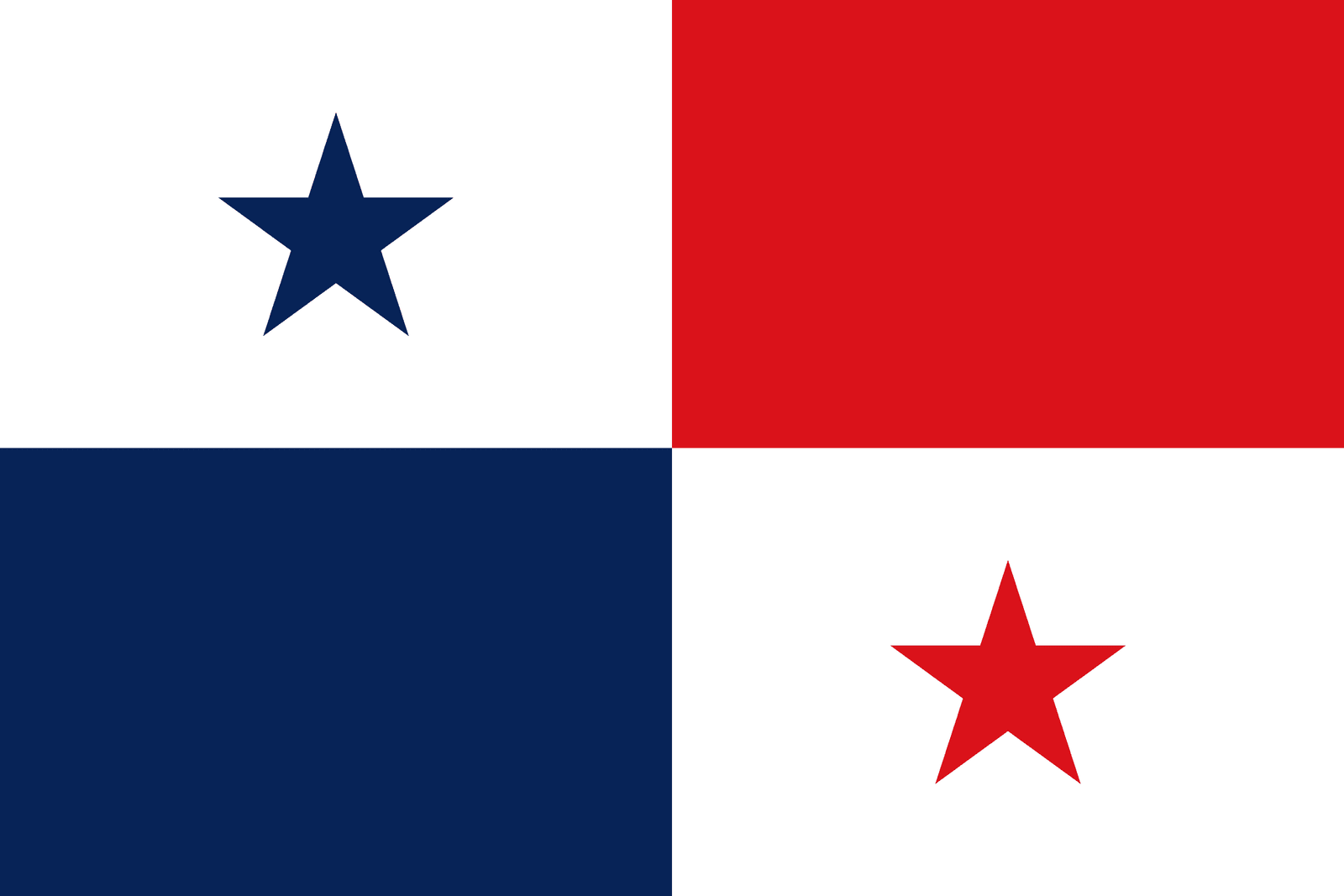
Flag: Blue, red, and white quadrants with two stars.
Coat of Arms: Depicts Isthmus of Panama, cornucopia, sword, and national motto: “Pro Mundi Beneficio” (“For the Benefit of the World”).
National Anthem: Himno Nacional de Panamá
National Animals / Plants: Harpy eagle (national bird), royal palm, and golden frog (symbolic amphibian).
National Flag (Detailed Section)
The flag of Panama, adopted on March 25, 1925, is divided into four quadrants:
Upper-left white quadrant: Blue five-pointed star
Lower-right white quadrant: Red five-pointed star
Other quadrants: Blue (bottom-left) and red (top-right)
Symbolism:
Stars: Represent the two political parties (Liberal and Conservative) and peace.
Red and Blue: Political factions
White: Peace and unity
Protocol: Flown at government buildings, schools, international events, and national celebrations.
Usage: Represents national identity, sovereignty, and unity.
Flag flying days
| Date | Flag Position | Occasion / Reason |
|---|
| November 3 | Full-mast | Separation from Colombia Day |
| November 28 | Full-mast | Independence from Spain Day |
| December 20 | Full-mast | National Flag Day |
| National Mourning | Half-mast | Death of public officials or national tragedies |
| Other Civic Holidays | Full-mast | Cultural and regional celebrations |