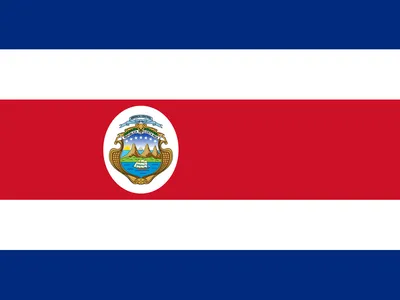
Flag of Costa Rica
| Legal Name | Republic of Costa Rica |
|---|---|
| Flag |
|
| Capital City |
San José |
| Total Area | ~51,100 km² |
| Land Area | ~51,060 km² |
| Water Area | ~40 km² |
| Population | ~5.3 million |
| Major Cities | San José (350,000), Alajuela (300,000 metro), Cartago (165,000), Heredia (140,000), Limón (95,000) |
| Currency | Costa Rican Colón (CRC) |
| GDP | ~US$80–85 billion |
| GDP Per Capita | ~US$27,000 (PPP-based) |
About of Costa Rica
Costa Rica is a Central American nation located between Nicaragua to the north and Panama to the southeast. It is uniquely positioned with coastlines on both the Pacific Ocean and the Caribbean Sea, giving it significant maritime access and ecological diversity. Despite its relatively small size, the country is internationally recognized for its environmental leadership and political stability.
The capital and largest city, San José, lies in the fertile Central Valley, which also hosts the majority of the population and economic activity. Other important urban centers include Alajuela, Cartago, and Heredia, all closely linked within the metropolitan area.
Costa Rica has a diverse yet cohesive population shaped by Indigenous heritage, Spanish colonial influence, and later migration. It is fully recognized internationally as a sovereign democratic republic and maintains strong diplomatic relations across the Americas and beyond.
Strategically, Costa Rica plays an important role in regional diplomacy, environmental policy, and peacebuilding. Its decision to abolish its military has made it a symbol of peaceful governance and redirected national resources toward education, healthcare, and conservation.
Etymology
The name “Costa Rica” originates from Spanish and translates to “Rich Coast.” Early Spanish explorers believed the region held abundant gold and natural wealth along its shores.
While the anticipated mineral riches were limited, the name endured and later came to symbolize the country’s ecological wealth and agricultural productivity rather than precious metals. Over time, “Costa Rica” evolved into a national identity associated with peace, biodiversity, and social development.
History
Human settlement in Costa Rica dates back thousands of years, with Indigenous peoples such as the Chorotega, Bribri, and Cabécar inhabiting the region. These societies developed agriculture, pottery, and trade networks but did not form large centralized empires.
Spanish explorers arrived in the early 16th century, and Costa Rica became a peripheral colony of the Spanish Empire. Due to its relative isolation and lack of mineral wealth, colonial development was modest, fostering a more egalitarian society compared to other colonies.
In 1821, Costa Rica gained independence as part of the broader Central American independence movement. It later became a fully sovereign republic after the dissolution of the Federal Republic of Central America.
A brief civil war in 1948 marked a turning point, leading to major reforms including the abolition of the military and the establishment of a new constitution. Since then, Costa Rica has enjoyed long-term democratic stability, peaceful transfers of power, and consistent institutional development.
Government and Politics
Costa Rica is a democratic presidential republic governed under the 1949 Constitution. The President serves as both head of state and government, elected through popular vote.
Legislative authority rests with the unicameral Legislative Assembly, while an independent judiciary is headed by the Supreme Court. The country is divided into seven provinces, further subdivided into cantons and districts.
Costa Rica maintains active participation in international organizations, including the United Nations, Organization of American States, and various environmental and human rights bodies. The country has no standing army; instead, national security is handled by civilian police forces and coast guards.
Economy
Costa Rica is classified as an upper-middle-income, developing economy with strong institutional foundations. Its economy is diversified, with key sectors including services, tourism, advanced manufacturing, agriculture, and technology.
Agriculture remains significant, producing coffee, bananas, pineapples, and sugar. Manufacturing includes medical devices, electronics, and precision equipment, while services—especially eco-tourism—form the backbone of economic growth.
The country has limited mineral resources but compensates through renewable energy, skilled labor, and trade openness. Major trading partners include the United States, European Union, and regional neighbors.
Challenges include income inequality, public debt, and infrastructure needs. However, continued investment in education, sustainability, and innovation supports a positive long-term outlook.
Demographics
Costa Rica’s population is largely of mixed European descent, with notable Indigenous, Afro-Caribbean, and immigrant communities. Spanish is the official language, with English and Indigenous languages spoken in certain regions.
Roman Catholicism is historically dominant, though religious diversity and secularism have grown. Most Costa Ricans live in urban areas, particularly in the Central Valley. Population growth has slowed in recent decades due to declining birth rates and increased life expectancy.
Culture and Society
Costa Rican culture emphasizes peace, democracy, and environmental respect. The phrase “Pura Vida” reflects a national outlook centered on optimism, simplicity, and appreciation of life.
The arts, music, and literature draw from both Spanish and Indigenous traditions. Cuisine features rice, beans, corn, fresh fruits, and seafood, with regional variations.
Festivals, national holidays, and community events play an important social role. Football (soccer) is the most popular sport, and Costa Rican athletes regularly compete at international levels.
Education and Healthcare
Costa Rica has a strong public education system, with compulsory primary education and widespread access to secondary and higher education. Literacy rates are high, and universities enjoy strong regional reputations.
The healthcare system is universal and publicly funded, providing broad access to medical services. Public health indicators such as life expectancy and infant mortality compare favorably with developed nations, though resource pressures remain.
Geography and Climate
Costa Rica features remarkable geographic diversity, including mountain ranges, volcanoes, rainforests, coastal plains, and wetlands. It has coastlines on both the Pacific and Caribbean but no deserts.
The climate is tropical, with distinct wet and dry seasons. Natural hazards include earthquakes, volcanic activity, floods, and hurricanes on the Caribbean coast. Environmental protection is central to national policy.
Flora and Fauna
Despite covering a small portion of the Earth’s surface, Costa Rica hosts around 5% of global biodiversity. Rainforests, cloud forests, and marine ecosystems support countless plant and animal species.
Wildlife includes jaguars, sloths, monkeys, sea turtles, and hundreds of bird species. A robust network of national parks and protected areas safeguards ecosystems and promotes conservation-based tourism
Map of Costa Rica
Costa Rica’s national symbols reflect its history and natural heritage. These include the national flag, coat of arms, and national anthem, as well as symbolic animals such as the white-tailed deer and national flora like the guaria morada orchid.
National Flag (Detailed Section)
The Costa Rican flag features five horizontal stripes: blue, white, red, white, and blue, with the red stripe double the width of the others. The national coat of arms appears on the red stripe near the hoist.
Adopted in the 19th century, the design was inspired by democratic ideals and European revolutionary symbolism. Blue represents the sky and ideals, white stands for peace and wisdom, and red symbolizes the blood shed for freedom and the warmth of the people.
The flag is displayed on public buildings, during national celebrations, and at international events, following established protocols.
Flag flying days
| Date | Flag Position | Occasion or Reason |
|---|---|---|
| 15 September | Full-mast | Independence Day |
| 25 July | Full-mast | Annexation of Guanacaste Day |
| 11 April | Full-mast | Juan Santamaría Day |
| 1 May | Full-mast | Labor Day |
| National Mourning Days | Half-mast | Official periods of national mourning |