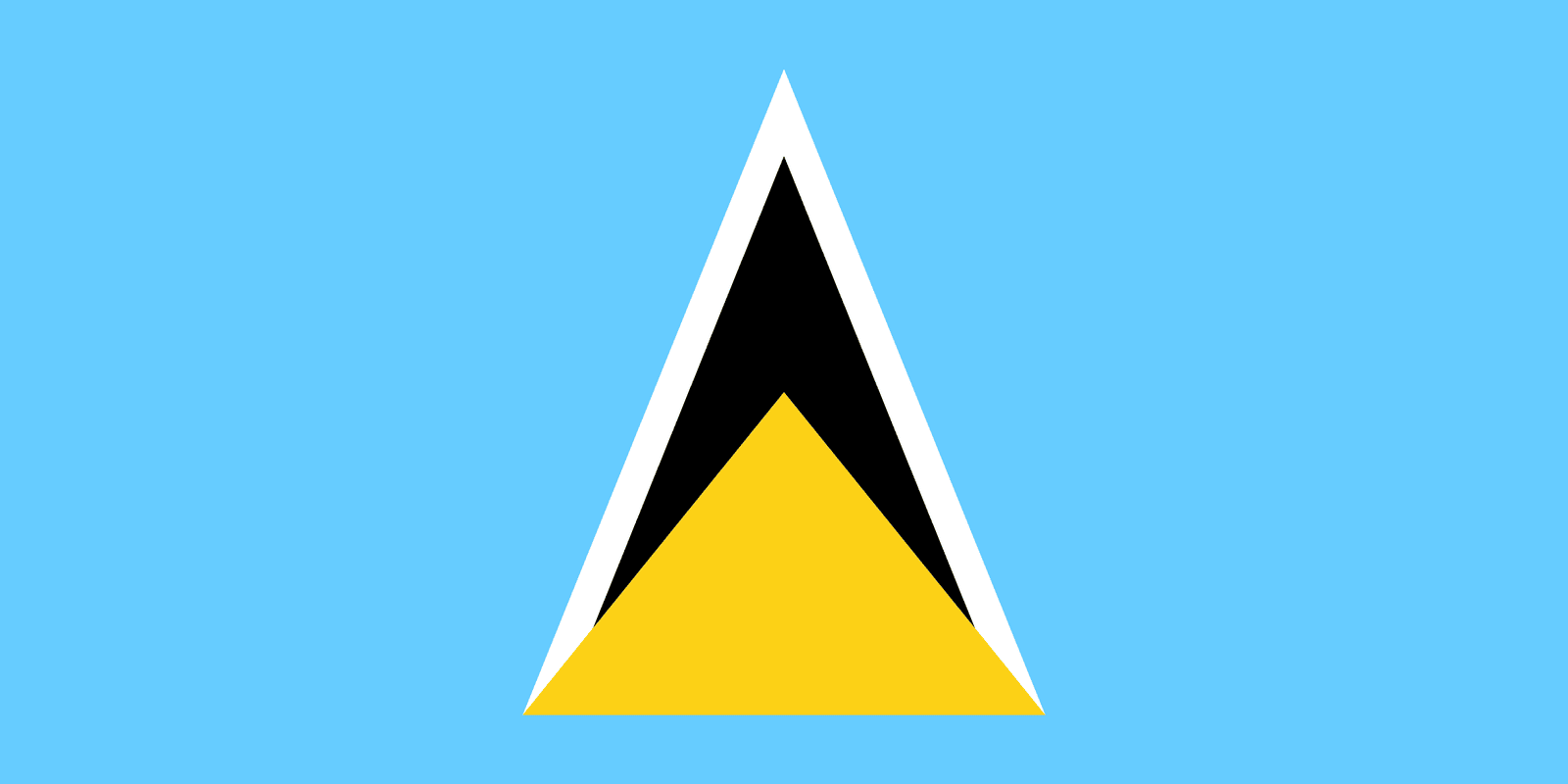
Flag of Saint Lucia
| Legal Name | Saint Lucia |
|---|---|
| Flag |
|
| Capital City |
Castries |
| Total Area | 617 |
| Land Area | ~617 |
| Water Area | Negligible |
| Population | Approximately 185,000 |
| Major Cities | Castries (~70,000 metro), Vieux Fort (~20,000), Soufrière (~8,000), Gros Islet (~7,000) |
| Currency | Eastern Caribbean Dollar (XCD) |
| GDP | ~USD 2.3 billion |
| GDP Per Capita | ~USD 12,000 (nominal); ~USD 20,000 (PPP) |
About of Saint Lucia
Saint Lucia is a sovereign island nation located in the eastern Caribbean Sea, forming part of the Windward Islands in the Lesser Antilles. Positioned between the Atlantic Ocean and the Caribbean Sea, the island lies south of Martinique, north of Saint Vincent and the Grenadines, and west of Barbados.
The country has no land borders, but its maritime boundaries connect it closely to neighboring Caribbean states. Castries, the capital and largest urban center, is situated on the northwest coast and functions as the administrative, commercial, and cultural heart of the nation. Other important towns include Vieux Fort, home to the island’s main international airport, and Soufrière, known for its volcanic landscape.
Saint Lucia has a diverse population shaped by centuries of migration, colonization, and cultural blending. It is a fully independent state, internationally recognized and active in global and regional organizations, including the United Nations, Commonwealth of Nations, Caribbean Community (CARICOM), and Organization of Eastern Caribbean States (OECS). Strategically, Saint Lucia plays a role in regional maritime trade, tourism, climate diplomacy, and disaster resilience within the Caribbean basin.
Etymology
The name “Saint Lucia” is traditionally believed to originate from Saint Lucy of Syracuse, a Christian martyr. According to historical accounts, French sailors shipwrecked on the island on December 13, Saint Lucy’s feast day, and named the island in her honor.
The name reflects the island’s European colonial heritage, particularly French influence. Over time, despite changes in political control, the name Saint Lucia remained constant and became firmly associated with the island’s identity.
History
Prehistoric and Indigenous Period
Before European arrival, Saint Lucia was inhabited by Amerindian peoples, including the Arawaks and later the Caribs (Kalinago). These communities relied on fishing, agriculture, and inter-island trade and strongly resisted early European settlement.
Colonial Rivalry
Saint Lucia became one of the most contested islands in the Caribbean, changing hands between France and Britain at least 14 times between the 17th and 18th centuries. French cultural influence remained strong, especially in language, land tenure, and social customs.
British Control
In 1814, Saint Lucia was formally ceded to Britain. Under British colonial administration, plantation agriculture—based on enslaved African labor—dominated the economy. Slavery was abolished in 1834, profoundly reshaping society and labor systems.
Path to Independence
Throughout the 20th century, constitutional reforms gradually expanded self-rule. Saint Lucia joined the West Indies Federation (1958–1962) and later became an associated state with internal self-government.
Independence and Modern Era
Saint Lucia gained full independence on February 22, 1979. Since then, it has maintained democratic governance and political stability. Modern political developments have focused on economic diversification, tourism growth, education reform, and climate resilience.
Government and Politics
Saint Lucia operates as a constitutional monarchy with a parliamentary democratic system. The British monarch serves as ceremonial head of state, represented locally by a Governor-General.
Executive authority is exercised by the Prime Minister and Cabinet, drawn from the elected members of Parliament. Legislative power rests in a bicameral Parliament, consisting of the House of Assembly and the Senate. The judiciary is independent and forms part of the Eastern Caribbean Supreme Court.
Administratively, the country is divided into districts rather than provinces. Saint Lucia maintains active diplomatic relations worldwide and is engaged in regional security and development cooperation. Defense responsibilities are handled by the Royal Saint Lucia Police Force, which includes a coast guard unit.
Economy
Saint Lucia has a developing, service-oriented economy, with tourism as its dominant sector. The island is a major destination for luxury travel, cruise tourism, and eco-tourism, contributing significantly to employment and foreign exchange earnings.
Agriculture, once centered on bananas, has declined but still plays a role through diversified crops such as cocoa, fruits, and root vegetables. Manufacturing is limited, focusing on beverages, food processing, and light assembly.
The island has few natural resources, relying primarily on human capital, fertile soils, and natural beauty. Major trading partners include the United States, the United Kingdom, and regional Caribbean states. Economic challenges include exposure to external shocks, public debt, and climate risks, while future prospects emphasize renewable energy, digital services, and sustainable tourism.
Demographics
Saint Lucia’s population is predominantly of African descent, with smaller communities of mixed heritage, East Indian, and European ancestry. English is the official language, while Saint Lucian Creole French (Kwéyòl) is widely spoken and culturally significant.
Christianity is the dominant religion, with Roman Catholicism being the largest denomination. The population is increasingly urbanized, particularly around Castries and the northern corridor. Population growth remains modest, influenced by migration trends.
Culture and Society
Saint Lucian culture reflects a rich blend of African, French, and British influences. Music and dance are central to national life, with calypso, soca, reggae, zouk, and traditional folk music widely enjoyed.
Cuisine features dishes such as green fig and saltfish, callaloo soup, fresh seafood, and Creole-seasoned meats. Social customs emphasize community ties, respect, and celebration of heritage. Major events include Saint Lucia Carnival, Independence Day, and Jounen Kwéyòl, which celebrates Creole culture. Cricket, football, and athletics are popular sports.
Education and Healthcare
Education in Saint Lucia is free and compulsory at the primary and secondary levels. The country boasts a high literacy rate and access to tertiary education through local colleges and regional universities.
Healthcare is delivered through a network of public hospitals and clinics, complemented by private providers. Public health priorities include chronic disease management, maternal care, and disaster preparedness. Health indicators are generally strong compared to regional averages.
Geography and Climate
Saint Lucia is a volcanic and mountainous island, famous for the Pitons, two dramatic volcanic peaks rising from the southwest coast and designated as a UNESCO World Heritage Site. The island also features fertile valleys, rainforests, and coral reefs.
The climate is tropical, with a dry season from December to May and a rainy season from June to November. Natural hazards include hurricanes, floods, landslides, and volcanic activity. Environmental efforts focus on forest conservation, coastal protection, and climate adaptation.
Flora and Fauna
Saint Lucia supports diverse ecosystems, including rainforests, mangroves, coral reefs, and dry forests. Native plant species include orchids, tree ferns, and hardwoods.
Wildlife includes tropical birds, reptiles, marine life, and the Saint Lucia parrot, which is endemic to the island. Conservation efforts are centered on protected areas, marine reserves, and biodiversity management programs.
Map of Saint Lucia
National Flag: Blue field with gold, black, and white triangles
Coat of Arms: Shield featuring the Pitons, bamboo crosses, and national motto
National Anthem: “Sons and Daughters of Saint Lucia”
National Bird: Saint Lucia Parrot
National Flower: Rose
National Flag (Detailed Section)
The national flag of Saint Lucia features a light blue background, symbolizing the surrounding sea and sky. At the center are two superimposed triangles—a larger white triangle outlined in black and a smaller gold triangle—representing the Pitons.
Adopted at independence in 1979, the flag reflects the island’s natural beauty and cultural heritage. Blue symbolizes peace and loyalty, gold represents sunshine and prosperity, while black and white together signify racial harmony. The flag is used on public buildings, schools, and during official ceremonies in accordance with national protocol.
Realted Flags
Flag flying days
| Date | Flag Position | Occasion / Reason |
|---|---|---|
| February 22 | Full-mast | Independence Day |
| August (Carnival Period) | Full-mast | Saint Lucia Carnival |
| May 1 | Full-mast | Labour Day |
| National Mourning Days | Half-mast | State-declared mourning |