
Flag of Brazil
| Legal Name | Federative Republic of Brazil |
|---|---|
| Flag |
|
| Capital City |
Brasília |
| Total Area | 8,515,767 km² |
| Land Area | 8,456,510 km² |
| Water Area | 59,257 km² |
| Population | ~215 million |
| Major Cities | São Paulo (~12.5 million), Rio de Janeiro (~6.7 million), Brasília (~4.3 million), Salvador (~2.9 million), Fortaleza (~2.7 million) |
| Currency | Brazilian Real (BRL) |
| GDP | ~US$2.05 trillion |
| GDP Per Capita | ~US$9,500 (PPP ~US$18,000) |
About of Brazil
Brazil is the largest country in South America and the fifth-largest in the world by both area and population. It spans much of the continent’s eastern portion, encompassing a wide range of geographic zones from Amazon rainforest in the north to the Pampas and Pantanal wetlands in the south.
It shares borders with 10 countries: Argentina, Bolivia, Colombia, Guyana, Paraguay, Peru, Suriname, Uruguay, Venezuela, and France (via French Guiana). The country has an extensive Atlantic coastline of 7,491 km, supporting key ports and economic activity.
The capital, Brasília, was purpose-built in 1960 as a modernist hub designed to foster national integration. Other major urban centers include São Paulo, Rio de Janeiro, Salvador, and Fortaleza, which drive economic and cultural activity. Brazil is internationally recognized for its cultural diversity, economic size, biodiversity, and political influence, serving as a regional leader in South America and an influential player in BRICS, G20, and the United Nations.
3. Etymology
The name “Brazil” originates from the pau-brasil tree, a type of redwood that was abundant along the Brazilian coast during early Portuguese exploration. The term “brasa” in Portuguese means “ember,” referring to the tree’s red dye. Over time, the name came to designate the entire land claimed by Portugal during the 16th century.
4. History
Human habitation in Brazil dates back over 11,000 years, with early indigenous societies cultivating manioc, maize, and engaging in fishing and hunting.
The 16th century marked Portuguese exploration and colonization, driven by trade, sugarcane plantations, and African slave labor. Brazil became a colony of Portugal in 1500 and was later the seat of the Portuguese monarchy during the Napoleonic Wars in Europe.
Brazil declared independence in 1822, forming the Empire of Brazil under Emperor Pedro I. The monarchy lasted until 1889, when Brazil became a federal republic. The 20th century saw industrialization, urbanization, military rule (1964–1985), and the re-establishment of democracy.
Recent decades have focused on economic liberalization, social reforms, environmental conservation, and global integration, though challenges remain in inequality, deforestation, and political polarization.
5. Government and Politics
Brazil is a federal presidential republic with three branches:
Executive: The President is both head of state and government, elected for a four-year term.
Legislative: Bicameral National Congress consisting of the Chamber of Deputies and the Federal Senate.
Judiciary: Independent courts headed by the Supreme Federal Court.
The country comprises 26 states and one federal district, each with its own governor and legislature. Brazil is active in international diplomacy, participating in BRICS, Mercosur, the Organization of American States, and UN peacekeeping missions. The military is substantial, focusing on national defense, border security, and disaster response.
6. Economy
Brazil is classified as an emerging upper-middle-income economy, characterized by a diverse industrial base, agricultural exports, and services. Key sectors include:
Agriculture: Soybeans, coffee, sugarcane, beef, and poultry.
Industry: Automobiles, steel, aircraft, and machinery.
Services: Finance, tourism, information technology, and retail.
Natural resources include iron ore, oil, natural gas, and hydroelectric potential, with energy generation heavily reliant on hydropower. Major trading partners include China, the US, Argentina, and the European Union. Economic challenges include income inequality, inflation, and environmental concerns; however, Brazil remains a global player in agriculture, energy, and biodiversity-based tourism.
7. Demographics
Brazil’s population is ethnically diverse, with European, African, Indigenous, and Asian ancestry. Major languages include Portuguese, with indigenous languages and immigrant languages recognized regionally.
Religions are predominantly Christian (Roman Catholic and Protestant), alongside Afro-Brazilian religions and small communities of other faiths. About 87% of the population is urban, concentrated in megacities and metropolitan areas. Population growth has slowed due to declining fertility rates, though the population remains young relative to developed nations.
8. Culture and Society
Brazilian culture is renowned for music, dance, festivals, and cuisine. Iconic expressions include:
Carnival: Rio de Janeiro’s world-famous festival.
Music: Samba, Bossa Nova, and Forró.
Cuisine: Feijoada, a traditional bean and meat stew, and regional dishes influenced by indigenous, African, and European traditions.
Sports are central to national identity, with football (soccer) dominating, alongside volleyball, basketball, and martial arts like capoeira. Social norms value family, hospitality, and community, while regional diversity influences local customs and festivals.
9. Education and Healthcare
Brazil has free public education, including primary, secondary, and higher education. Universities such as University of São Paulo and Federal University of Rio de Janeiro are globally recognized. Literacy rates exceed 93%, though quality varies by region.
Healthcare is provided through the Sistema Único de Saúde (SUS), offering universal coverage. Challenges include access in rural areas, endemic diseases, and urban healthcare strain, but achievements include vaccination programs and improved maternal and child health.
10. Geography and Climate
Brazil’s geography is highly diverse:
Physical Features: Amazon rainforest, Pantanal wetlands, Cerrado savannas, Atlantic Forest, and mountain ranges like Serra do Mar and Serra da Mantiqueira.
Rivers: Amazon, Paraná, São Francisco, and Tocantins.
Climate Zones: Equatorial in the north, tropical in central regions, semi-arid in the northeast, temperate in the south.
Natural hazards include floods, droughts, landslides, and occasional hurricanes. Environmental concerns focus on deforestation, biodiversity loss, and climate change mitigation.
11. Flora and Fauna
Brazil is one of the most biodiverse countries globally, home to:
Flora: Amazon rainforest species, Atlantic Forest trees, savanna grasses.
Fauna: Jaguars, tapirs, macaws, capybaras, river dolphins, and countless amphibians and reptiles.
National parks like Amazonas, Pantanal, and Iguaçu support conservation and ecotourism, protecting ecosystems and endangered species.
Map of Brazil
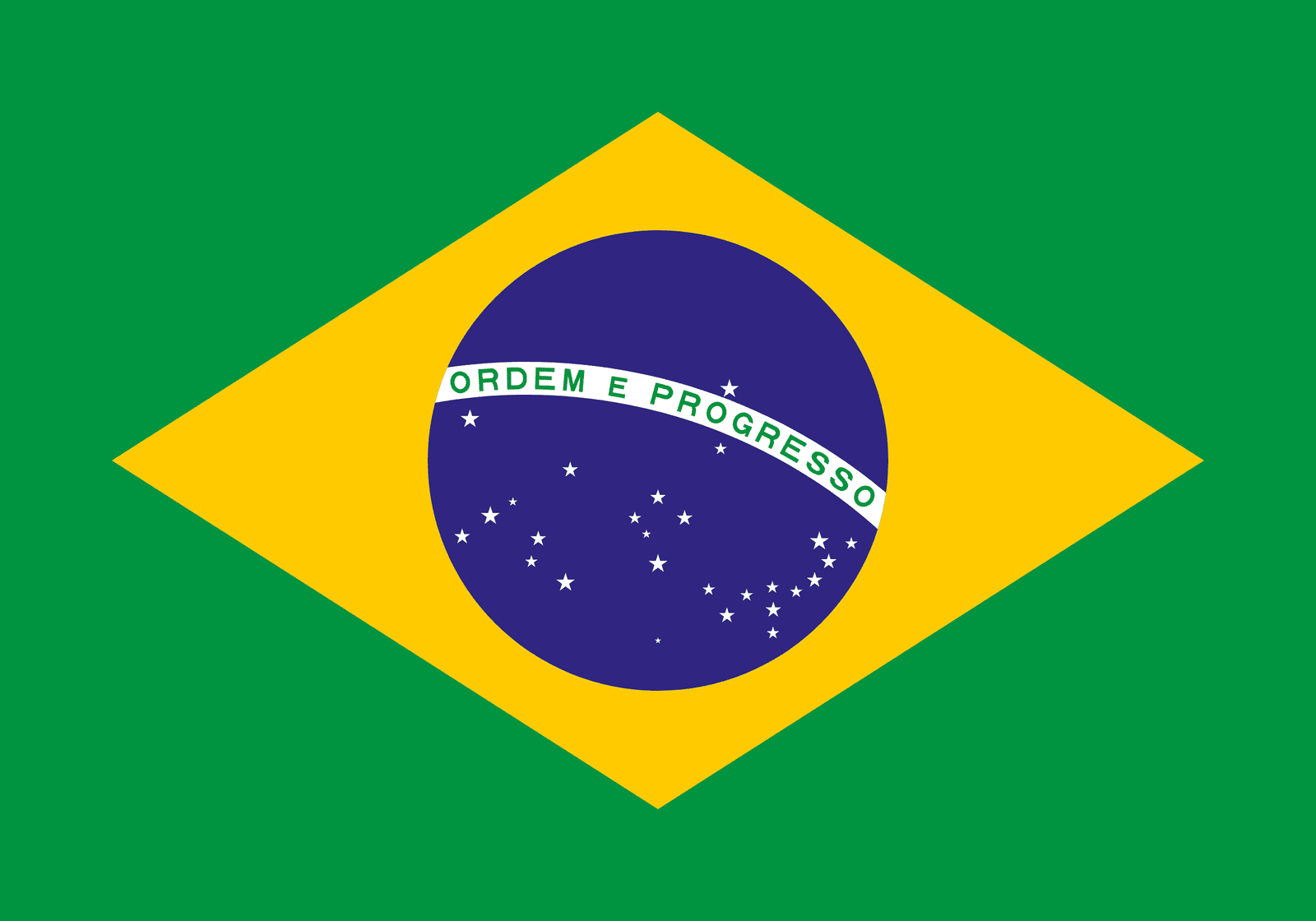
National Flag: Green field, yellow diamond, blue globe with 27 stars and the motto “Ordem e Progresso.”
Coat of Arms: Features a central star, coffee and tobacco branches, and the national motto.
National Anthem: “Hino Nacional Brasileiro.”
National Animal: Jaguar.
National Plant: Pau-brasil tree.
National Monument: Christ the Redeemer statue in Rio de Janeiro.
National Flag (Detailed Section)
The Brazilian flag, adopted in 1889, reflects national identity:
Green field: Represents forests and natural wealth.
Yellow diamond: Symbolizes gold and mineral resources.
Blue globe with stars: Depicts the sky over Rio de Janeiro on November 15, 1889, including all states.
Motto “Ordem e Progresso”: Inspired by positivism, emphasizing order and progress.
Flag protocol requires respectful display at government buildings, schools, and during national celebrations.
Realted Flags
Flag flying days
| Date | Flag Position | Occasion |
|---|---|---|
| 7 September | Full-mast | Independence Day |
| 15 November | Full-mast | Republic Proclamation Day |
| 21 April | Full-mast | Tiradentes Day (National Hero) |
| 2 November | Half-mast | All Souls’ Day / Mourning |
| State mourning | Half-mast | Death of a President or national tragedy |