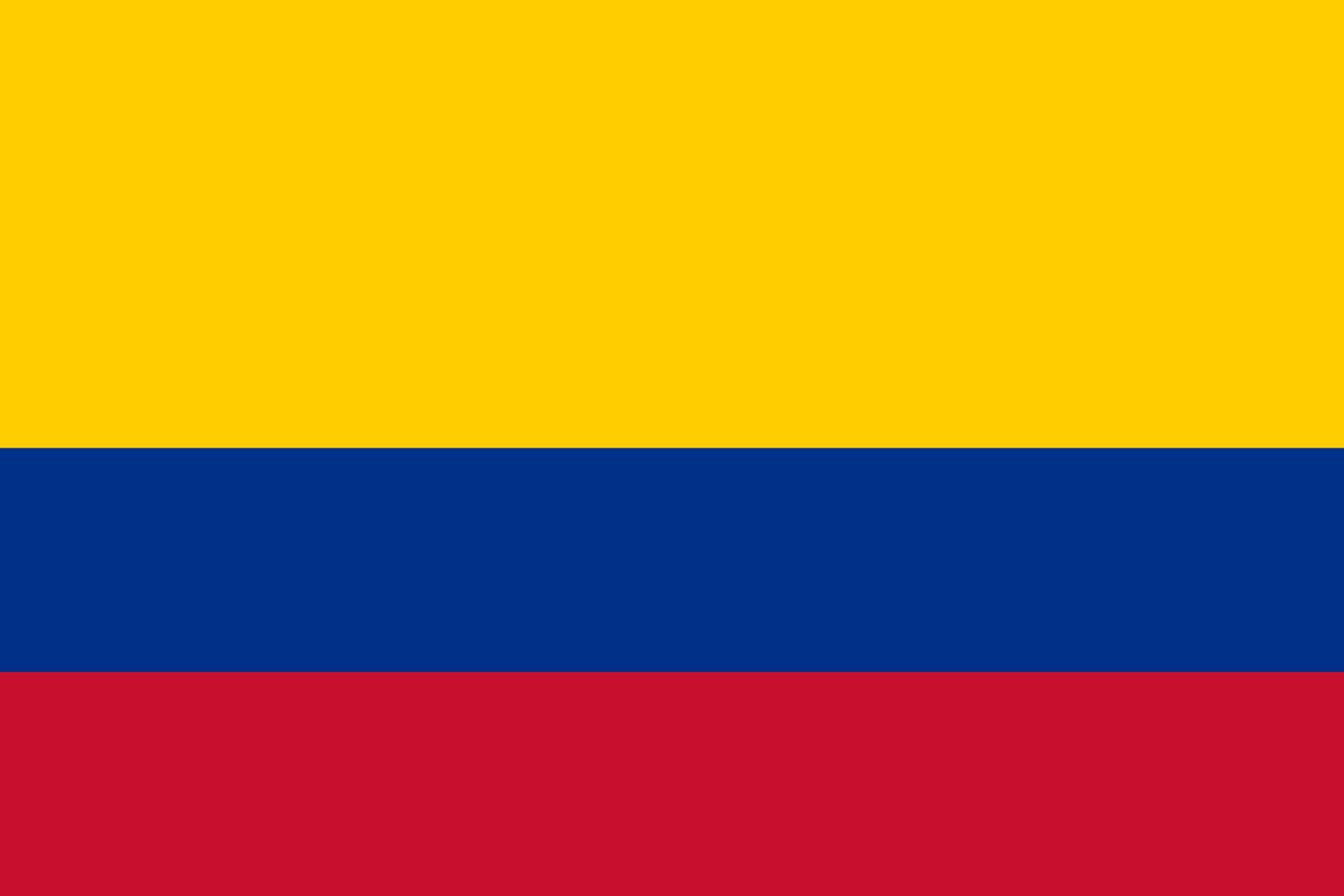
Flag of Colombia
| Legal Name | Republic of Colombia |
|---|---|
| Flag |
|
| Capital City |
Bogotá |
| Total Area | 1,141,748 km² |
| Land Area | ~1,038,700 km² |
| Water Area | ~103,000 km² |
| Population | ~52 million |
| Major Cities | Bogotá (8 million), Medellín (2.6 million), Cali (2.3 million), Barranquilla (1.3 million), Cartagena (1 million) |
| Currency | Colombian Peso (COP) |
| GDP | ~US$360 billion |
| GDP Per Capita | ~US$19,000 (PPP-based) |
About of Colombia
Colombia is a country located in the northwestern region of South America, uniquely positioned as the only nation on the continent with coastlines on both the Caribbean Sea and the Pacific Ocean. This geographic advantage has shaped Colombia’s history, culture, and role in regional trade.
It shares land borders with Venezuela, Brazil, Peru, Ecuador, and Panama, and maritime borders with several Caribbean nations. The capital, Bogotá, sits high in the Andes Mountains and serves as the political, economic, and cultural heart of the country. Other major urban centers such as Medellín, Cali, Barranquilla, and Cartagena are important hubs for industry, commerce, and tourism.
Colombia is one of the most ethnically and culturally diverse countries in Latin America, with a population shaped by Indigenous heritage, Spanish colonization, African ancestry, and later global migration. It is a fully sovereign state with strong international recognition and an active role in regional and global affairs.
Strategically, Colombia holds importance due to its geographic position connecting Central and South America, its access to two oceans, and its influence in Andean and Caribbean geopolitics.
Etymology
The name “Colombia” is derived from Christopher Columbus (Cristóbal Colón in Spanish). The term was popularized in the early 19th century to symbolize the New World and independence from Spanish rule.
Over time, “Colombia” came to represent not only a geographic territory but also the political identity of a new nation emerging from colonial rule. The name reflects ideals of exploration, independence, and unity across northern South America.
History
Human presence in present-day Colombia dates back over 14,000 years, with early Indigenous cultures adapting to diverse landscapes. Prior to European contact, advanced societies such as the Muisca, Tairona, and Quimbaya developed agriculture, goldwork, and complex social systems.
Spanish explorers arrived in the early 16th century, and Colombia became part of the Viceroyalty of New Granada. Colonial rule introduced Christianity, the Spanish language, and new political structures, while also causing major demographic shifts due to disease and forced labor.
The independence movement, led by figures such as Simón Bolívar, culminated in independence from Spain in 1819. Colombia initially formed part of Gran Colombia, a short-lived federation that included Venezuela, Ecuador, and Panama.
The post-independence period was marked by political instability, civil wars, and territorial changes, including the separation of Panama in 1903. In the late 20th century, Colombia faced internal conflict involving guerrilla groups, drug cartels, and state forces. In recent decades, peace efforts and political reforms have significantly improved security and stability.
Government and Politics
Colombia is a unitary presidential republic governed under a constitution adopted in 1991, which strengthened democratic institutions and civil rights.
The executive branch is led by the President, who serves as head of state and government. The legislative branch consists of a bicameral Congress, while the judicial branch includes the Supreme Court, Constitutional Court, and Council of State.
Administratively, Colombia is divided into 32 departments and one capital district. The country maintains active diplomatic relations worldwide and is a member of organizations such as the United Nations, Organization of American States, and Pacific Alliance.
Colombia has one of the largest and most capable military forces in Latin America, primarily focused on national defense and internal security.
Economy
Colombia is classified as an upper-middle-income, emerging economy with a diversified economic base. Major sectors include energy, agriculture, manufacturing, mining, and services.
The country is a leading global exporter of coffee, flowers, coal, oil, and emeralds. Manufacturing industries include textiles, chemicals, food processing, and automobiles, while services such as finance, tourism, and telecommunications are growing rapidly.
Key trade partners include the United States, China, and the European Union. Despite progress, challenges remain, including income inequality, regional disparities, and reliance on commodity exports. Long-term growth prospects are supported by demographic trends, infrastructure development, and expanding international trade ties.
Demographics
Colombia’s population is ethnically diverse, comprising mestizo, white, Afro-Colombian, Indigenous, and mixed-heritage communities. Spanish is the official language, while numerous Indigenous languages are also recognized.
The majority of Colombians identify as Christian, predominantly Roman Catholic, with growing Protestant communities. Urbanization is high, with over 80% of the population living in cities.
Population growth has slowed in recent years, reflecting broader demographic transitions seen across Latin America.
Culture and Society
Colombian culture reflects a fusion of Indigenous traditions, Spanish heritage, African influences, and modern global trends. Regional identities are strong, contributing to varied music, dialects, and customs.
Colombia is internationally renowned for its music and dance, including cumbia, vallenato, and salsa. Literature has global prominence through writers such as Gabriel García Márquez. Colombian cuisine varies by region, featuring staples such as corn, rice, beans, tropical fruits, and seafood.
National holidays, religious festivals, and cultural carnivals play a central role in social life. Football (soccer) is the most popular sport, followed by cycling and athletics.
Education and Healthcare
Colombia has a structured education system comprising primary, secondary, and higher education, with both public and private institutions. Literacy rates are high, and university enrollment has expanded significantly.
The healthcare system combines public and private providers and offers near-universal coverage. While access has improved, disparities remain between urban and rural areas. Public health achievements include improved life expectancy and reduced infant mortality.
Geography and Climate
Colombia is one of the world’s most geographically diverse countries, featuring Andes mountain ranges, Amazon rainforest, Caribbean and Pacific coastlines, plains, and deserts.
Its climate varies by altitude rather than season, ranging from tropical heat at sea level to cold alpine conditions in high mountains. Natural hazards include earthquakes, volcanic activity, floods, and landslides.
Environmental concerns include deforestation, biodiversity loss, and the impacts of climate change.
Flora and Fauna
Colombia is among the most biodiverse countries on Earth, hosting an extraordinary variety of plant and animal species. It ranks first globally in bird and orchid species diversity.
National parks and protected areas preserve rainforests, wetlands, coral reefs, and mountain ecosystems. Conservation efforts are increasingly important for sustainable development.
Map of Colombia
Colombia’s national symbols include the flag, coat of arms, national anthem, and iconic natural emblems such as the Andean condor and wax palm, the world’s tallest palm tree.
National Flag (Detailed Section)
The flag of Colombia features three horizontal bands: yellow, blue, and red, with yellow occupying the top half. The design originated during the independence era in the early 19th century.
Yellow symbolizes wealth and natural resources, blue represents the seas and skies, and red stands for courage and the sacrifices made for independence. The flag is widely displayed during national celebrations and official events.
Flag flying days
| Date | Flag Position | Occasion or Reason |
|---|---|---|
| 20 July | Full-mast | Independence Day |
| 7 August | Full-mast | Battle of Boyacá |
| 12 October | Full-mast | Cultural Heritage Day |
| National Mourning Days | Half-mast | Official periods of mourning |
| Constitution Day (4 July) | Full-mast | Adoption of the Constitution |