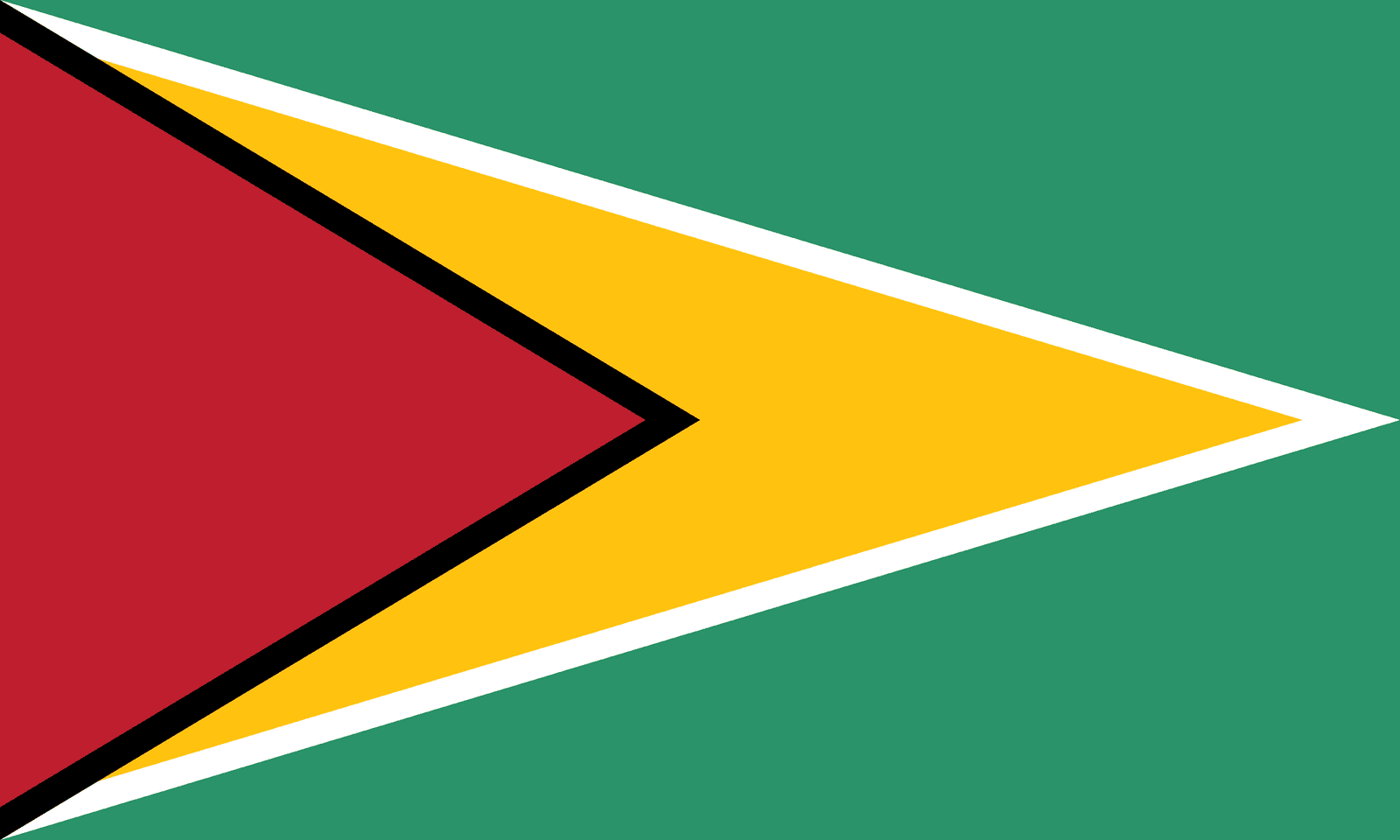
Flag of Guyana
| Legal Name | Co-operative Republic of Guyana |
|---|---|
| Flag |
|
| Capital City |
Georgetown |
| Total Area | 214,969 km² |
| Land Area | Approximately 214,000 km² |
| Water Area | Approximately 969 km² |
| Population | ~820,000 |
| Major Cities | Georgetown (~120,000), Linden (~30,000), New Amsterdam (~35,000), Anna Regina (~15,000) |
| Currency | Guyanese Dollar (GYD) |
| GDP | Approximately USD 15–17 billionn |
| GDP Per Capita | Approximately USD 20,000 (PPP) |
About of Guyana
Guyana is located on the northeastern coast of South America, uniquely positioned as the only English-speaking country on the continent. Despite its geographic placement in South America, Guyana is culturally and politically aligned with the Caribbean and is an active member of Caribbean regional institutions.
The country shares land borders with Venezuela to the west, Brazil to the south and southwest, and Suriname to the east, while its northern coastline lies along the Atlantic Ocean. Maritime boundaries connect Guyana to the wider Atlantic basin, giving it access to major shipping routes and offshore resources.
Georgetown, the capital and largest city, serves as the country’s political, economic, and cultural hub. Most of Guyana’s population lives along the narrow coastal plain, while the vast interior remains sparsely populated and dominated by forests, rivers, and savannahs.
Guyana is internationally recognized as a sovereign state and has gained growing global attention due to significant offshore oil discoveries. Its strategic importance has increased in recent years because of its energy resources, location between major South American states, and role as a bridge between the Caribbean and South America.
Etymology
The name Guyana is derived from an Indigenous word, often traced to the Arawakan term “Guiana”, meaning “Land of Many Waters.” This name reflects the country’s dense network of rivers, creeks, and waterways that define its geography.
Historically, the term “Guiana” referred to a broader region along the northeastern coast of South America, encompassing present-day Guyana, Suriname, French Guiana, and parts of Venezuela and Brazil. Over time, as colonial boundaries solidified, the name became associated specifically with the territory that is now the Co-operative Republic of Guyana.
History
Long before European contact, Guyana was inhabited by Indigenous peoples including the Arawak, Carib, Akawaio, and Wapishana, who developed sophisticated societies based on agriculture, fishing, and river trade.
European exploration began in the late 15th century, followed by Dutch colonization in the 17th century. The Dutch established plantation economies based on sugar, using enslaved African labor. In the early 19th century, control of the territory passed to the British, who unified the colonies into British Guiana in 1831.
The abolition of slavery in 1834 led to major labor shortages, prompting the introduction of indentured laborers from India, China, and Portugal. This period shaped Guyana’s multicultural population and social structure.
Guyana gained independence from the United Kingdom on May 26, 1966, and became a republic in 1970. The post-independence era included periods of political instability, economic nationalization, and authoritarian governance.
Since the 1990s, Guyana has transitioned toward democratic governance and economic liberalization. The discovery of large offshore oil reserves in the 2010s marked a turning point, significantly reshaping the country’s economic prospects and international standing.
Government and Politics
Guyana operates as a presidential representative democratic republic. The President serves as both head of state and head of government and is elected through national elections tied to parliamentary representation.
The Constitution of Guyana provides the legal foundation for governance, outlining the separation of powers among the executive, legislative, and judicial branches. The National Assembly is unicameral and responsible for lawmaking and oversight.
Administratively, Guyana is divided into 10 regions, each with its own regional administration. The judiciary is independent, with the Caribbean Court of Justice serving as the country’s highest appellate court.
Guyana maintains active foreign relations and is a member of the United Nations, CARICOM, the Commonwealth of Nations, the Organization of American States, and other international bodies. The Guyana Defence Force is relatively small and focused on territorial defense, border security, and disaster response.
Economy
Guyana is classified as a developing economy, though it has recently become one of the fastest-growing economies in the world due to oil production. Offshore petroleum extraction now plays a central role alongside traditional sectors.
Agriculture remains important, particularly rice, sugar, and livestock, while mining contributes significantly through gold and bauxite. Manufacturing is limited but includes food processing and light industrial goods.
Services, especially finance, construction, and public administration, have expanded alongside oil-related activities. Natural resources include petroleum, gold, diamonds, timber, and freshwater reserves.
Guyana’s main trading partners include the United States, China, Canada, and CARICOM countries. While economic growth prospects are strong, challenges remain in income inequality, infrastructure development, environmental management, and governance capacity.
Demographics
Guyana’s population is ethnically diverse. People of Indian descent form the largest group, followed by those of African descent, mixed heritage, Indigenous peoples, and smaller European and Chinese communities.
English is the official language, while Guyanese Creole is widely spoken. Indigenous languages are preserved in interior regions. Christianity is the dominant religion, alongside Hinduism, Islam, and traditional beliefs.
Approximately 30–35% of the population lives in urban areas, primarily along the coast. Population growth is moderate, with migration playing a significant role in demographic trends.
Culture and Society
Guyana’s culture reflects its Indigenous roots, colonial history, and immigrant communities. National identity emphasizes unity in diversity, often described through the country’s motto, “One People, One Nation, One Destiny.”
Music styles include calypso, chutney, reggae, and folk traditions. Literature and oral storytelling hold an important place in cultural expression. Cuisine blends African, Indian, Indigenous, and European influences.
Social customs emphasize family ties, religious observance, and community gatherings. Major festivals include Mashramani, Diwali, Eid-ul-Adha, Phagwah, and Christmas. Cricket, football, and athletics are popular sports.
Education and Healthcare
Guyana’s education system includes primary, secondary, and tertiary levels, with public education provided nationwide. Literacy rates are relatively high, and the University of Guyana is the country’s main higher-education institution.
Healthcare is primarily public, supported by private providers. Common challenges include access in remote regions and resource limitations, while progress has been made in maternal health and infectious disease control.
Geography and Climate
Guyana’s geography consists of a low-lying coastal plain, central rainforest highlands, and southern savannahs. Major rivers include the Essequibo, Demerara, and Berbice.
The climate is tropical, with warm temperatures year-round and two rainy seasons. Natural hazards include flooding and coastal erosion. Environmental concerns focus on deforestation, mining impacts, and climate change vulnerability.
Flora and Fauna
Guyana is one of the most biodiverse countries in South America, with vast tracts of untouched rainforest. Native plant species include hardwood trees and medicinal plants.
Wildlife features jaguars, giant river otters, harpy eagles, and thousands of bird and insect species. Conservation efforts are centered on protected areas such as Kaieteur National Park and community-based forest management.
Map of Guyana
Guyana’s national symbols reflect its natural wealth and unity. The flag, coat of arms, and anthem emphasize independence, progress, and harmony. The jaguar and the Victoria regia water lily are among recognized national emblems.
National Flag (Detailed Section)
The national flag of Guyana, known as “The Golden Arrowhead,” features a green field symbolizing forests and agriculture. A large yellow triangle represents mineral wealth, bordered in white for rivers and water resources.
A smaller red triangle, edged in black, symbolizes zeal, dynamism, and resilience, while black represents endurance. The flag was officially adopted at independence in 1966 and is governed by formal usage protocols.
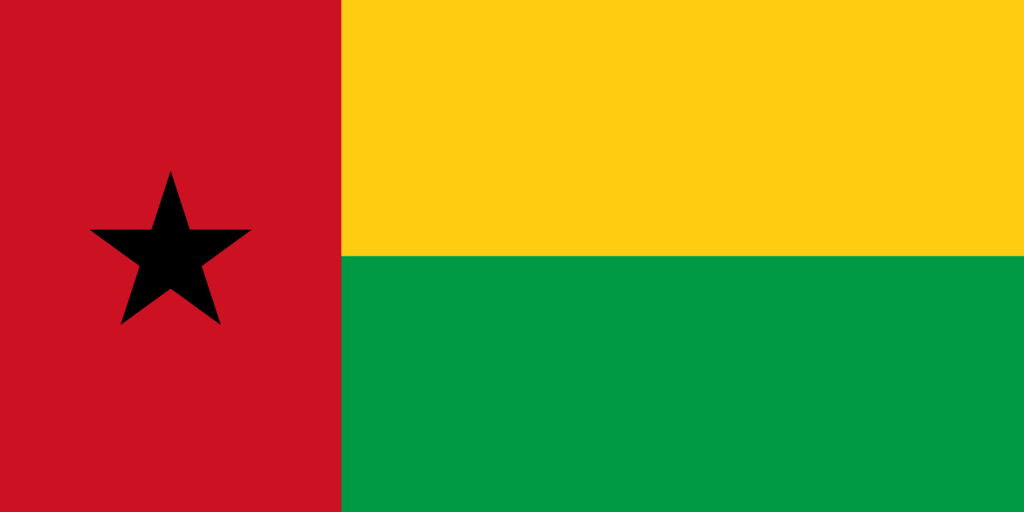
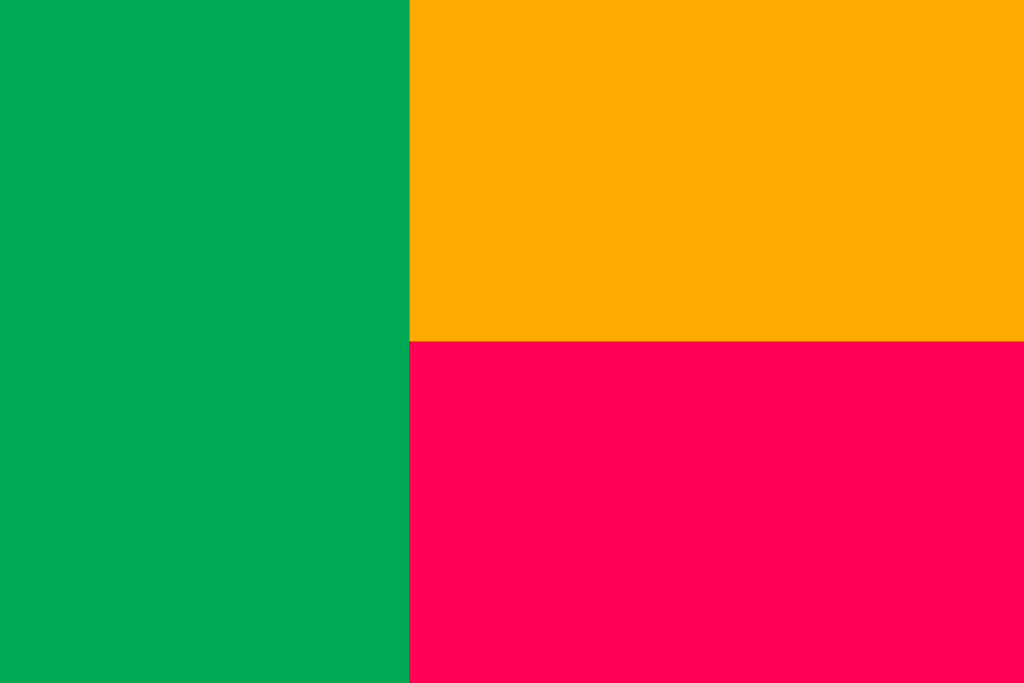
Realted Flags
Flag flying days
| Date | Flag Position | Occasion or Reason |
|---|
| January 1 | Full-mast | New Year’s Day |
| February 23 | Full-mast | Republic Day |
| May 26 | Full-mast | Independence Day |
| August 1 | Full-mast | Emancipation Day |
| October 6 | Full-mast | Amerindian Heritage Day |
| National Mourning Days | Half-mast | State-declared mourning |