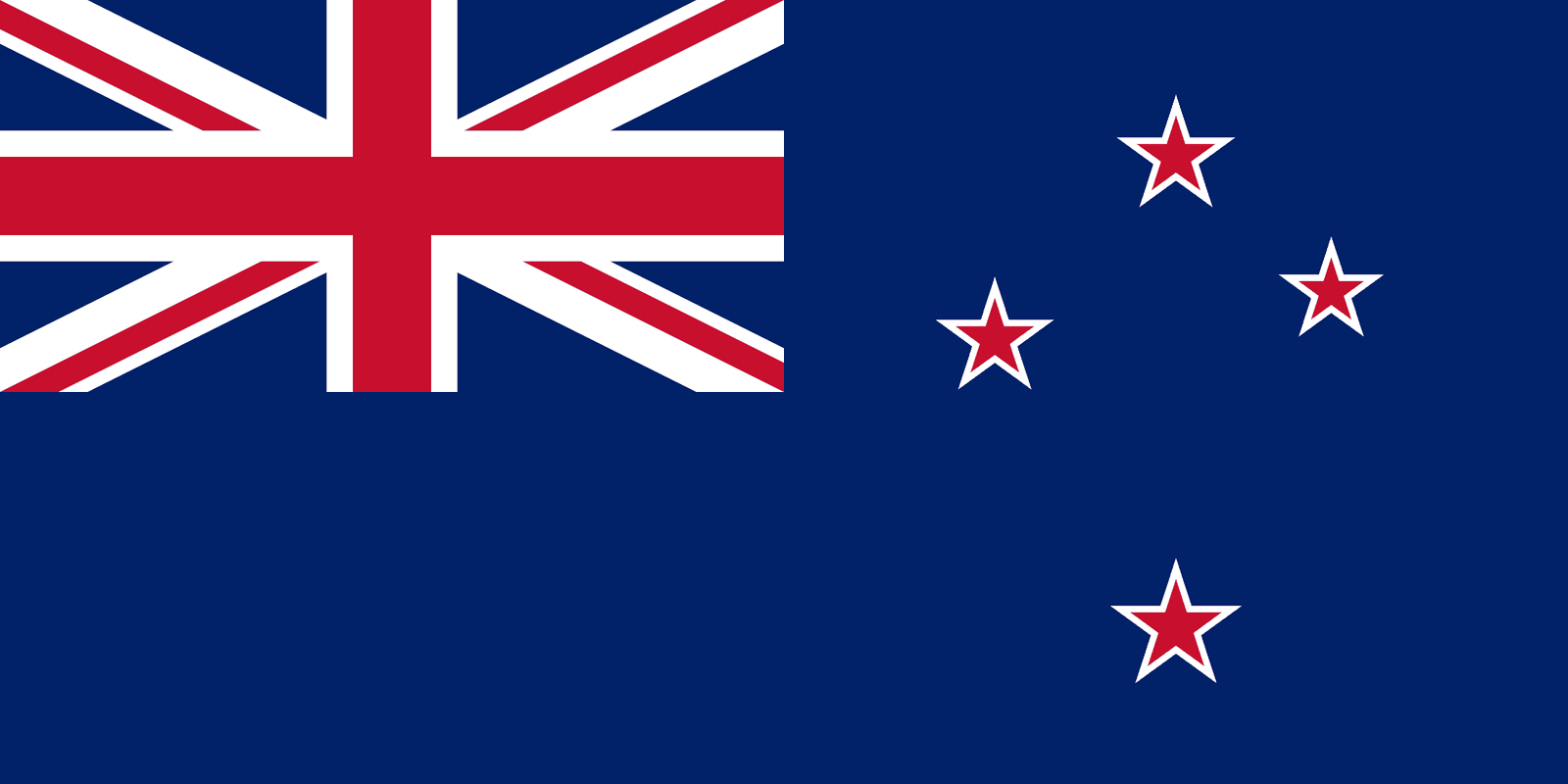
Flag of New Zealand
| Legal Name | New Zealand |
|---|---|
| Flag |
|
| Capital City |
Wellington |
| Total Area | Approximately 268,021 km² |
| Land Area | Approximately 267,710 km² |
| Water Area | Approximately 311 km² |
| Population | About 5.1 million |
| Major Cities | Auckland (1.7M), Wellington (430K), Christchurch (380K), Hamilton (180K), Tauranga (160K) |
| Currency | New Zealand Dollar (NZD) |
| GDP | Approximately USD 270 billion |
| GDP Per Capita | Approximately USD 53,000 (nominal) |
About of New Zealand
New Zealand is a sovereign island nation located in the southwestern Pacific Ocean, comprising two main landmasses—the North Island and the South Island—and over 700 smaller islands. It lies southeast of Australia, separated by the Tasman Sea, and north of Antarctica, placing it strategically in the South Pacific region. Its maritime boundaries extend over a large exclusive economic zone, emphasizing its regional influence in oceanic affairs.
The capital city, Wellington, serves as the political, administrative, and cultural hub, while Auckland is the largest metropolitan area and economic center. Other notable urban centers include Christchurch, Hamilton, and Dunedin, which are key for education, tourism, and regional commerce. New Zealand’s population is highly urbanized, with approximately 87% living in urban areas.
Internationally, New Zealand is recognized as a stable, democratic, and highly developed nation. It plays an active role in global organizations including the United Nations, Commonwealth of Nations, World Trade Organization, and Asia-Pacific Economic Cooperation (APEC). Its strategic significance stems from its location in the Pacific, advanced economy, and role in maritime security, environmental conservation, and international diplomacy.
Etymology
The name “New Zealand” originates from the Dutch explorer Abel Tasman, who mapped parts of the islands in 1642 and named them “Nieuw Zeeland” after the Dutch province of Zeeland. The indigenous Māori name for the country is Aotearoa, commonly translated as “Land of the Long White Cloud,” reflecting the nation’s natural landscapes and early Polynesian navigation lore.
History
Prehistoric and Indigenous Settlements
The Māori arrived in New Zealand around the 13th century, establishing tribal groups, complex social structures, and agricultural practices. Early Māori culture emphasized navigation, communal living, oral history, and environmental stewardship.
European Exploration and Colonial Period
European contact began in the 17th century with Dutch explorer Abel Tasman and later British explorer James Cook in 1769. British influence intensified during the 19th century, culminating in the Treaty of Waitangi in 1840, which established New Zealand as a British colony while recognizing Māori land rights.
Independence and Nationhood
New Zealand gradually achieved legislative independence from Britain, formalized through the Statute of Westminster Adoption Act 1947, which granted full sovereign control over domestic and foreign policy. Post-independence, New Zealand developed as a parliamentary democracy with strong social, economic, and cultural institutions.
Modern Political Developments
New Zealand is renowned for progressive social policies, environmental legislation, and active participation in global diplomacy. Key modern developments include environmental conservation initiatives, Māori cultural revitalization, and leadership in international climate and humanitarian efforts.
Government and Politics
New Zealand is a unitary parliamentary democracy and constitutional monarchy, recognizing King Charles III as the head of state, represented domestically by a Governor-General.
Executive Branch: Led by the Prime Minister and Cabinet, responsible for policy and administration.
Legislative Branch: Unicameral House of Representatives, elected through a mixed-member proportional system.
Judiciary: Independent courts including the Supreme Court, High Court, and Court of Appeal.
Administratively, the country is divided into 16 regions with local councils managing regional affairs. Foreign relations emphasize alliances with Australia, the United States, the European Union, and Pacific neighbors, alongside active roles in the UN, APEC, and Commonwealth. Defense is overseen by the New Zealand Defence Force, focusing on peacekeeping, maritime security, and disaster response.
Economy
New Zealand has a highly developed economy, notable for its efficiency, innovation, and international trade. Key sectors include:
Agriculture and Horticulture: Dairy, meat, wool, kiwifruit, and wine exports.
Manufacturing: Food processing, machinery, and technology products.
Services: Tourism, education, and finance dominate urban economies.
Natural resources such as forests, fisheries, geothermal energy, and minerals bolster economic sustainability. Major trade partners include Australia, China, the United States, Japan, and the European Union. Challenges include environmental sustainability, housing affordability, and economic diversification, with growth prospects tied to technology, renewable energy, and high-value exports.
Demographics
New Zealand’s population of 5.1 million is ethnically diverse:
European / Pākehā: ~70%
Māori: ~17%
Asian: ~15%
Pacific Peoples: ~8%
The official languages are English, Māori, and New Zealand Sign Language. Christianity is predominant, though secularism and religious diversity are significant. Urban centers house the majority of the population, with ongoing trends of urban migration and moderate population growth.
Culture and Society
New Zealand culture reflects Māori heritage, British colonial influence, and multicultural immigration. The country emphasizes bicultural identity, environmental stewardship, and social equity.
Arts and literature thrive with Māori carving, weaving, and haka performance, alongside contemporary music, theatre, and film. Cuisine incorporates seafood, lamb, dairy, and Pacific flavors. National identity is celebrated through festivals like Waitangi Day (February 6), cultural events, and sporting excellence, particularly in rugby.
Education and Healthcare
The education system comprises primary, secondary, and tertiary institutions, with strong public and private university networks. Literacy rates exceed 99%, and higher education is globally competitive.
Healthcare is publicly funded, offering comprehensive services with private sector supplementation. Public health challenges include obesity, mental health, and rural access, with achievements in vaccination and maternal health.
Geography and Climate
New Zealand features mountainous terrains (Southern Alps), rolling plains, fjords, volcanic plateaus, and extensive coastlines. Major rivers include the Clutha, Waikato, and Whanganui.
Climate zones range from temperate maritime in the north to cool temperate in the south. Natural hazards include earthquakes, volcanic activity, and cyclones. Environmental management prioritizes sustainable forestry, marine conservation, and renewable energy development.
Flora and Fauna
New Zealand is renowned for unique biodiversity:
Flora: Native forests with kauri, rimu, and pohutukawa trees.
Wildlife: Flightless birds (kiwi, takahe), bats, and diverse marine life.
Conservation: Protected areas include Fiordland National Park, Tongariro National Park, and Abel Tasman National Park.
Map of New Zealand
Flag: Blue with the Union Jack and Southern Cross constellation.
Coat of Arms: Features a shield with symbols of agriculture, industry, and maritime heritage, flanked by a European woman and Māori warrior.
National Anthem: God Defend New Zealand
National Animals / Plants: Kiwi (bird), silver fern (plant), and tuatara (reptile).
National Flag (Detailed Section)
The New Zealand flag combines the Union Jack, symbolizing historical ties with Britain, with the Southern Cross constellation, representing its location in the Southern Hemisphere. Adopted in 1902, the flag embodies national heritage and maritime history. Protocol dictates its display on public buildings, schools, and during official national celebrations.
Flag flying days
| Date | Flag Position | Occasion / Reason |
|---|---|---|
| February 6 | Full-mast | Waitangi Day |
| April 25 | Full-mast | ANZAC Day |
| Queen’s Birthday (June) | Full-mast | Monarchy observance |
| National Mourning | Half-mast | Death of notable figures or national tragedies |