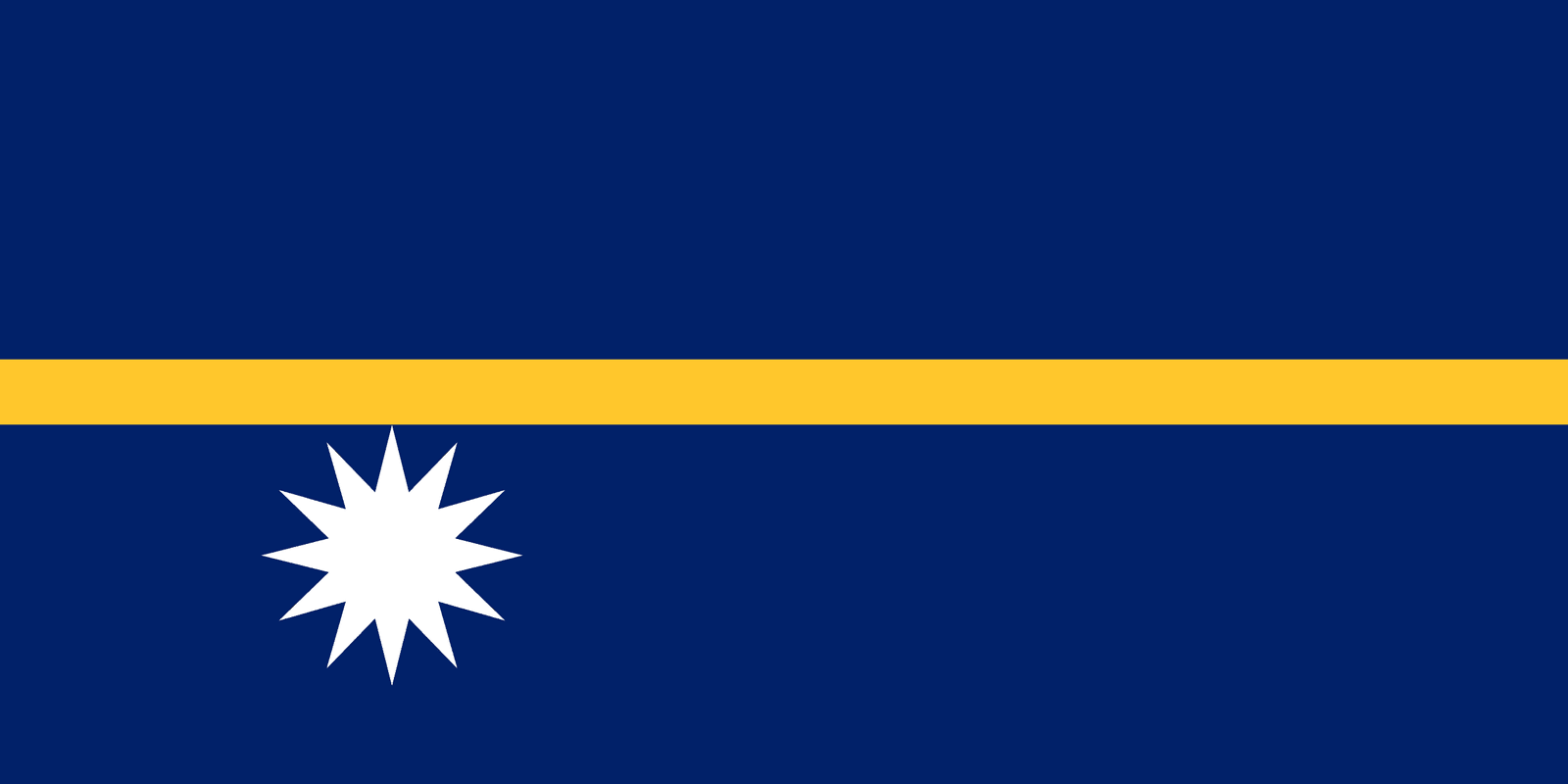
Flag of Nauru
| Legal Name | Republic of Nauru |
|---|---|
| Flag |
|
| Capital City |
Yaren (de facto) |
| Total Area | 21 km² |
| Land Area | 21 km² |
| Water Area | 0 km² |
| Population | Approximately 10,900 |
| Major Cities | Yaren (~1,100), Aiwo (~1,000), Denigomodu (~1,100) |
| Currency | Australian Dollar (AUD) |
| GDP | USD 120 million |
| GDP Per Capita | USD 11,000 |
About of Nauru
Nauru is a small, island country in Micronesia, located in the central Pacific Ocean, northeast of Australia. Covering only 21 km², it is the third smallest country by area in the world and the smallest island nation. The country has no formal land borders, being entirely surrounded by the Pacific Ocean, and its exclusive economic zone covers roughly 308,000 km² of ocean.
Yaren serves as the de facto capital and largest urban center, hosting the government offices and administrative functions, though Nauru lacks an officially designated capital. Despite its small population, Nauru is recognized internationally as a sovereign state and a member of the United Nations, the Pacific Islands Forum, and other regional organizations. Geopolitically, Nauru holds importance due to its strategic location in the Pacific, exclusive economic zone, and participation in regional dialogues on maritime and environmental issues.
Etymology
The name “Nauru” is derived from the Nauruan word “Anáoero”, meaning “I go to the beach” or “the place of the beach,” reflecting the islanders’ connection to the ocean. Over time, European explorers adapted it to “Nauru,” which became the official name of the republic. The term signifies the island’s maritime culture and its long-standing traditions linked to fishing and coastal life.
History
Prehistoric and Ancient Civilizations
Archaeological evidence indicates that Nauru has been inhabited for over 3,000 years, with early settlers relying on fishing, coconut farming, and palm-based subsistence. Small clan-based communities developed, each with distinct customs and land stewardship practices.
European Contact
The island was first sighted by Europeans in the late 18th century, including visits by British and whaling ships. The island became known to traders for its phosphate deposits, which would later define its economy.
Colonial Rule
Germany annexed Nauru in 1888, establishing it as a protectorate. During World War I, Australian forces occupied Nauru. After the war, it became a League of Nations mandate under Australia, New Zealand, and the United Kingdom, later transitioning to a UN trusteeship after World War II.
Independence
Nauru gained full independence on 31 January 1968, becoming the world’s smallest independent republic at the time. The newly formed government nationalized phosphate mining, which had been controlled by foreign companies.
Post-Independence Events
Phosphate mining drove early economic prosperity, making Nauru one of the wealthiest countries per capita in the 1970s. However, resource depletion by the late 20th century caused economic decline. Nauru adapted by engaging in offshore banking, foreign aid, and hosting regional refugee processing centers in collaboration with Australia.
Government and Politics
Nauru operates as a unitary parliamentary republic with a presidential system. The Constitution of Nauru (1968) provides the legal framework for governance.
Executive: The President, elected by the Parliament, acts as both head of state and government.
Legislative: Unicameral Parliament of Nauru with 19 members elected every three years.
Judiciary: Independent judiciary with a Supreme Court overseeing legal matters.
Nauru has no formal administrative divisions, and governance is centralized. The country maintains diplomatic relations with a range of states, including Australia, the United States, and regional Pacific nations. Defense is minimal, with Australia providing security assistance, as Nauru does not maintain a standing military.
Economy
Nauru’s economy is classified as developing and highly dependent on natural resources and foreign aid.
Major Industries: Historically dominated by phosphate mining; currently includes offshore banking, tuna fishing, and government services.
Agriculture: Subsistence farming of coconuts, bananas, and root crops.
Services: Public administration, education, and health sectors are major employers.
Trade Partners: Australia, New Zealand, and regional Pacific markets.
Economic challenges include resource depletion, small population size, geographic isolation, and dependence on imports. The government is pursuing sustainable development, fisheries, and international aid programs to stabilize the economy.
Demographics
Population Composition: Predominantly Nauruan (~75%), with minorities of Tuvaluans, Kiribati, and other Pacific Islanders.
Languages: Nauruan (official), English widely used in government and business.
Religions: Christianity dominates, primarily Protestant and Roman Catholic denominations.
Urban vs Rural: Majority reside in coastal settlements like Yaren, Aiwo, and Denigomodu.
Population Trends: Low population growth due to emigration and limited land resources.
Culture and Society
Nauruan culture is heavily influenced by Polynesian and Micronesian traditions, emphasizing family, communal activities, and respect for elders. Music, dance, and traditional storytelling remain central. Cuisine relies on fish, coconuts, breadfruit, and local root crops. Key public holidays include Independence Day (31 January) and Angam Day, celebrating the survival of the Nauruan people. Sports, especially weightlifting, football, and Australian rules football, play an important role in community life.
Education and Healthcare
Education is free and compulsory up to secondary level, with one major secondary school in each district. Literacy is nearly universal. Higher education is mostly pursued abroad, particularly in Australia. Healthcare is provided by the Republic of Nauru Hospital and smaller clinics, supplemented by Australian assistance. Public health challenges include obesity, diabetes, and non-communicable diseases, while vaccination coverage and primary care are well-maintained.
Geography and Climate
Nauru is a coral atoll with a raised phosphate plateau at its center and a narrow coastal strip. The island has no rivers or significant lakes, and the terrain is mostly flat with a few limestone pinnacles. It has a tropical climate, with warm temperatures year-round, high humidity, and seasonal rainfall from November to February. Natural hazards include droughts and tropical storms, while environmental concerns center on land degradation from phosphate mining.
Flora and Fauna
Nauru has limited biodiversity due to its small size and human activity. Native flora includes coconut palms, pandanus, and native shrubs, while fauna features fruit bats, seabirds, and limited reptiles. Conservation efforts are minimal, focusing on rehabilitation of mined lands and marine protection.
Map of Nauru
Flag: Blue with yellow stripe and white 12-pointed star.
Coat of Arms: Depicts a frigatebird, coconut palm, and ocean waves, representing Nauru’s maritime heritage.
National Anthem: Nauru Bwiema
National Animals / Plants: Frigatebird, sea turtles, and coconut palm.
National Flag (Detailed Section)
Nauru’s flag features a blue field representing the Pacific Ocean, a yellow horizontal stripe near the center symbolizing the equator, and a white 12-pointed star representing the island’s location and twelve original tribes. The flag was adopted at independence in 1968 and reflects Nauru’s cultural identity and geographic context. It is flown on government buildings, public holidays, and official events.
Flag flying days
| Date | Flag Position | Occasion / Reason |
|---|---|---|
| 31 January | Full-mast | Independence Day |
| 26 October | Full-mast | Angam Day (population recovery celebration) |
| 25 December | Full-mast | Christmas Day |
| National Mourning | Half-mast | Death of prominent leaders or national tragedies |