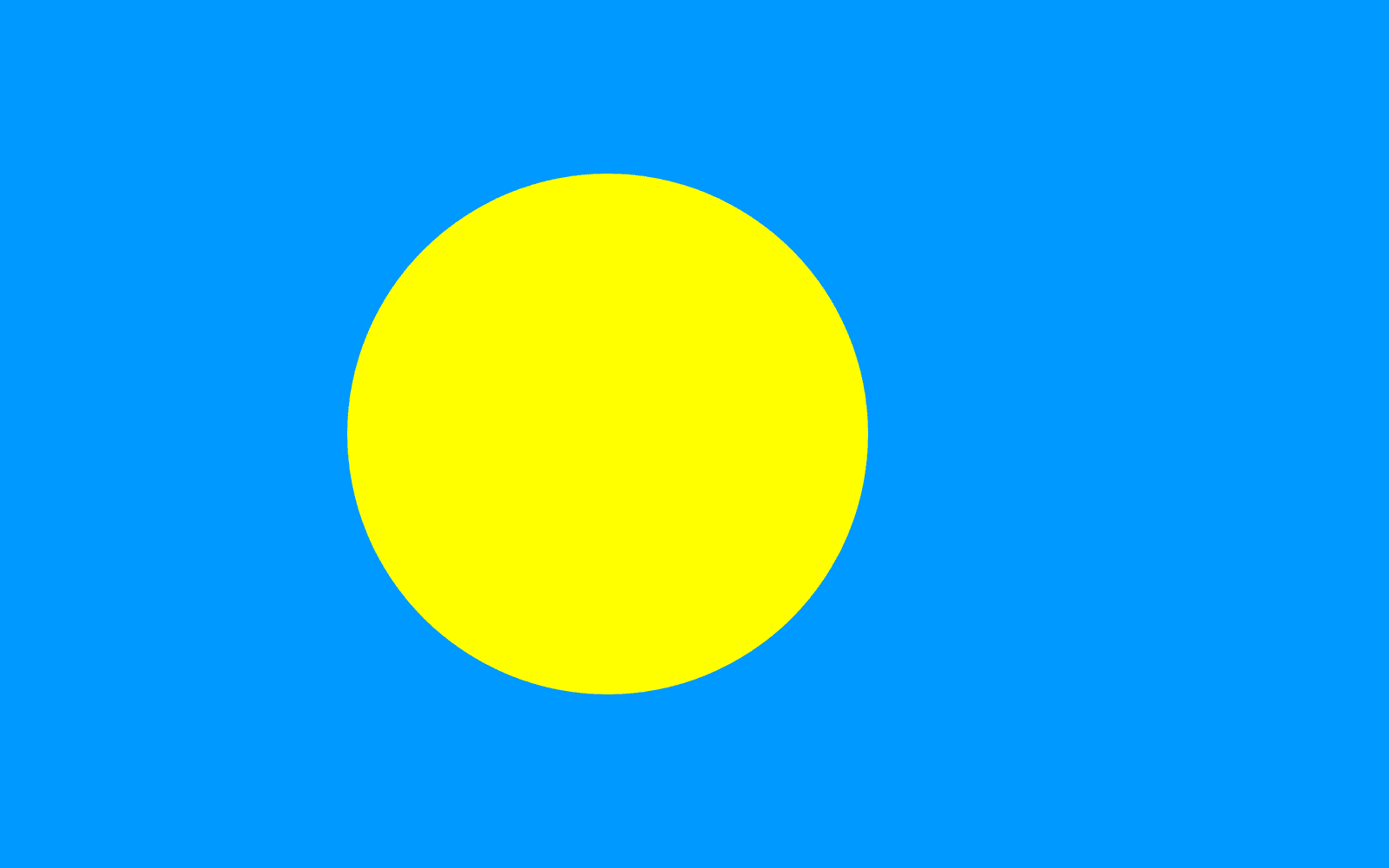
Flag of Palau
| Legal Name | Republic of Palau |
|---|---|
| Flag |
|
| Capital City |
Ngerulmud |
| Total Area | 459 km² |
| Land Area | 458 km² |
| Water Area | 1 km² |
| Population | Approximately 18,000 |
| Major Cities | Koror (~11,000), Airai (~2,800), Melekeok (~400) |
| Currency | United States Dollar (USD) |
| GDP | USD 300 million |
| GDP Per Capita | USD 16,700 (PPP) |
About of Palau
Palau is a sovereign island nation located in the western Pacific Ocean, part of the Micronesia region. It consists of over 500 islands, of which about 8 are inhabited, including the largest islands Babeldaob and Koror. Palau’s maritime territory extends over a vast expanse of ocean, giving it significant strategic and ecological importance.
Palau is surrounded by the Federated States of Micronesia to the east, the Philippines to the west, and the Pacific Ocean. Its capital, Ngerulmud, is located on the island of Babeldaob, while Koror is the largest and most economically active urban center. The population is relatively small and concentrated mainly on Koror, with a demographic profile characterized by a young population and high literacy rates. Palau is internationally recognized as a sovereign state and a member of the United Nations, Pacific Islands Forum, and other international organizations. Its location and extensive exclusive economic zone (EEZ) make it strategically significant for marine conservation and regional security partnerships.
Etymology
The name “Palau” is believed to derive from the Palauan word “Belau”, meaning “village” or “community,” reflecting the islanders’ strong social and communal traditions. Historically, the name evolved through European exploration, appearing in Spanish, Dutch, and English maps in the 16th and 17th centuries. The contemporary spelling “Palau” reflects modern transliteration while maintaining local linguistic heritage.
History
Prehistoric and Ancient Civilizations
Archaeological evidence indicates human settlement in Palau for over 3,000 years, with early inhabitants practicing agriculture, fishing, and navigation. Megalithic structures such as stone monoliths and ceremonial platforms remain as evidence of ancient social organization.
Classical and Medieval Periods
Before European contact, Palauan society was organized into chiefly clans and matrilineal systems, with intricate customary law governing land, sea, and social relations.
Colonial and Imperial Rule
European contact began in the 16th century with Spanish explorers. In 1885, Spain sold Palau to Germany, which administered it as part of German New Guinea. Following World War I, Japan administered Palau under the League of Nations mandate. During World War II, Palau was a significant Japanese military outpost and saw extensive conflict during the Battle of Peleliu in 1944.
Independence Movement
After World War II, Palau became part of the United Nations Trust Territory of the Pacific Islands, administered by the United States. In 1979, Palau adopted its own constitution, and in 1994, it became a fully sovereign state under a Compact of Free Association with the United States.
Modern Political Developments
Palau maintains stable governance and international partnerships, focusing on sustainable development, environmental protection, and regional cooperation. It continues to manage its relations with the U.S., regional Pacific nations, and the broader international community.
Government and Politics
Palau is a unitary presidential republic:
Executive: President serves as head of state and government, elected for four-year terms.
Legislative: Bicameral Palau National Congress (Olbiil Era Kelulau) with a Senate and House of Delegates.
Judiciary: Independent courts including Supreme Court, Court of Appeals, and lower courts.
Administrative Divisions: 16 states, each with local government and traditional chiefs.
Foreign Relations: Member of the UN, Pacific Islands Forum, and maintains diplomatic relations with over 60 nations; close association with the U.S. under the Compact of Free Association.
Defense: No standing military; security provided under the U.S.-Palau Compact, supplemented by local police forces.
Economy
Palau’s economy is small but developed relative to Pacific island standards:
Economic Classification: Developing island economy with strong service sector.
Major Industries: Tourism, fishing, agriculture, and small-scale manufacturing.
Agriculture: Coconut, taro, cassava, and tropical fruits.
Services: Tourism is the primary driver, supported by eco-tourism, diving, and cultural heritage.
Natural Resources: Marine biodiversity, fisheries, and mineral deposits.
Trade Partners: United States, Japan, South Korea, and other Pacific nations.
Economic Challenges: Geographic isolation, small domestic market, reliance on imports.
Outlook: Sustainable tourism, fisheries management, and international aid are central to growth prospects.
Demographics
Population Composition: Predominantly Palauan (~73%), with Filipino, Chinese, and other Pacific Islanders.
Languages: Palauan (official), English (official), and smaller indigenous dialects.
Religions: Predominantly Christian (Roman Catholic and Protestant denominations).
Urban vs Rural: Majority reside in Koror and Babeldaob; rural populations practice subsistence agriculture and fishing.
Population Growth: Stable, slow growth; small labor force with migration for employment abroad.
Culture and Society
Cultural Heritage: Traditional clan system, matrilineal inheritance, and customary law (bul).
National Identity: Strong emphasis on environmental stewardship and cultural continuity.
Arts & Music: Traditional dances, story-telling, and carving; contemporary art integrates modern themes.
Cuisine: Seafood, taro, tropical fruits, and traditional Palauan dishes.
Social Norms: Respect for elders, communal land management, and ceremonial observances.
Festivals: Independence Day (October 1), Constitution Day, cultural performances.
Sports: Canoeing, baseball, soccer, and traditional wrestling.
Education and Healthcare
Education System: Primary and secondary education is compulsory; Palau Community College offers higher education.
Literacy Rate: Over 95%.
Healthcare: Public and private clinics; basic healthcare widely available; advanced treatments often accessed abroad.
Public Health: Focus on non-communicable diseases, maternal-child health, and preventive care programs.
Geography and Climate
Physical Geography: Island chains with limestone and volcanic islands; Babeldaob is largest and mountainous.
Climate Zones: Tropical marine climate; hot, humid, with wet and dry seasons.
Natural Hazards: Typhoons, flooding, and occasional droughts.
Environmental Concerns: Coral reef conservation, deforestation, and freshwater scarcity.
Flora and Fauna
Biodiversity: Rich marine life, coral reefs, mangroves, and tropical rainforests.
Native Plants: Coconut, breadfruit, pandanus, betel nut.
Wildlife: Fruit bats, monitor lizards, sea turtles, and diverse reef fish.
National Parks & Conservation: Rock Islands Southern Lagoon (UNESCO World Heritage), protected marine reserves, and biodiversity programs.
Map of Palau
Flag: Light blue with yellow disc symbolizing the moon.
Coat of Arms: Features traditional canoe, Palauan iconography, and ocean waves.
National Anthem: Belau rekid
National Animals / Plants: Palauan flying fox (symbolic), coconut palm, and traditional canoe.
National Flag (Detailed Section)
Design and Layout: Light blue field with an off-center golden-yellow circle toward the hoist side.
Historical Development: Adopted in 1981 upon independence from the UN trusteeship.
Symbolism:
Blue: Pacific Ocean and freedom
Yellow Circle: Full moon, prosperity, and peace
Flag Protocol: Flown on government buildings, schools, embassies, and national celebrations.
Usage: Represents unity, national identity, and sovereignty.
Realted Flags
Flag flying days
| Date | Flag Position | Occasion / Reason |
|---|---|---|
| October 1 | Full-mast | Independence Day |
| November 17 | Full-mast | Constitution Day |
| National Mourning | Half-mast | Death of prominent leaders or tragic events |
| Other Cultural Festivals | Full-mast | Cultural and traditional celebrations |