Flag of Samoa
| Legal Name | Independent State of Samoa |
|---|---|
| Flag |
|
| Capital City |
Apia |
| Total Area | 2,842 |
| Land Area | ~2,821 |
| Water Area | ~21 |
| Population | Approximately 225,000 |
| Major Cities | Apia (~40,000), Vaitele (~18,000), Faleula (~15,000), Siusega (~14,000) |
| Currency | Samoan Tālā (WST) |
| GDP | ~USD 1.0 billion |
| GDP Per Capita | ~USD 4,500 (nominal); ~USD 7,000 (PPP) |
About of Samoa
Samoa is a sovereign island nation located in the South Pacific Ocean, forming part of Polynesia. It lies roughly halfway between Hawaii and New Zealand and consists primarily of two main islands, Upolu and Savaiʻi, along with several smaller islands. Its strategic position has historically made it a cultural and maritime crossroads in the Pacific.
The country has no land borders, but its maritime boundaries place it near American Samoa, Tonga, Tokelau, and Wallis and Futuna. Apia, situated on the northern coast of Upolu, serves as both the capital and the largest urban center, concentrating political, economic, and cultural life.
Samoa is internationally recognized as an independent state and maintains a strong presence in regional and global organizations. It plays an important geopolitical role in the Pacific through regional diplomacy, climate advocacy, and cultural leadership, particularly among Polynesian nations.
Etymology
The name “Samoa” originates from the Samoan language, with roots deeply embedded in Polynesian oral tradition. One commonly cited interpretation links the name to the words “sa” (sacred) and “moa” (center), reflecting the belief that Samoa was a sacred origin point of Polynesian culture.
Over centuries, the name remained consistent through oral history and early European contact, becoming firmly established as the identifier of the islands and their people.
History
Ancient and Prehistoric Periods
Samoa has been inhabited for over 3,000 years, making it one of the oldest Polynesian societies. Early settlers developed advanced navigation skills, social structures, and agricultural systems, forming the foundation of Polynesian expansion across the Pacific.
Classical and Traditional Era
For centuries, Samoa was governed through a complex system of chiefly titles (matai), with authority rooted in extended families and village councils. This indigenous governance structure remains influential today.
Colonial Period
In the late 19th century, Samoa became the focus of rivalry between Germany, Britain, and the United States. The islands were divided in 1899, with western Samoa administered by Germany and eastern islands becoming American Samoa. After World War I, Western Samoa came under New Zealand administration.
Independence Movement
Growing nationalist sentiment led to political reforms and self-governance. Samoa achieved independence on January 1, 1962, becoming the first Pacific island nation to do so in the modern era.
Post-Independence and Modern Developments
Since independence, Samoa has maintained political stability, blending traditional leadership with democratic institutions. Recent developments include constitutional reforms, increased participation of women in leadership, and a strong focus on climate resilience and sustainable development.
Government and Politics
Samoa operates as a parliamentary democracy rooted in traditional Samoan governance. The country has a written constitution that integrates customary law with modern legal principles.
Executive authority rests with the Prime Minister and Cabinet, while legislative power is exercised by a unicameral Legislative Assembly. The judiciary is independent, with a Supreme Court and Court of Appeal.
Administratively, Samoa is divided into districts and villages, governed largely through customary systems. Samoa maintains active foreign relations and is a member of the United Nations, Commonwealth of Nations, Pacific Islands Forum, and other regional bodies. It does not maintain a standing military, relying instead on police and regional security cooperation.
Economy
Samoa has a developing, small-island economy characterized by a mix of subsistence agriculture, services, and remittances. The services sector, particularly tourism, dominates economic activity, supported by hospitality, transportation, and public administration.
Agriculture remains important, with coconuts, taro, bananas, and cocoa among key products. Manufacturing is limited, focusing on food processing and light industry. Samoa’s natural resources are modest, consisting mainly of fertile land and marine resources.
Major trade partners include New Zealand, Australia, China, and the United States. Economic challenges include vulnerability to natural disasters, reliance on remittances, and limited export diversification. Future growth strategies emphasize renewable energy, sustainable tourism, and digital connectivity.
Demographics
Samoa’s population is overwhelmingly ethnic Samoan, with small communities of mixed Polynesian, European, and Asian descent. Samoan and English are the official languages, with Samoan widely used in daily life and cultural expression.
Christianity is the dominant religion, shaping social norms and community life. The population is largely rural, though urbanization around Apia has increased steadily. Population growth remains moderate, influenced by migration and fertility trends.
Culture and Society
Samoan culture is centered on the fa‘a Samoa, or “the Samoan way,” which emphasizes respect, family, community, and tradition. Extended families and village life form the backbone of society.
Arts and cultural expression include traditional dance (siva), music, tattooing (tatau), storytelling, and woodcarving. Cuisine features root crops, seafood, coconut-based dishes, and earth-oven cooking (umu). Major festivals include Independence Day celebrations and cultural performances. Rugby, netball, and weightlifting are popular sports.
Education and Healthcare
Education in Samoa is compulsory at the primary level, with strong emphasis on literacy and cultural values. Secondary and tertiary education are available through local institutions and regional universities. Literacy rates are high by regional standards.
Healthcare services are provided through public hospitals, district clinics, and community health programs. Samoa has made notable progress in maternal and child health, though challenges remain in managing non-communicable diseases and ensuring access in remote areas.
Geography and Climate
Samoa is of volcanic origin, with rugged mountains, fertile plains, waterfalls, and extensive coastlines. Mount Silisili on Savaiʻi is the highest point. Coral reefs surround much of the coastline, supporting marine biodiversity.
The climate is tropical, with a warm, humid environment year-round. A wet season typically occurs from November to April, coinciding with cyclone risk. Environmental concerns include coastal erosion, deforestation, and climate change impacts.
Flora and Fauna
Samoa hosts rich biodiversity, particularly in its rainforests and marine environments. Native plant species include hardwood trees, palms, and medicinal plants.
Wildlife includes birds, bats, reptiles, and diverse marine species. Conservation efforts focus on national parks, marine protected areas, and community-led environmental stewardship to preserve ecosystems and cultural landscapes.
Map of Samoa
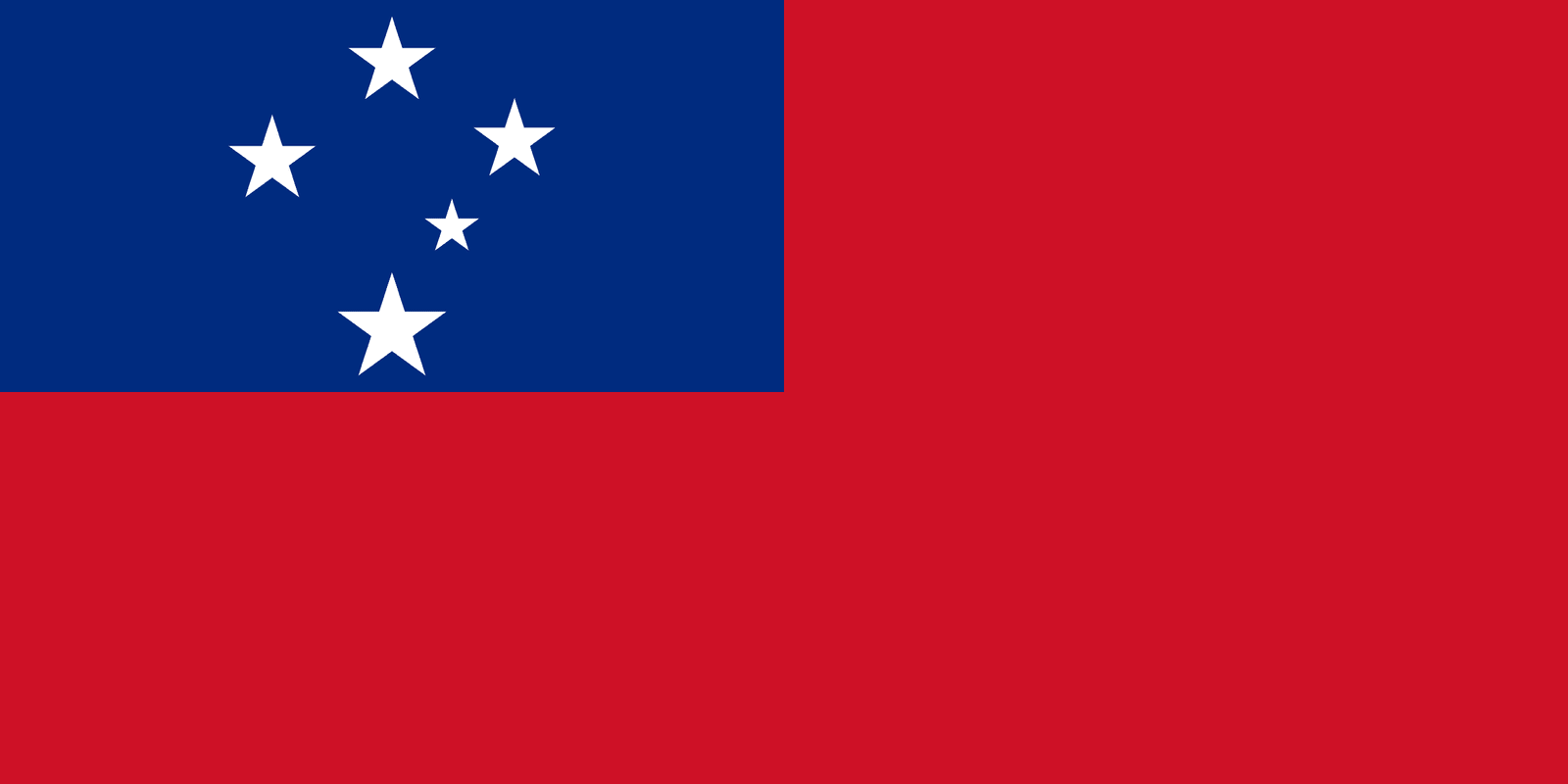
National Flag: Red and blue with white stars
Coat of Arms: Shield with a Southern Cross, olive branch, and national motto
National Anthem: “The Banner of Freedom”
National Flower: Teuila
National Bird: Manumea (tooth-billed pigeon)
National Flag (Detailed Section)
The flag of Samoa features a red field symbolizing courage and sacrifice, with a blue canton in the upper hoist containing five white stars representing the Southern Cross constellation. The design reflects Samoa’s Christian heritage and its geographic location in the Southern Hemisphere.
Adopted in 1949 and retained at independence, the flag is a key symbol of national unity. It is flown on government buildings, schools, and during official ceremonies in accordance with national protocol.
Realted Flags
Flag flying days
| Date | Flag Position | Occasion / Reason |
|---|
| January 1 | Full-mast | Independence Day |
| June 1 | Full-mast | National Flag Day |
| October (UN Day) | Full-mast | United Nations Day |
| National Mourning Days | Half-mast | State-declared mourning |