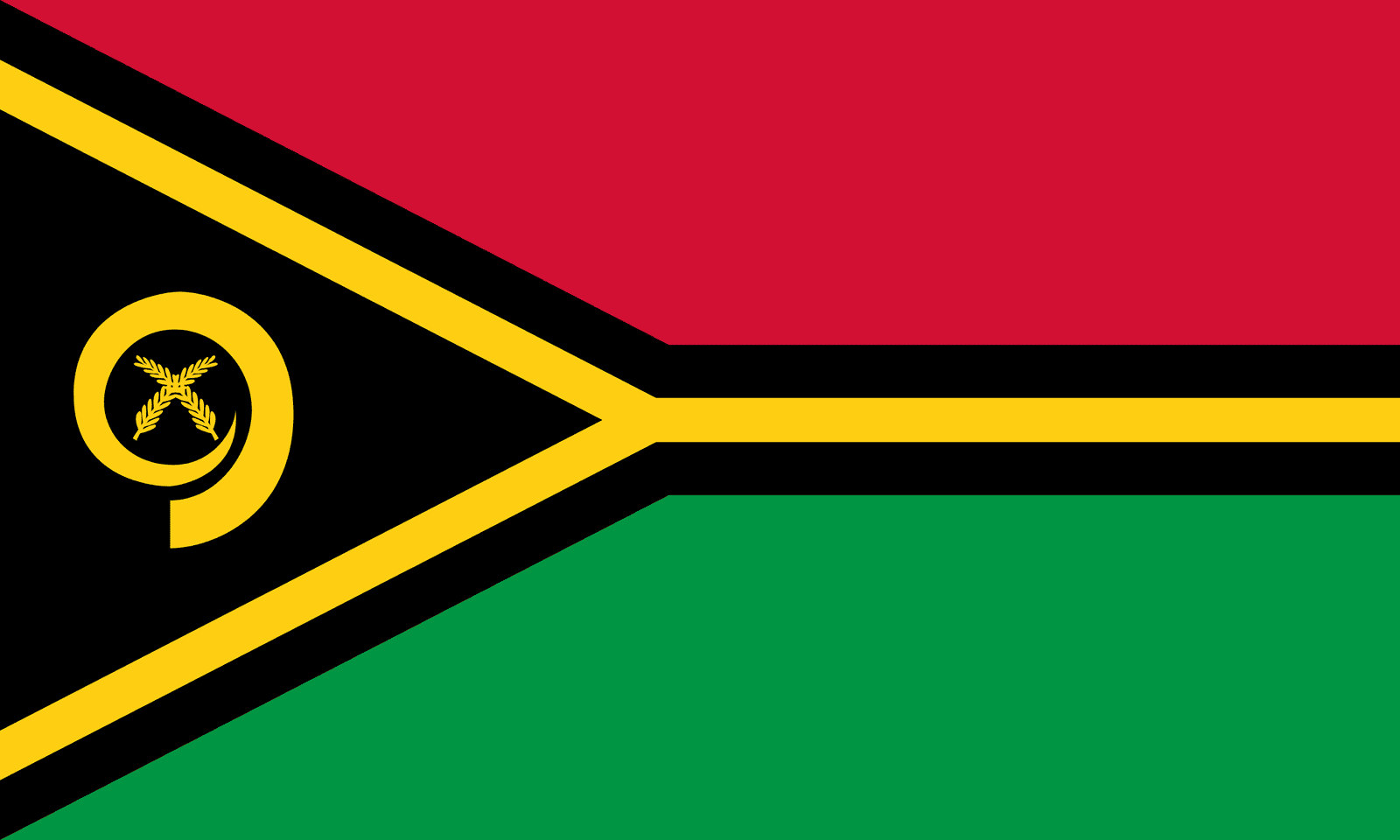
Flag of Vanuatu
| Legal Name | Republic of Vanuatu |
|---|---|
| Flag |
|
| Capital City |
Port Vila |
| Total Area | ~12,189 km² |
| Land Area | ~12,189 km² |
| Water Area | Minimal (archipelagic state; territorial waters extensive) |
| Population | ~335,000 |
| Major Cities | Port Vila (~55,000), Luganville (~18,000) |
| Currency | Vanuatu vatu (VUV) |
| GDP | ~USD 1.1–1.2 billion |
| GDP Per Capita | ~USD 3,300 (nominal) |
About of Vanuatu
Vanuatu is an island nation in the South Pacific Ocean, located in Melanesia. It lies east of Australia, west of Fiji, north of New Caledonia, and south of the Solomon Islands. The country consists of an archipelago of more than 80 islands stretching roughly 1,300 kilometers from north to south.
As an archipelagic state, Vanuatu has no land borders, but its maritime boundaries place it within a strategically important region of the Pacific. The capital and largest urban center, Port Vila, is situated on the island of Efate and serves as the country’s political, economic, and cultural hub. Luganville, on the island of Espiritu Santo, is the second-largest town and a key regional center.
Vanuatu’s population is relatively small and predominantly rural, with most people living in villages and relying on subsistence agriculture. The society is ethnically Melanesian, with strong communal traditions and linguistic diversity unmatched by most countries of comparable size.
Internationally, Vanuatu is a fully sovereign state and a member of the United Nations and the Pacific Islands Forum. Although not a major military or economic power, it holds strategic importance within the Pacific due to its location along key maritime routes and its active role in regional diplomacy, climate advocacy, and decolonization efforts.
Etymology
The name “Vanuatu” is derived from the words vanua and tu, common across several Austronesian languages. Vanua broadly means “land” or “home,” while tu conveys the idea of “standing” or “independent.” Together, the name is generally interpreted as “Our Land Forever” or “Land That Stands Independent.”
The name was adopted at independence in 1980, replacing the colonial designation “New Hebrides.” Its adoption symbolized national unity, indigenous identity, and political sovereignty following decades of foreign rule.
History
Human settlement in Vanuatu dates back over 3,000 years, with the arrival of Austronesian-speaking Lapita peoples. These early settlers established coastal communities, practiced agriculture, and engaged in regional trade networks across Melanesia.
For centuries, the islands developed independently, organized around kinship-based societies with complex customary systems. There were no large centralized empires, but social structures were governed by chiefs, customary law, and ceremonial exchanges.
European contact began in the early 17th century, with Spanish and later British and French explorers visiting the islands. During the 19th century, missionary activity, sandalwood trading, and labor recruitment significantly altered local societies.
In 1906, Britain and France established a unique joint colonial administration known as the Anglo-French Condominium, under which both powers governed simultaneously but separately. This arrangement created administrative complexity and limited political rights for indigenous inhabitants.
A nationalist movement emerged in the mid-20th century, culminating in negotiations for independence. On 30 July 1980, the Republic of Vanuatu achieved independence, with Walter Lini as its first Prime Minister.
Since independence, Vanuatu has experienced periods of political instability, frequent changes of government, and constitutional disputes. Nevertheless, democratic institutions have endured, and the country remains committed to parliamentary governance and regional cooperation.
Government and Politics
Vanuatu is a sovereign republic with a parliamentary democratic system. The constitution, adopted at independence, establishes a framework that combines modern democratic governance with recognition of customary law.
Executive power is exercised by the Prime Minister and the Council of Ministers, drawn from the unicameral Parliament. The President, elected by an electoral college, serves as a largely ceremonial head of state with limited constitutional powers.
The legislative branch consists of a single-chamber Parliament elected by proportional representation. The judiciary is independent and includes the Supreme Court and Court of Appeal, alongside customary courts that address matters of traditional law.
Administratively, the country is divided into six provinces, each with local councils responsible for regional governance.
Vanuatu maintains active foreign relations and is a member of organizations such as the United Nations, Commonwealth of Nations, Pacific Islands Forum, and Melanesian Spearhead Group. It has no standing army; national security relies on the Vanuatu Police Force, which includes a paramilitary wing for internal security and disaster response.
Economy
Vanuatu is classified as a developing economy, with a strong reliance on agriculture, tourism, and services. The economy is small and vulnerable to external shocks, particularly natural disasters and global economic fluctuations.
Agriculture employs a significant portion of the population and includes subsistence farming alongside commercial production of copra, cocoa, kava, beef, and fish. Manufacturing is limited, primarily focused on food processing and small-scale production.
The services sector dominates GDP, driven by tourism, government services, and offshore financial activities. Natural resources are modest, though fertile soils and marine resources support livelihoods.
Major trading partners include Australia, New Zealand, China, and regional Pacific states. Key exports are agricultural products, while imports consist largely of fuel, machinery, and manufactured goods.
Economic challenges include geographic isolation, infrastructure limitations, disaster vulnerability, and a narrow export base. Long-term development strategies emphasize sustainable tourism, agricultural value addition, and climate resilience.
Demographics
Vanuatu’s population is overwhelmingly Melanesian, with small communities of Polynesian, Micronesian, European, and Asian descent. The population is youthful and growing steadily.
The country is one of the most linguistically diverse in the world, with over 100 indigenous languages. Bislama, an English-based creole, serves as the national lingua franca, alongside English and French as official languages.
Christianity is the dominant religion, practiced by the majority of the population, often blended with traditional beliefs. Urbanization remains limited, with most citizens living in rural villages.
Culture and Society
Vanuatu’s culture is deeply rooted in customary practices, communal living, and respect for ancestral traditions. The concept of kastom governs social relations, land ownership, and dispute resolution.
Artistic expression includes wood carving, sand drawing, storytelling, music, and dance. Traditional foods rely on root crops, fish, coconut, and tropical fruits, often prepared using earth ovens.
Social norms emphasize community cohesion, respect for elders, and reciprocal obligations. Cultural festivals, church events, and national holidays play a central role in social life. Sports such as football, rugby, and traditional canoe racing are popular.
Education and Healthcare
The education system includes primary, secondary, and tertiary levels, with instruction in English or French. Literacy rates have improved steadily, though access to higher education remains limited.
Healthcare services are provided through public hospitals, regional clinics, and community health centers. Key public health challenges include infectious diseases, non-communicable diseases, and access to care in remote areas. Significant progress has been made in maternal and child health.
Geography and Climate
Vanuatu’s islands are mostly volcanic, characterized by rugged mountains, fertile valleys, coral reefs, and extensive coastlines. Several volcanoes remain active.
The climate is tropical, with warm temperatures year-round and a rainy season from November to April. Cyclones, earthquakes, volcanic eruptions, and tsunamis are major natural hazards.
Environmental concerns include deforestation, coral reef degradation, and the impacts of climate change, particularly sea-level rise.
Flora and Fauna
Vanuatu hosts rich biodiversity, including tropical rainforests, mangroves, and coral reef ecosystems. Native plant species include hardwood trees, pandanus, and a variety of palms.
Wildlife includes birds, bats, reptiles, and diverse marine species. Conservation efforts focus on protected areas, community-managed forests, and marine reserves to preserve ecosystems and endemic species.
Map of Vanuatu
The national flag represents unity and cultural heritage. The coat of arms features a Melanesian warrior and symbols of peace and agriculture. The national anthem, “Yumi, Yumi, Yumi,” expresses collective identity. The boar’s tusk and namele leaves are widely recognized national symbols.
National Flag (Detailed Section)
The flag of Vanuatu consists of horizontal red, green, and black stripes intersected by a yellow-edged black triangle at the hoist. Within the triangle is a boar’s tusk encircling two crossed namele leaves.
Adopted at independence in 1980, the flag reflects indigenous symbolism and political identity. Red represents the blood of the people and their struggle for independence, green symbolizes the land and agriculture, and black signifies the Melanesian people. Yellow stands for peace and Christianity.
The flag is displayed on government buildings, schools, and during national celebrations, following official protocols that emphasize respect and dignity.
Flag flying days
| Date | Flag Position | Occasion or Reason |
|---|
| 30 July | Full-mast | Independence Day |
| 24 July | Full-mast | Children’s Day |
| As proclaimed | Half-mast | National mourning or remembrance events |