Flag of Iceland
| Legal Name | Republic of Iceland |
|---|---|
| Flag |
|
| Capital City |
Reykjavík |
| Total Area | 103,000 km² |
| Land Area | Approximately 100,250 km² |
| Water Area | Approximately 2,750 km² |
| Population | ~390,000 |
| Major Cities | Reykjavík (~140,000), Kópavogur (~39,000), Hafnarfjörður (~30,000), Akureyri (~20,000), Reykjanesbær (~19,000) |
| Currency | Icelandic Króna (ISK) |
| GDP | Approximately USD 30–32 billion |
| GDP Per Capita | Approximately USD 68,000 (PPP) |
About of Iceland
Iceland is a Nordic island country located in the North Atlantic Ocean, positioned between Greenland and mainland Europe. It lies just south of the Arctic Circle and forms part of Northern Europe, though it is geographically isolated from the European continent. The country is renowned for its dramatic landscapes shaped by volcanic and glacial activity.
Iceland has no land borders. Its maritime boundaries extend across the North Atlantic, bordering international waters near Greenland, the Faroe Islands, and Norway. The country’s extensive coastline has played a central role in its history, economy, and settlement patterns.
Reykjavík, the capital and largest city, is the northernmost capital of a sovereign state in the world. It serves as the political, economic, and cultural center of Iceland, with most of the population living in or near the southwest region. Despite its small population, Iceland maintains a high standard of living and strong social cohesion.
Iceland is an internationally recognized sovereign state and an active participant in global affairs. It is a founding member of NATO and a member of the United Nations, the European Economic Area (EEA), and the Nordic Council. Its strategic importance stems from its North Atlantic location, control of key air and sea routes, and role in Arctic and transatlantic security.
Etymology
The name Iceland originates from Old Norse Ísland, meaning “Land of Ice.” According to historical tradition, the name was chosen by early Norse settlers who encountered drifting sea ice along the island’s northern coast.
While much of Iceland is not permanently ice-covered, glaciers occupy a significant portion of the interior. The name reflects both the physical environment encountered by early explorers and the Norse tradition of descriptive place-naming. Over time, the name remained unchanged and became firmly established in both local and international usage.
History
Iceland was one of the last major landmasses in Europe to be settled by humans. Archaeological and historical evidence suggests settlement began in the late 9th century, primarily by Norse settlers from Scandinavia, along with people of Celtic origin from the British Isles.
By 930 CE, Iceland established the Althing, one of the world’s oldest parliamentary institutions, marking the beginning of the Icelandic Commonwealth. During the medieval period, Iceland lacked a centralized monarchy and was governed through regional chieftains.
In the 13th century, internal conflict led to Iceland coming under Norwegian rule, and later Danish control following the Kalmar Union. For centuries, Iceland remained a peripheral territory within the Danish kingdom, with limited autonomy and economic hardship.
A growing independence movement in the 19th and early 20th centuries led to home rule in 1904 and sovereignty as a kingdom in personal union with Denmark in 1918. In 1944, Iceland formally declared itself a republic following a national referendum.
Post-independence, Iceland developed rapidly, modernizing its economy and institutions. Key modern developments include joining NATO in 1949, expanding fishing rights during the Cod Wars, and navigating financial reforms following the 2008 banking crisis. Today, Iceland is a stable democracy with a strong welfare state.
Government and Politics
Iceland is a unitary parliamentary republic. Its constitution, originally adopted in 1944, provides the framework for democratic governance and civil liberties.
Executive power is exercised by the government, led by the Prime Minister. The President of Iceland serves as head of state, with largely ceremonial responsibilities but certain constitutional powers. Legislative authority resides in the Althing, a unicameral parliament. The judiciary operates independently through a system of district courts and a Supreme Court.
Administratively, Iceland is divided into regions and municipalities with local governance responsibilities. The country maintains active foreign relations and participates in international organizations, including NATO, the UN, EEA, and OECD. Iceland has no standing army, relying instead on a coast guard and defense agreements for national security.
Economy
Iceland is classified as a developed, high-income economy with a strong emphasis on sustainability and innovation. Its economic model combines free-market principles with a comprehensive welfare system.
Key industries include fisheries, renewable energy, tourism, aluminum production, and information technology. Agriculture is limited due to climate conditions but includes livestock and greenhouse farming. Services, particularly tourism and finance, account for a significant share of GDP.
Iceland is rich in renewable energy resources, especially geothermal and hydropower, which provide nearly all domestic electricity. Major exports include fish products, aluminum, and services. Economic challenges include currency volatility, inflation control, and managing tourism’s environmental impact, while future prospects focus on green energy and innovation.
Demographics
Iceland has a small and relatively young population compared to other European countries. The majority of residents are of Icelandic or Nordic descent, with growing immigrant communities in recent decades.
The official language is Icelandic, which has remained remarkably stable over centuries. English is widely spoken as a second language. The predominant religion is Christianity, mainly Lutheran, though religious affiliation has diversified, and secularism is common.
Over 90% of the population lives in urban areas, primarily in the southwest. Population growth has been modest but positive, supported by immigration and relatively high life expectancy.
Culture and Society
Icelandic culture places strong emphasis on literature, language preservation, and connection to nature. National identity is deeply rooted in medieval sagas, folklore, and a shared sense of resilience shaped by a harsh environment.
The arts are vibrant, particularly music, literature, and visual arts. Icelandic cuisine features seafood, lamb, and dairy products, alongside modern culinary innovation. Social norms emphasize equality, community trust, and environmental awareness.
Public holidays include National Day (June 17), Christmas, and cultural festivals such as Þorrablót. Popular sports include football, handball, and outdoor activities like hiking and swimming in geothermal pools.
Education and Healthcare
Iceland provides free and compulsory education through secondary level, with high enrollment in tertiary education. Literacy is nearly universal, and higher education institutions emphasize research and international collaboration.
Healthcare is publicly funded and universally accessible, delivering strong health outcomes. Challenges include providing services in remote areas and managing costs associated with an aging population.
Geography and Climate
Iceland’s geography is defined by volcanic plateaus, glaciers, fjords, and rugged coastlines. Major features include active volcanoes, lava fields, glaciers such as Vatnajökull, and geothermal areas.
The climate is subpolar oceanic, with cool summers and relatively mild winters due to the North Atlantic Current. Natural hazards include volcanic eruptions, earthquakes, glacial floods, and severe weather. Environmental protection focuses on climate adaptation and sustainable land use.
Flora and Fauna
Iceland’s biodiversity is limited but distinctive. Native vegetation includes mosses, grasses, and low shrubs adapted to harsh conditions. Forests are sparse but expanding through reforestation efforts.
Wildlife includes Arctic foxes, seabirds, seals, and rich marine life such as whales. National parks, including Þingvellir, Vatnajökull, and Snæfellsjökull, play a central role in conservation and eco-tourism.
Map of Iceland
Iceland’s national symbols reflect its natural environment and historical continuity. These include the national flag, the coat of arms featuring a guardian spirit motif, and the national anthem celebrating independence and faith.
National Flag (Detailed Section)
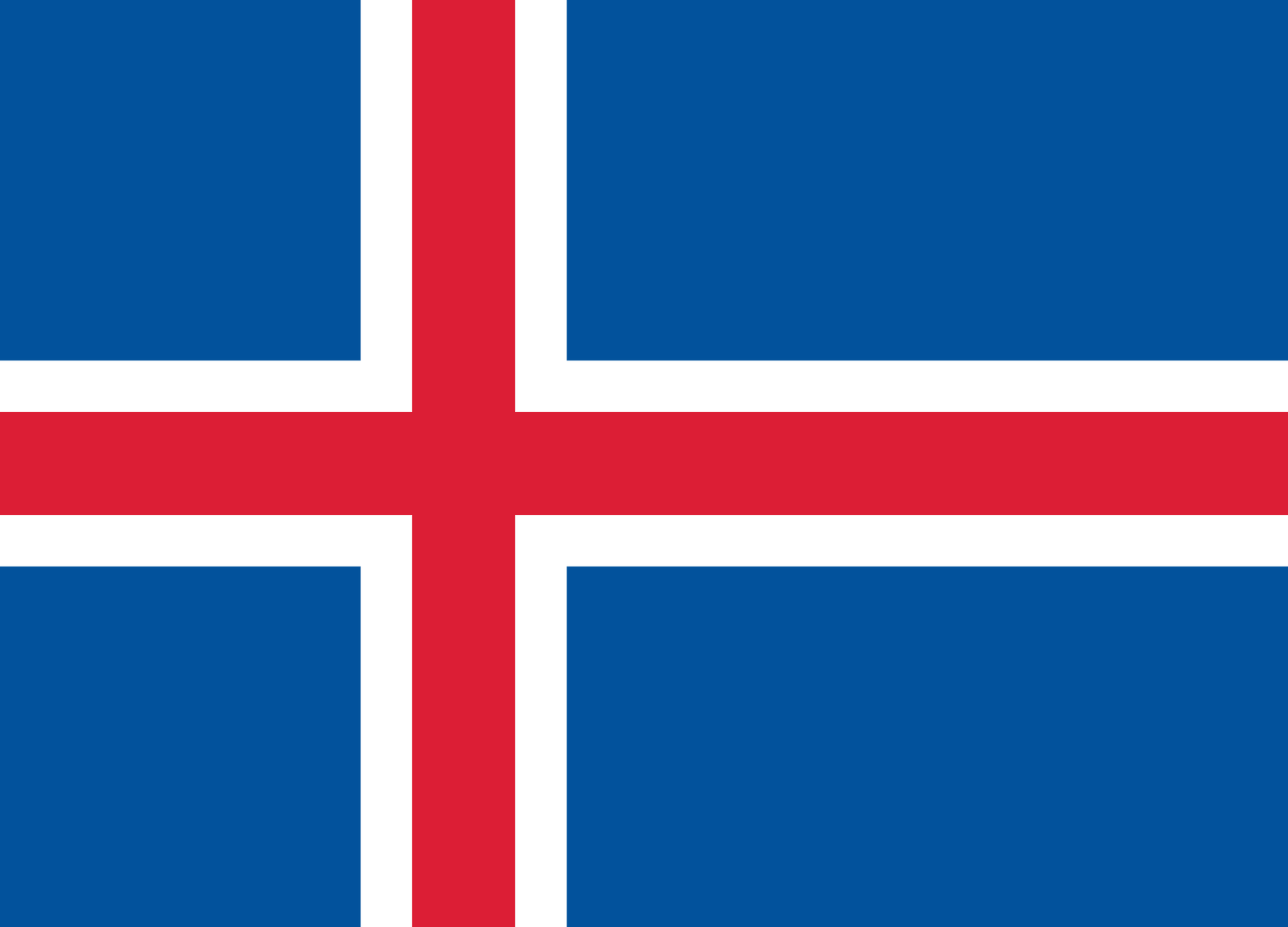
The Icelandic flag features a red Nordic cross outlined in white on a blue field. The design follows the Scandinavian cross tradition, symbolizing Iceland’s cultural ties to other Nordic countries.
Blue represents the Atlantic Ocean and sky, white symbolizes ice and snow, and red reflects volcanic fire. The flag was officially adopted in 1915 and reaffirmed upon the establishment of the republic in 1944. Strict protocols govern its display, emphasizing respect and national dignity.
Flag flying days
| Date | Flag Position | Occasion or Reason |
|---|---|---|
| June 17 | Full-mast | National Day (Republic Day) |
| April 25 | Full-mast | First Day of Summer |
| December 1 | Full-mast | Sovereignty Day |
| State Mourning Days | Half-mast | Official national mourning |