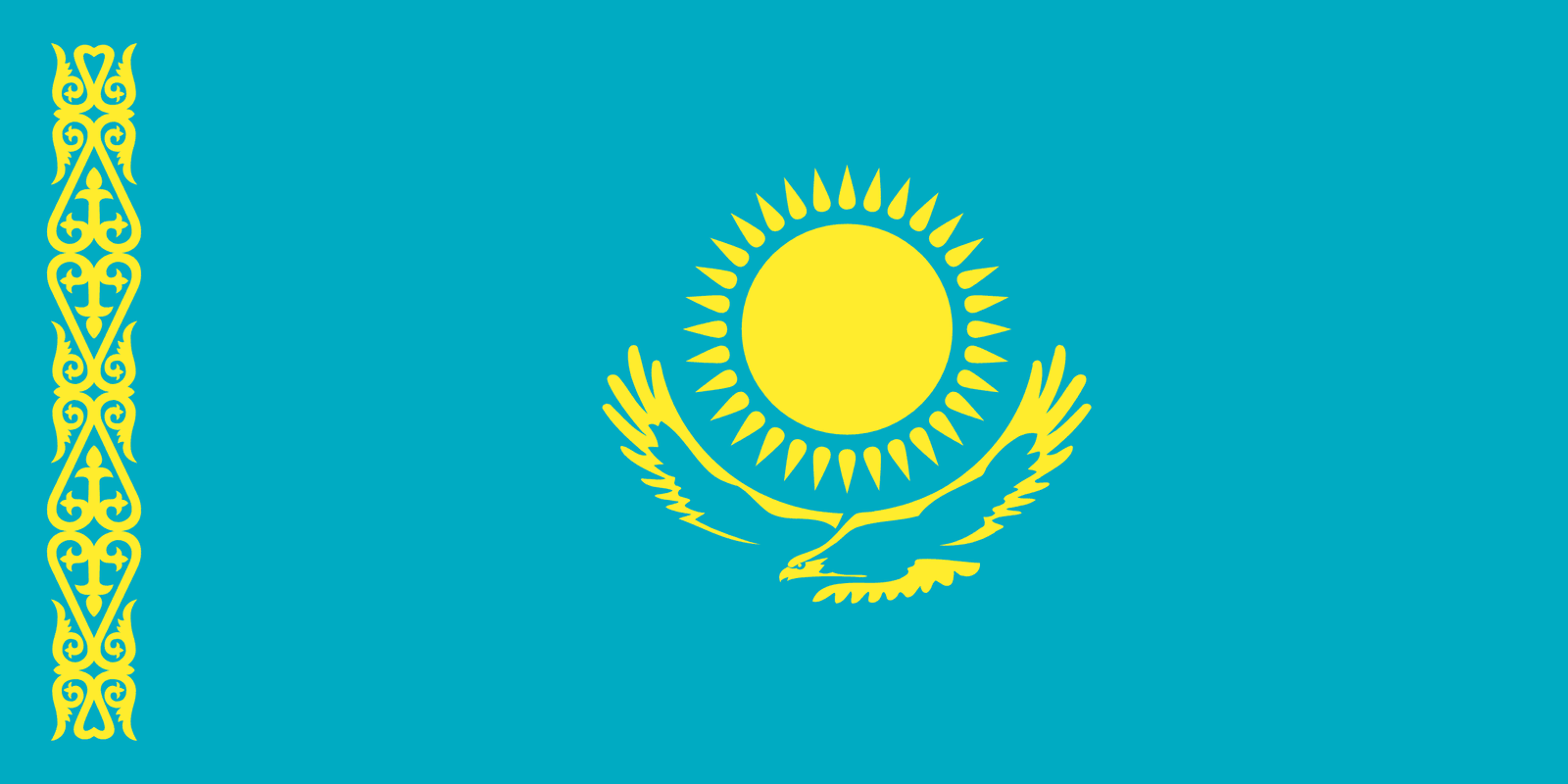
Flag of Kazakhstan
| Legal Name | Republic of Kazakhstan |
|---|---|
| Flag |
|
| Capital City |
Astana |
| Total Area | 2,724,900 km² |
| Land Area | Approximately 2,699,700 km² |
| Water Area | Approximately 25,200 km² |
| Population | ~20 million |
| Major Cities | Almaty (~2.1m), Astana (~1.4m), Shymkent (~1.2m), Karaganda (~500k), Aktobe (~500k) |
| Currency | Kazakhstani Tenge (KZT) |
| GDP | Approximately USD 260 billion |
| GDP Per Capita | Approximately USD 13,000 (nominal) / USD 37,000 (PPP) |
About of Kazakhstan
Kazakhstan is the world’s largest landlocked country and the ninth-largest country overall by land area. It is located in Central Asia, with a small portion west of the Ural River in Eastern Europe, placing it at the crossroads of Europe and Asia. The country’s vast territory spans steppe, desert, semi-desert, mountain ranges, and inland seas.
Kazakhstan shares land borders with Russia, China, Kyrgyzstan, Uzbekistan, and Turkmenistan, and has an extensive coastline along the Caspian Sea, the world’s largest inland body of water. Astana serves as the capital and administrative center, while Almaty remains the country’s largest city and main cultural, financial, and educational hub.
The population of Kazakhstan is ethnically diverse, shaped by centuries of migration, nomadic traditions, and Soviet-era settlement policies. The country is internationally recognized as a sovereign state and plays an active role in regional and global diplomacy.
Strategically, Kazakhstan is significant due to its energy resources, geographic position along Eurasian transport corridors, and role as a stabilizing power in Central Asia. It functions as a bridge between East and West in trade, energy transit, and geopolitical dialogue.
Etymology
The name Kazakhstan is derived from the Turkic word “Kazakh,” which historically meant “free,” “independent,” or “wanderer,” reflecting the nomadic lifestyle of the Kazakh people. The suffix “-stan” comes from Persian, meaning “land” or “place.”
Together, Kazakhstan translates to “Land of the Kazakhs.” The name evolved over centuries as Kazakh tribes consolidated their identity and territory, eventually becoming formalized during the Soviet period and retained after independence.
History
Kazakhstan’s territory has been inhabited since prehistoric times, with archaeological evidence of early human activity and advanced Bronze Age cultures. Ancient nomadic civilizations thrived on the steppe, mastering horse domestication and long-distance trade.
During classical and medieval periods, the region was influenced by Scythians, Turks, and Mongols. It became a vital part of the Silk Road, facilitating cultural and commercial exchange between Asia and Europe. The Kazakh Khanate, formed in the 15th century, marked the emergence of a distinct Kazakh political identity.
By the 18th and 19th centuries, Kazakhstan gradually came under the control of the Russian Empire, later becoming part of the Soviet Union. Soviet rule transformed society through collectivization, industrialization, and demographic changes, but also caused significant hardship, including famine.
Kazakhstan declared independence in 1991 following the dissolution of the Soviet Union. Since then, it has undergone major political, economic, and social transformations. Modern developments include capital relocation to Astana, economic diversification efforts, and gradual political reforms shaping contemporary governance.
Government and Politics
Kazakhstan is a presidential republic with a centralized political system defined by its constitution. The constitution establishes Kazakhstan as a secular state with a strong executive branch.
The President serves as head of state and government, supported by the Cabinet. Legislative authority is vested in a bicameral Parliament consisting of the Mazhilis (lower house) and the Senate (upper house). The judiciary operates independently, headed by the Supreme Court.
Administratively, the country is divided into regions (oblasts), cities of national significance, and districts. Kazakhstan maintains an active foreign policy and is a member of the United Nations, Commonwealth of Independent States, Shanghai Cooperation Organisation, and other international bodies. Its armed forces focus on national defense, regional security, and peacekeeping cooperation.
Economy
Kazakhstan is classified as an upper-middle-income emerging economy and is the largest economy in Central Asia. Its economic structure is heavily influenced by natural resources, particularly hydrocarbons.
The energy sector dominates, with oil, natural gas, and uranium as key exports. Agriculture plays a significant role, especially grain production and livestock, while manufacturing includes metallurgy, chemicals, machinery, and food processing. The services sector has expanded rapidly, driven by finance, transportation, and telecommunications.
Kazakhstan is rich in minerals, including uranium, copper, zinc, and rare earth elements. Major trade partners include neighboring Eurasian states, China, and European markets. Economic challenges include dependence on commodities, regional inequality, and diversification needs, while future growth strategies emphasize innovation, green energy, and logistics development.
Demographics
Kazakhstan’s population is ethnically diverse, with Kazakhs forming the majority, alongside significant communities of Russians, Uzbeks, Ukrainians, Uighurs, and others.
The official language is Kazakh, while Russian is widely used in government, business, and daily life. Islam is the predominant religion, mainly Sunni, followed by Christianity, particularly Russian Orthodoxy.
Urbanization has increased steadily, with most people living in cities and large towns. Population growth is moderate, supported by natural increase and internal migration.
Culture and Society
Kazakh culture is deeply rooted in nomadic heritage, emphasizing hospitality, respect for elders, and strong family ties. National identity blends traditional customs with modern statehood.
Music, oral poetry, and epic storytelling are central to cultural expression. Traditional cuisine features meat-based dishes, dairy products, and bread, reflecting pastoral traditions. Social norms value community, honor, and cultural continuity.
Public holidays commemorate independence, historical milestones, and religious celebrations. Sports such as wrestling, horse riding, boxing, and football are popular, alongside traditional equestrian games.
Education and Healthcare
Kazakhstan has a well-developed education system with compulsory primary and secondary education. Literacy rates are high, and the country hosts numerous universities and research institutions, including internationally oriented campuses.
Healthcare is provided through a mix of public and private systems. Major achievements include expanded access to care and improved life expectancy, though challenges remain in rural access and chronic disease management.
Geography and Climate
Kazakhstan’s physical geography is dominated by vast steppes, deserts, and semi-deserts, with mountain ranges such as the Altai and Tien Shan in the east and southeast. Major rivers include the Irtysh, Ural, and Syr Darya.
The climate is continental, characterized by hot summers and cold winters, with significant temperature extremes. Natural hazards include earthquakes in mountainous areas, droughts, and flooding. Environmental concerns focus on desertification, water management, and the legacy of the Aral Sea crisis.
Flora and Fauna
Kazakhstan supports diverse ecosystems ranging from alpine meadows to desert plains. Native plant species include steppe grasses, wild tulips, and desert shrubs.
Wildlife includes saiga antelope, snow leopards, wolves, eagles, and numerous bird species. National parks and reserves, such as Altyn-Emel and Korgalzhyn, play a vital role in conservation and biodiversity protection.
Map of Kazakhstan
Kazakhstan’s national symbols emphasize freedom, unity, and the natural landscape. These include the national flag, coat of arms, national anthem, and iconic animals such as the snow leopard and steppe eagle.
National Flag (Detailed Section)
The flag of Kazakhstan features a sky-blue background symbolizing peace, freedom, and the open sky. At its center is a golden sun with 32 rays, representing life and energy, beneath which flies a golden steppe eagle symbolizing power, independence, and vision.
Along the hoist side is a vertical traditional ornamental pattern reflecting national culture and artistic heritage. The flag was adopted in 1992 following independence and is protected by law, with strict protocols governing its respectful display and use.
Realted Flags
Flag flying days
| Date | Flag Position | Occasion or Reason |
|---|---|---|
| March 22 | Full-mast | Nauryz (Spring and Renewal Festival) |
| June 4 | Full-mast | State Symbols Day |
| August 30 | Full-mast | Constitution Day |
| December 16 | Full-mast | Independence Day |
| National Mourning Days | Half-mast | Official state mourning |