
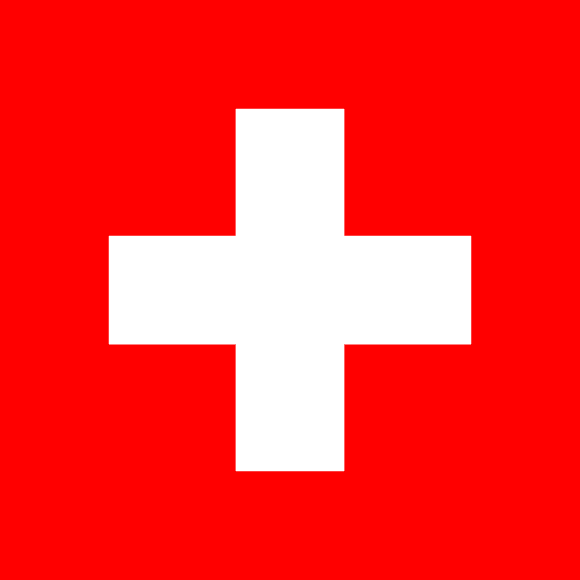
Flag of Switzerland
| Legal Name | Swiss Confederation |
|---|---|
| Flag |
|
| Capital City |
Bern |
| Total Area | 41,285 km² |
| Land Area | 39,997 km² |
| Water Area | 1,288 km² |
| Population | Approximately 8.8 million |
| Major Cities | Zurich (435,000), Geneva (203,000), Basel (178,000), Bern (133,000), Lausanne (140,000) |
| Currency | Swiss Franc (CHF) |
| GDP | USD 824 billion |
| GDP Per Capita | USD 93,700 (nominal) |
About of Switzerland
Switzerland is a landlocked country located in Central Europe, known for its mountainous terrain dominated by the Alps in the south and the Jura mountains in the northwest. Its central location provides a strategic crossroads between Western, Northern, and Southern Europe, facilitating trade and cultural exchange.
Switzerland shares borders with Italy, France, Germany, Austria, and Liechtenstein. Despite having no coastline, the country boasts numerous lakes, including Lake Geneva, Lake Constance, and Lake Lucerne. Bern serves as the political capital, while Zurich and Geneva are major financial, commercial, and cultural centers. Switzerland has a high standard of living and a population noted for ethnic, linguistic, and religious diversity.
Internationally, Switzerland maintains a policy of neutrality, avoiding military alliances while hosting numerous international organizations, including the Red Cross, the United Nations offices in Geneva, and the World Health Organization. This strategic neutrality has positioned Switzerland as a key diplomatic hub and mediator in global affairs.
Etymology
The name “Switzerland” derives from Schwyz, one of the founding cantons of the Swiss Confederation. Historically, Schwyz gave its name to the entire region due to its central role in forming the confederation in the late Middle Ages. The Latin term Helvetia is also used as a national personification and appears on coins and stamps, reflecting the ancient Helvetii tribe that inhabited the region during the Roman era.
History
Prehistoric and Ancient Civilizations
Human habitation in Switzerland dates back to the Paleolithic era. Neolithic settlements, including lake-dwelling communities around the Alps, showcase early advancements in agriculture and architecture. Celtic tribes, notably the Helvetii, dominated the region prior to Roman conquest in the 1st century BCE.
Roman and Medieval Periods
Under Roman rule, Switzerland became part of the provinces of Raetia and Gallia Belgica. After the fall of the Roman Empire, Germanic tribes such as the Alemanni and Burgundians settled in the region. By the medieval period, numerous feudal territories and ecclesiastical states governed the area, leading to fragmented political control.
Formation of the Swiss Confederation
In 1291, the cantons of Uri, Schwyz, and Unterwalden formed a defensive alliance against external threats, marking the origin of the Swiss Confederation. Over centuries, additional cantons joined, gradually establishing the modern federal state.
Early Modern and Modern History
Switzerland maintained neutrality during European conflicts, including the Thirty Years’ War. The Napoleonic era introduced centralized governance under the Helvetic Republic, later restored to a federal structure in 1815. Switzerland formally adopted its federal constitution in 1848, establishing a democratic, federal state with decentralized cantonal powers.
20th and 21st Century
Switzerland remained neutral during both World Wars, fostering international diplomacy. The country joined the United Nations in 2002 and continues to maintain its policy of neutrality while engaging in international humanitarian and financial initiatives.
Government and Politics
Switzerland operates as a federal directorial republic with a multi-tiered political system:
Executive: Seven-member Federal Council serves collectively as head of state and government; presidency rotates annually.
Legislature: Bicameral Federal Assembly comprises the National Council (200 members) and the Council of States (46 members).
Judiciary: Federal Supreme Court oversees legal interpretations; cantonal courts handle local jurisdictions.
Administrative Divisions: 26 cantons, each with substantial autonomy, own constitutions, governments, and legal systems.
Foreign Relations: Switzerland maintains neutrality, hosts international organizations, and participates in humanitarian missions.
Defense: Swiss Armed Forces operate under a militia system; compulsory military service applies to male citizens.
Economy
Switzerland has a highly developed, advanced economy with global influence in finance, technology, and manufacturing:
Major Industries: Banking, insurance, pharmaceuticals, precision instruments, machinery, tourism.
Agriculture: Dairy farming, vineyards, and specialty crops.
Services: Financial services dominate, with Zurich and Geneva as international finance hubs.
Natural Resources: Limited mineral deposits; hydropower is significant for energy.
Trade Partners: Germany, France, Italy, the United States, and the United Kingdom.
Economic Challenges: Maintaining competitiveness, high living costs, and demographic pressures.
Outlook: Continued innovation, financial sector resilience, and sustainable development initiatives.
Demographics
Switzerland’s population reflects linguistic and cultural diversity:
Ethnic Groups: Predominantly Swiss, with German, French, Italian, and Romansh minorities.
Languages: German (majority), French, Italian, Romansh (official regional languages).
Religions: Christianity (Roman Catholic and Protestant), Islam, and other minority faiths.
Urbanization: Approximately 74% urban population, concentrated in Zurich, Geneva, Basel, and Bern.
Population Trends: Moderate growth; immigration contributes significantly to demographic dynamics.
Culture and Society
Swiss culture emphasizes regional identities, neutrality, and civic responsibility. Traditional music, literature, and cuisine vary by linguistic region. Swiss cuisine includes fondue, raclette, rosti, and chocolate.
National identity is reinforced through multilingualism, federalism, and communal participation. Major festivals include Swiss National Day (August 1), Sechseläuten in Zurich, and Fasnacht in Basel. Winter sports, mountaineering, and hiking are integral to recreation, reflecting the Alpine environment.
Education and Healthcare
Switzerland has a robust education system with compulsory primary and secondary education, complemented by vocational and higher education institutions. Literacy rates exceed 99%. Prominent universities include ETH Zurich and the University of Geneva.
Healthcare is universally accessible, high-quality, and funded through mandatory insurance schemes. Public health indicators are strong, with low infant mortality and high life expectancy.
Geography and Climate
Switzerland features varied geography:
Mountains: Alps (south), Jura Mountains (northwest)
Rivers: Rhine, Rhone, Aare, Ticino
Lakes: Geneva, Zurich, Constance, Lucerne
Climate: Alpine climate in highlands, temperate in lowlands; distinct seasons with snow in winter.
Natural Hazards: Avalanches, landslides, occasional flooding.
Environmental Concerns: Alpine ecosystem preservation, air and water quality maintenance.
Flora and Fauna
Switzerland hosts diverse ecosystems:
Flora: Alpine meadows, coniferous and deciduous forests, endemic plant species.
Wildlife: Deer, chamois, ibex, marmots, birds of prey, and endemic insects.
Conservation: National parks, nature reserves, and biodiversity programs protect habitats and species.
Map of Switzerland
Flag: Red with a centered white cross.
Coat of Arms: Shield with white cross on red background.
National Anthem: Swiss Psalm
National Animals/Plants: St. Bernard dog, edelweiss, ibex, and marmot symbolize national heritage.
National Flag (Detailed Section)
The Swiss flag is a square red field with a bold, equilateral white cross centered. It symbolizes freedom, honor, and faith. Its design dates back to the 14th century, associated with the Old Swiss Confederacy. The square shape is unique among national flags and reflects historical battle standards.
Flag protocol mandates its display at government buildings, public events, and national holidays. It is flown at half-mast during national mourning or significant international tragedies.
Realted Flags
Flag flying days
| Date | Flag Position | Occasion or Reason |
|---|
| August 1 | Full-mast | Swiss National Day |
| As Declared | Half-mast | National mourning or death of prominent leaders |
| May 1 | Full-mast | Labor Day celebrations |
| December 25 | Full-mast | Christmas (cultural display |