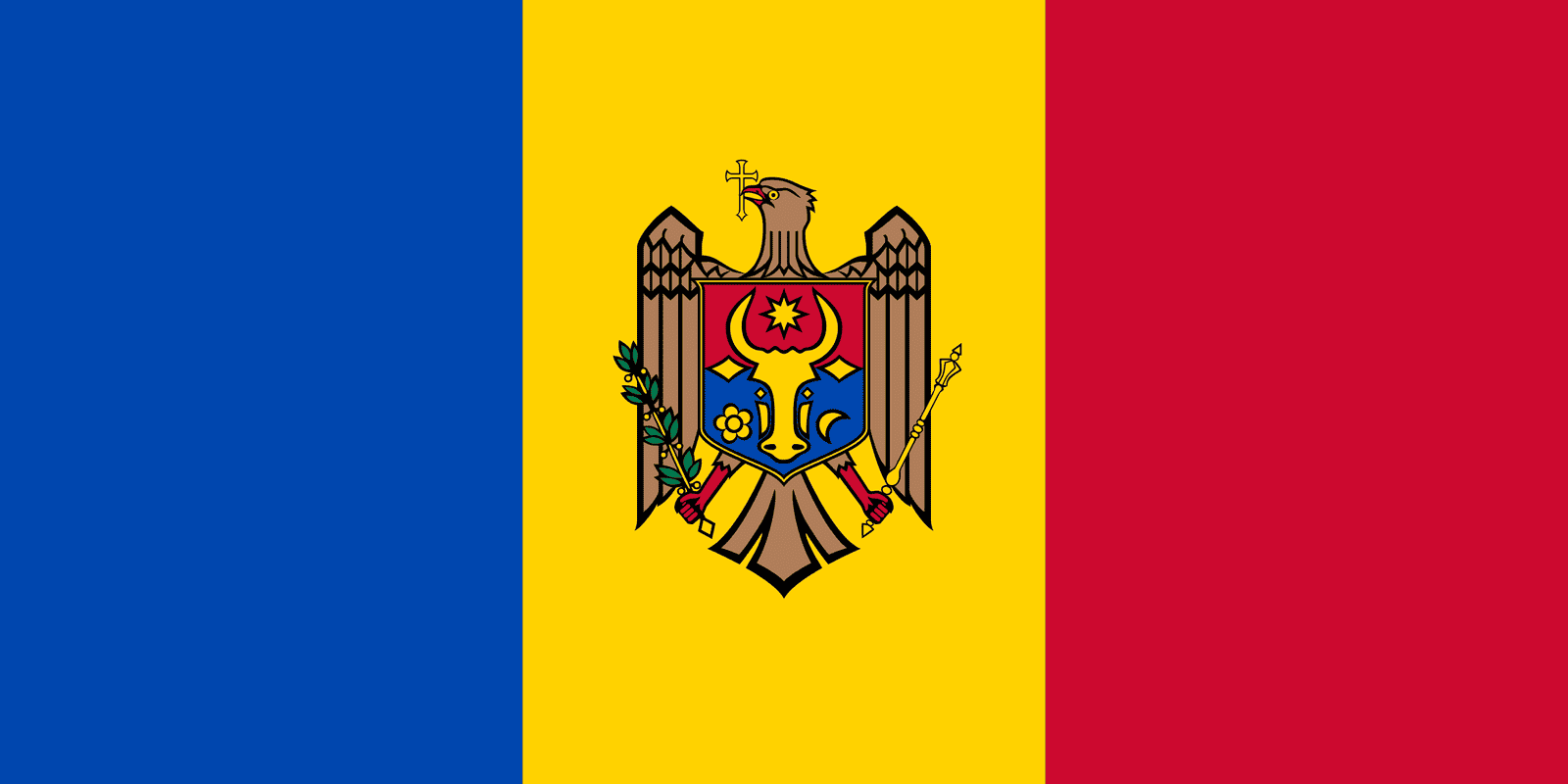
Flag of Moldova
| Legal Name | Republic of Moldova |
|---|---|
| Flag |
|
| Capital City |
Chișinău |
| Total Area | 33,846 km² |
| Land Area | 33,843 km² |
| Water Area | Approximately 3 km² |
| Population | Approximately 2.5–2.6 million |
| Major Cities | Chișinău (≈ 630,000), Bălți (≈ 100,000), Tiraspol (≈ 130,000), Bender/Tighina (≈ 90,000) |
| Currency | Moldovan Leu (MDL) |
| GDP | Approximately USD 15–16 billion |
| GDP Per Capita | Approximately USD 6,000 (nominal); USD 17,000–18,000 (PPP) |
About of Moldova
Moldova is a landlocked country in Eastern Europe, situated between Romania to the west and Ukraine to the north, east, and south. It lies largely within the historical region of Bessarabia and occupies a strategic position between Central and Eastern Europe. The country has no direct access to the sea, though it lies close to the Black Sea basin via the lower Danube region.
The capital and largest city, Chișinău, serves as Moldova’s political, economic, and cultural center. Other important urban centers include Bălți in the north and Tiraspol and Bender in the east, the latter two located in the breakaway region of Transnistria. Moldova’s population is predominantly rural, with agriculture playing a historically central role in settlement patterns.
Moldova is internationally recognized as a sovereign state and has been a member of the United Nations since 1992. Its geopolitical significance stems from its location at the crossroads of European Union and post-Soviet spheres of influence. The unresolved status of Transnistria continues to shape Moldova’s domestic politics and foreign relations.
Etymology
The name “Moldova” derives from the medieval Principality of Moldavia, which emerged in the 14th century. The origin of the word is commonly linked to the Moldova River, itself possibly derived from an old Slavic or Dacian root meaning “dark” or “deep.” Over time, the name came to designate both the principality and the broader cultural-historical region, from which the modern state takes its name.
History
Prehistoric and Ancient Civilizations
The territory of present-day Moldova has been inhabited since prehistoric times, with archaeological evidence of Neolithic cultures such as the Cucuteni–Trypillia civilization. In antiquity, the area was influenced by Thracian and Dacian tribes.
Classical and Medieval Periods
Following Roman expansion into neighboring Dacia, the region experienced indirect Roman influence. During the early medieval period, Slavic and other migratory peoples settled the area. By the 14th century, the Principality of Moldavia emerged as a significant regional power.
Major Empires and Kingdoms
Moldavia existed as an independent principality before becoming a vassal state of the Ottoman Empire while retaining internal autonomy. In 1812, the eastern half of Moldavia, known as Bessarabia, was annexed by the Russian Empire.
Modern Era and Independence
After the collapse of the Russian Empire, Bessarabia united with Romania in 1918. In 1940, the Soviet Union annexed the territory, forming the Moldavian Soviet Socialist Republic. Moldova declared independence in 1991 following the dissolution of the Soviet Union.
Post-Independence and Contemporary Developments
Since independence, Moldova has faced economic hardship, political instability, and the unresolved Transnistrian conflict. In recent years, the country has pursued closer integration with European institutions while balancing relations with neighboring states.
Government and Politics
Moldova is a parliamentary republic governed under a constitution adopted in 1994. Executive power is shared between the President, who serves as head of state, and the Prime Minister, who heads the government. Legislative authority resides in a unicameral Parliament elected by popular vote.
The judiciary is formally independent and includes constitutional, appellate, and lower courts. Administratively, Moldova is divided into districts (raioane), municipalities, and the autonomous territorial unit of Gagauzia. Transnistria operates as a de facto separate entity, though it is internationally recognized as part of Moldova.
Moldova maintains diplomatic relations with a wide range of countries and is a member of the United Nations, Council of Europe, and other international organizations. Its military is relatively small and defensive in nature, reflecting the country’s constitutional neutrality.
Economy
Moldova is classified as a developing and emerging economy. Agriculture remains a vital sector, with wine production, fruits, grains, and vegetables playing key roles. The country is internationally known for its wine industry, which has deep historical roots.
Manufacturing focuses on food processing, textiles, and light industry, while services—particularly trade, transport, and remittances—contribute significantly to GDP. Natural resources are limited, primarily consisting of fertile agricultural land.
Moldova’s main trade partners include the European Union, Romania, and regional neighbors. Economic challenges include emigration, labor shortages, energy dependence, and vulnerability to external shocks. Future prospects depend on structural reforms, investment, and continued integration with European markets.
Demographics
Moldova’s population is ethnically diverse, with Moldovans forming the majority, alongside Ukrainians, Russians, Gagauz, Bulgarians, and other minorities. Romanian (constitutionally referred to as the state language) is the official language, while Russian remains widely spoken.
Eastern Orthodox Christianity is the predominant religion. Moldova has a largely rural population, though urbanization has increased gradually. Population growth is negative, driven by low birth rates and significant emigration.
Culture and Society
Moldovan culture reflects a blend of Romanian, Slavic, and broader Eastern European influences. National identity has been shaped by history, language, and rural traditions.
Music, dance, and folklore play central roles in cultural life, while literature and poetry have been important expressions of national consciousness. Moldovan cuisine emphasizes local produce, maize-based dishes, meats, and wine.
Traditional customs value hospitality, family ties, and community. Major festivals include Independence Day and celebrations linked to agricultural cycles and religious holidays. Football and wrestling are among the most popular sports.
Education and Healthcare
The education system includes compulsory primary and secondary schooling, followed by vocational and higher education. Literacy rates are high, and universities in Chișinău serve as major academic centers.
Healthcare is organized through a public insurance system, complemented by private services. Moldova has made progress in public health indicators, though challenges remain in funding, rural access, and addressing non-communicable diseases.
Geography and Climate
Moldova’s landscape is characterized by rolling hills, fertile plains, and river valleys. The Dniester and Prut rivers define much of the country’s geography and borders. There are no mountains or coastlines.
The climate is temperate continental, with warm summers and cold winters. Natural hazards include droughts, floods, and occasional earthquakes. Environmental concerns focus on soil erosion, deforestation, and water quality.
Flora and Fauna
Moldova lies within a forest-steppe zone, supporting a mix of grasslands, deciduous forests, and agricultural landscapes. Native flora includes oak, beech, and steppe grasses.
Wildlife includes deer, foxes, wild boar, and various bird species. Protected areas and nature reserves aim to conserve biodiversity and manage natural resources sustainabl
Map of Moldova
National Flag: Blue, yellow, and red tricolor with the coat of arms
Coat of Arms: An eagle holding a cross and shield bearing an aurochs head
National Anthem: Limba noastră (“Our Language”)
National Symbols: The aurochs, vineyards, and historic monasteries
National Flag (Detailed Section)
Moldova’s national flag consists of a vertical tricolor of blue, yellow, and red, with the national coat of arms centered on the yellow stripe. Adopted at independence in 1991, it reflects shared cultural heritage with Romania while asserting Moldovan statehood. Blue symbolizes freedom, yellow prosperity, and red courage. The flag is flown on government buildings and during official ceremonies in accordance with national protocol.
Realted Flags
Flag flying days
| Date | Flag Position | Occasion or Reason |
|---|
| March 2 | Full-mast | Remembrance and Gratitude Day |
| August 27 | Full-mast | Independence Day |
| August 31 | Full-mast | National Language Day |
| Official State Ceremonies | Full-mast | State and national events |
| National Mourning Periods | Half-mast | Official mourning observances |