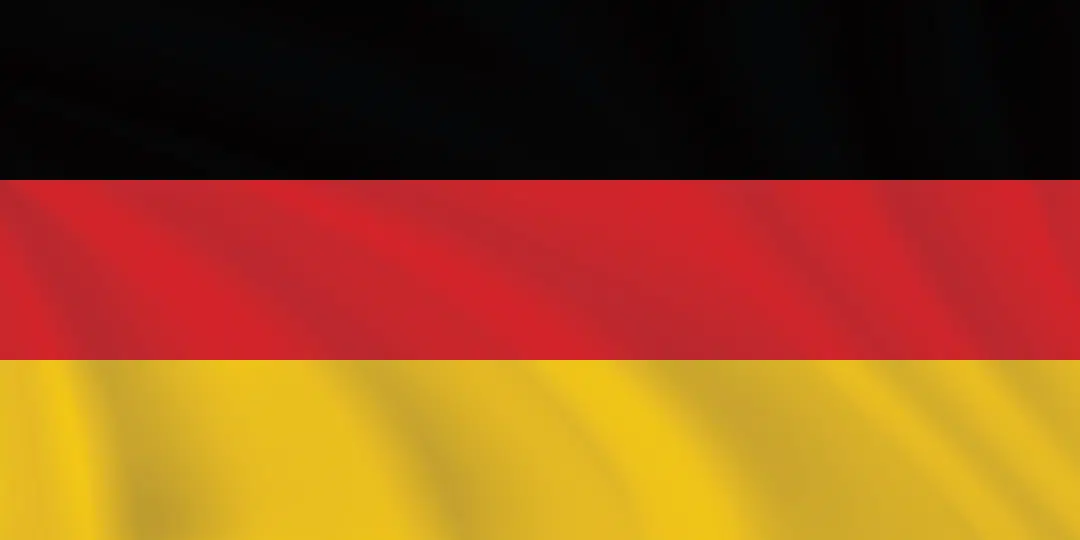
Flag of Germany
| Legal Name | Federal Republic of Germany |
|---|---|
| Flag |
|
| Capital City |
Berlin |
| Total Area | 357,022 km² |
| Land Area | 348,672 km² |
| Water Area | 8,350 km² |
| Population | Approximately 84 million |
| Major Cities | Berlin (~3.7 million), Hamburg (~1.9 million), Munich (~1.5 million), Cologne (~1.1 million), Frankfurt (~760,000) |
| Currency | Euro (€) (EUR) |
| GDP | Approximately USD 4.3 trillion |
| GDP Per Capita | Approximately USD 51,000 (nominal) |
About of Germany
Germany is located in Central Europe, bridging Western and Eastern Europe and serving as a crucial economic, political, and cultural hub. It shares borders with nine countries: Denmark to the north, Poland and the Czech Republic to the east, Austria and Switzerland to the south, and France, Luxembourg, Belgium, and the Netherlands to the west. Germany also has access to the North Sea and the Baltic Sea, giving it maritime significance in trade and transportation.
Berlin, the capital, is both a political and cultural center, renowned for its historical landmarks, vibrant arts scene, and modern economy. Other major urban centers include Hamburg, Munich, and Frankfurt, each playing key roles in commerce, finance, and industry. Germany is internationally recognized as a leading global economy, a founding member of the European Union, NATO, the G7, and the G20. Strategically, Germany’s location in Europe, strong industrial base, and political stability enhance its influence on regional and global affairs.
Etymology
The name “Germany” derives from the Latin term Germania, used by Julius Caesar to describe the tribes east of the Rhine River. In German, the country is called Deutschland, originating from the Old High German word diutisc, meaning “of the people,” signifying the language of the common people. Over centuries, this evolved to Deutsch, reflecting the cultural and linguistic identity of the Germanic peoples.
History
Prehistoric and Ancient Civilizations
Evidence of human habitation in Germany dates back to the Paleolithic era. The region was later inhabited by Celtic tribes and various Germanic peoples. Roman accounts describe the diverse and often decentralized Germanic tribes resisting Roman expansion east of the Rhine.
Classical and Medieval Periods
During the Middle Ages, the Holy Roman Empire dominated the region, encompassing a complex collection of semi-independent kingdoms, duchies, and principalities. German culture, law, and education flourished under this decentralized imperial system.
Major Empires and Dynasties
The Habsburg and Hohenzollern dynasties exerted significant influence in German-speaking lands. The rise of Prussia in the 18th and 19th centuries set the stage for German unification. Industrialization began transforming society, creating economic power and military strength.
Colonial and Imperial Rule
Germany established colonies in Africa, the Pacific, and China during the late 19th century. However, colonial ambitions ended after World War I, and the Treaty of Versailles imposed significant territorial and economic penalties.
20th Century and Modern History
The Weimar Republic emerged after World War I, followed by Nazi Germany under Adolf Hitler, leading to World War II and the Holocaust. Post-war Germany was divided into East and West Germany, with reunification achieved in 1990. Modern Germany emphasizes democracy, human rights, and European integration.
Government and Politics
Germany is a federal parliamentary republic. The President serves as the ceremonial head of state, while the Chancellor is the head of government, responsible for policy and administration. The Bundestag (federal parliament) and Bundesrat (representing federal states) comprise the legislative branch. The judiciary is independent, with the Federal Constitutional Court serving as the highest authority.
Germany consists of 16 federal states (Bundesländer), each with its own government, legislature, and administrative structure. Germany maintains robust diplomatic relations and participates actively in the EU, NATO, the UN, G7, and other international organizations. The Bundeswehr provides defense and contributes to international peacekeeping missions.
Economy
Germany is the largest economy in Europe and one of the most developed in the world. Its economy is export-oriented, with strong industrial, technological, and service sectors. Key industries include automotive, mechanical engineering, chemical, electrical, and electronics manufacturing.
Agriculture represents a small portion of GDP, with production of cereals, potatoes, vegetables, and livestock. Germany is rich in natural resources such as coal, lignite, natural gas, potash, and timber. Major trading partners include the United States, France, China, and other EU nations. Challenges include energy transition, demographic aging, and maintaining competitiveness. Germany’s economic outlook remains robust due to innovation, infrastructure, and global trade integration.
Demographics
Germany’s population is predominantly ethnic German, with significant immigrant communities from Turkey, Eastern Europe, and the Middle East. The official language is German, with regional dialects and minority languages present. Christianity, primarily Protestant and Catholic, is the dominant religion, alongside Islam, Judaism, and secular communities.
Urbanization is high, with the majority residing in metropolitan areas. Germany faces slow population growth and demographic aging, prompting policy initiatives on immigration, workforce participation, and social welfare sustainability.
Culture and Society
Germany has a rich cultural heritage, spanning philosophy, music, literature, architecture, and the arts. Figures like Goethe, Beethoven, Bach, and Kant shaped global intellectual and artistic landscapes. Cuisine varies regionally, with staples including bread, sausages, potatoes, and beer.
Social norms emphasize punctuality, order, and respect for privacy. Festivals such as Oktoberfest, Christmas markets, and Karneval celebrate tradition and community. Popular sports include football (soccer), handball, and winter sports. Germany has a strong tradition of scientific innovation, arts, and cultural preservation.
Education and Healthcare
Education is publicly funded, with primary, secondary, and tertiary institutions offering comprehensive instruction. Germany is home to prestigious universities and research institutes. Literacy rates are near 100%, and vocational training programs strengthen the workforce.
Healthcare is provided through a universal system, combining statutory health insurance and private options. Germany excels in medical research, healthcare infrastructure, and public health initiatives. Challenges include addressing aging populations and healthcare costs.
Geography and Climate
Germany’s physical geography includes the North German Plain, central uplands, and Alpine regions in the south. Major rivers include the Rhine, Elbe, and Danube. The country has a temperate seasonal climate, with mild to cold winters and warm summers. Natural hazards include flooding, storms, and occasional droughts. Environmental concerns focus on energy transition, air quality, and sustainable land use.
Flora and Fauna
Germany hosts diverse ecosystems, including forests, wetlands, rivers, and mountains. Native plant species include beech, oak, and spruce. Wildlife includes deer, foxes, wild boar, and numerous bird species. National parks such as the Black Forest and Bavarian Alps protect biodiversity and promote eco-tourism.
Map of Germany
Germany’s national symbols reflect unity, freedom, and heritage. These include the flag, coat of arms, national anthem, and emblematic fauna like the federal eagle. Monuments such as the Brandenburg Gate symbolize German resilience and history.
National Flag (Detailed Section)
The German flag consists of three horizontal stripes: black (top), red (middle), and gold (bottom). Adopted in its modern form after World War II, it represents unity, freedom, and democratic values. Black symbolizes determination and historical struggle, red represents bravery and strength, and gold signifies generosity and prosperity. The flag is prominently displayed on government buildings, national holidays, and international events.

Flag flying days
| Date | Flag Position | Occasion or Reason |
|---|---|---|
| October 3 | Full-mast | German Unity Day |
| May 1 | Full-mast | Labor Day |
| November 9 | Full-mast | Fall of the Berlin Wall (commemorative) |
| Official Mourning Periods | Half-mast | National mourning, deaths of state officials |
| August 23 | Full-mast | European Day of Remembrance |