
Flag of Bangladesh
| Legal Name | People’s Republic of Bangladesh |
|---|---|
| Flag |
|
| Capital City |
Dhaka |
| Total Area | ~148,460 km² |
| Land Area | ~130,170 km² |
| Water Area | ~18,290 km² |
| Population | ~172 million |
| Major Cities | Dhaka (22M metro), Chattogram/Chittagong (5M metro), Khulna (1M), Rajshahi (800K), Sylhet (700K) |
| Currency | Bangladeshi Taka (BDT) |
| GDP | ~US$460–480 billion |
| GDP Per Capita | ~US$2,600 (nominal) |
About of Bangladesh
The name “Bangladesh” originates from the Bengali words “Bangla” (referring to the Bengal region and the Bengali language) and “Desh” meaning “country” or “land.” Thus, Bangladesh translates to “Land of Bengal.”
Historically, the region was known as Bengal under various empires and colonial administrations. The modern name emerged during the mid-20th century nationalist movements that sought political autonomy and cultural recognition for the Bengali-speaking population. The term symbolized unity, linguistic pride, and independence from external rule.
4. History
The territory of present-day Bangladesh has been inhabited since prehistoric times, with archaeological findings revealing early agricultural settlements and advanced urban cultures. Ancient Bengal was part of influential Indian empires such as the Maurya and Gupta, which contributed to early governance, art, and trade networks.
During the medieval period, Bengal saw the rise of independent sultanates and later incorporation into the Mughal Empire, which left a lasting legacy of architecture, administration, and cultural synthesis. The region prospered as a center of textile production and international trade.
In the 18th century, Bengal gradually came under British colonial control following the Battle of Plassey in 1757. British rule significantly reshaped the economy, infrastructure, and social structures. After the partition of British India in 1947, East Bengal became East Pakistan, separated geographically from West Pakistan by over 1,600 kilometers of Indian territory.
Growing political, economic, and linguistic tensions led to the Bangladesh Liberation War in 1971. After a nine-month conflict, Bangladesh achieved independence and established itself as a sovereign nation. Since independence, the country has undergone periods of political upheaval, military rule, and democratic reforms. In recent decades, Bangladesh has experienced notable economic growth and social development, although governance and political polarization remain ongoing challenges.
5. Government and Politics
Bangladesh operates as a parliamentary representative democratic republic. The Constitution, adopted in 1972, establishes the framework for governance, fundamental rights, and the rule of law. The political system emphasizes legislative supremacy, multiparty elections, and civilian leadership.
The Executive Branch is led by the Prime Minister, who serves as head of government and exercises significant executive authority. The President acts as head of state with largely ceremonial duties. The Legislative Branch consists of a unicameral parliament known as the Jatiya Sangsad, whose members are elected through general elections. The Judicial Branch is independent and headed by the Supreme Court, which ensures constitutional interpretation and legal oversight.
Administratively, Bangladesh is divided into divisions, districts, and sub-districts. The country maintains active diplomatic relations worldwide and is a member of the United Nations, Commonwealth of Nations, SAARC, and the Organization of Islamic Cooperation. Its defense forces include the army, navy, and air force, primarily focused on national security, peacekeeping missions, and disaster response.
6. Economy
Bangladesh is classified as a developing and emerging economy with sustained growth over the past two decades. The economy is heavily driven by the ready-made garment (RMG) industry, which is one of the largest in the world and a major export earner. Other key sectors include agriculture, pharmaceuticals, shipbuilding, leather goods, and information technology services.
Agriculture remains vital, employing a significant portion of the workforce and producing rice, jute, tea, and fish. The services sector, including banking, telecommunications, and retail, has expanded rapidly. Natural resources such as natural gas and fertile soil contribute to domestic energy and food production.
Major trade partners include the United States, European Union countries, China, and India. Despite impressive economic progress, Bangladesh faces challenges such as infrastructure limitations, climate vulnerability, labor conditions, and income inequality. Future economic prospects are closely tied to industrial diversification, digital innovation, and sustainable development policies.
7. Demographics
Bangladesh has a predominantly Bengali ethnic majority, with small indigenous and minority communities in hill tracts and border regions. Bengali is spoken by the vast majority of the population and serves as both the official and national language.
Islam is the principal religion, followed by Hinduism, Buddhism, and Christianity. The country is highly urbanizing, though a substantial portion of the population still resides in rural areas dependent on agriculture. Population growth has slowed compared to previous decades due to improved education and healthcare access.
8. Culture and Society
Bangladeshi culture is deeply rooted in Bengali traditions, literature, music, and folk arts. Poetry, classical songs, and modern cinema play influential roles in national identity. Traditional cuisine features rice, fish, lentils, and diverse spices, reflecting both regional and historical influences.
Social customs emphasize hospitality, family values, and respect for elders. Major festivals include Pohela Boishakh (Bengali New Year), Eid-ul-Fitr, Eid-ul-Adha, and Durga Puja. Cricket is the most popular sport, followed by football and kabaddi.
9. Education and Healthcare
Bangladesh has made significant progress in literacy and primary education enrollment. The education system is structured into primary, secondary, and tertiary levels, with both public and private institutions. Universities in Dhaka and other cities attract domestic and international students.
Healthcare services are provided through government hospitals, private clinics, and community health programs. Public health initiatives have improved life expectancy and reduced infant mortality, although challenges remain in rural access, infrastructure, and funding.
10. Geography and Climate
Bangladesh is characterized by vast river deltas, floodplains, and coastal regions. The country experiences a tropical monsoon climate with hot summers, heavy rainfall during monsoon months, and mild winters. Seasonal flooding, cyclones, and river erosion are common natural hazards.
Environmental concerns include deforestation, water pollution, and vulnerability to rising sea levels. The Sundarbans, the world’s largest mangrove forest, is a significant ecological asset and UNESCO World Heritage Site.
11. Flora and Fauna
Bangladesh hosts rich biodiversity, especially within the Sundarbans mangrove ecosystem. Native plant species include mangrove trees, bamboo, and tropical hardwoods. Wildlife includes the Royal Bengal Tiger, spotted deer, crocodiles, and diverse bird species. National parks and wildlife sanctuaries play a crucial role in conservation and ecological protection.
Map of Bangladesh
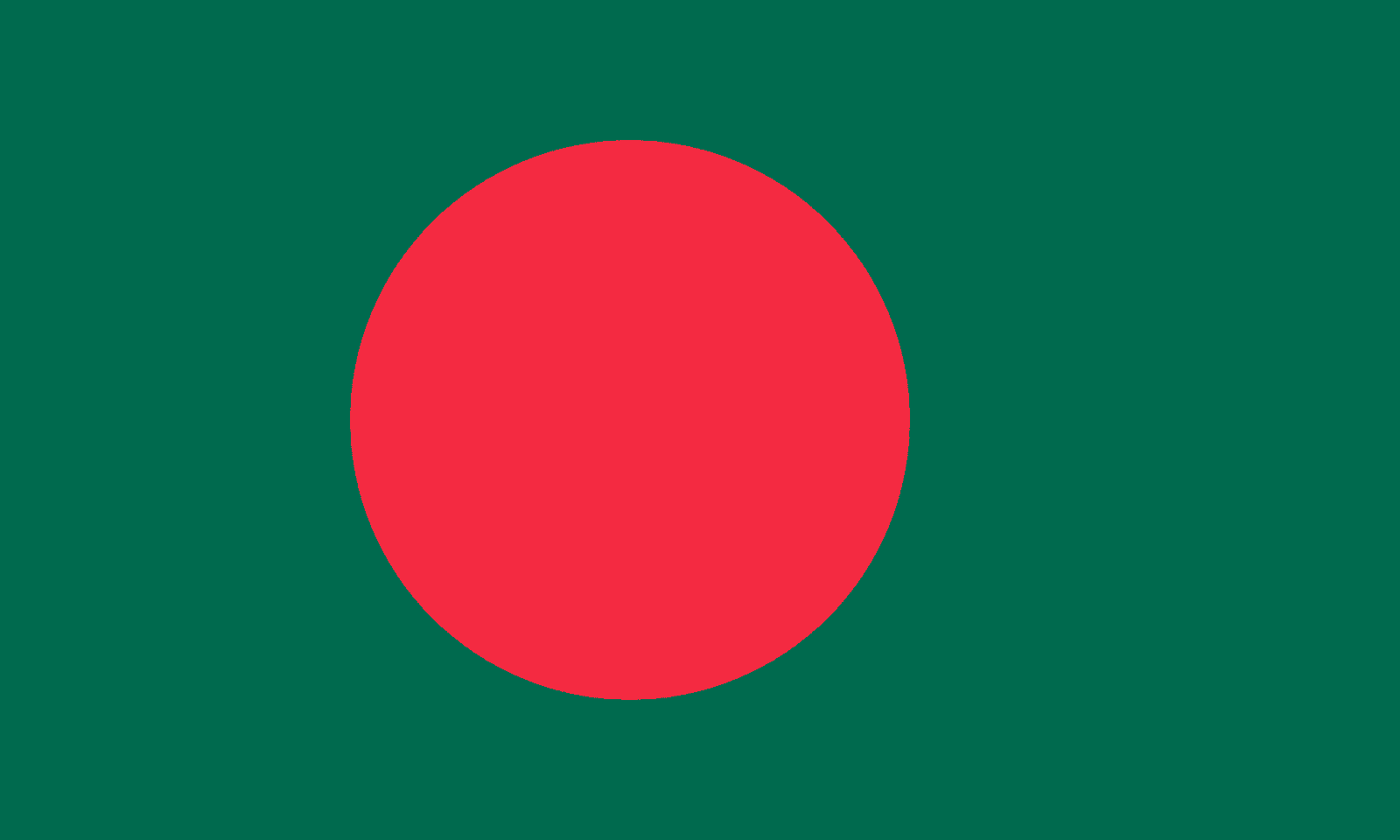
National Flag: Green background with red circle
Coat of Arms: Water lily flanked by rice sheaves with stars above
National Anthem: “Amar Sonar Bangla”
National Animal: Royal Bengal Tiger
National Flower: Water Lily
National Fruit: Jackfruit
National Flag (Detailed Section)
The national flag of Bangladesh features a dark green field with a red disc slightly shifted toward the hoist. The green symbolizes the lush landscape and vitality of the nation, while the red circle represents the rising sun and the sacrifices made during the independence struggle.
The flag was officially adopted in 1972 following independence. Its minimalist design reflects unity, resilience, and national pride. Flag protocol emphasizes respectful display on government buildings, educational institutions, and during national celebrations or days of mourning.


Flag flying days
| Date | Flag Position | Occasion |
|---|---|---|
| 26 March | Full-mast | Independence Day |
| 16 December | Full-mast | Victory Day |
| 21 February | Half-mast | International Mother Language Day |
| 15 August | Half-mast | National Mourning Day |
| 26 January (varies observance) | Full-mast | Republic/Constitutional Events |