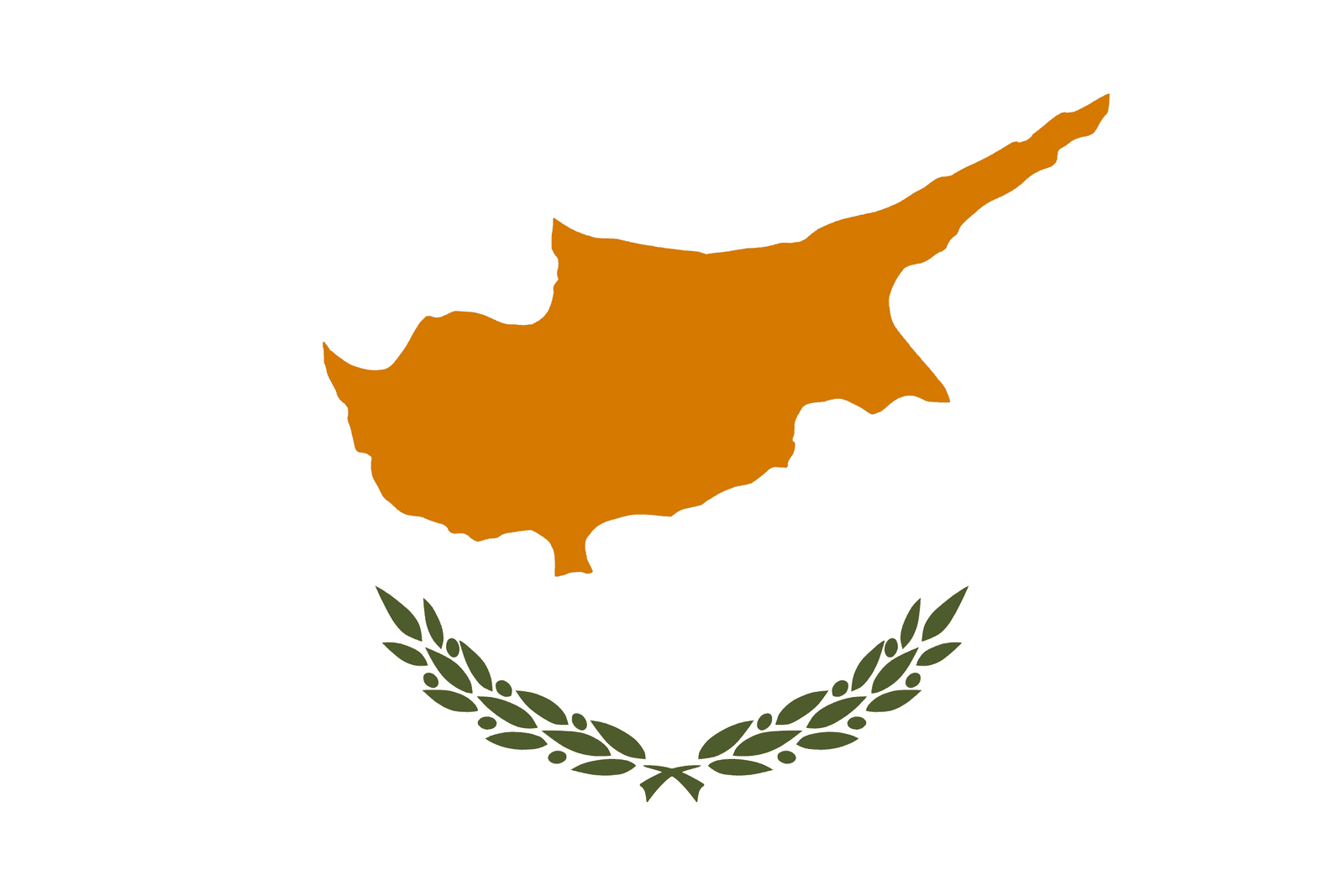
Flag of Cyprus
| Legal Name | \Republic of Cyprus |
|---|---|
| Flag |
|
| Capital City |
Nicosia |
| Total Area | ~9,251 km² |
| Land Area | ~9,241 km² |
| Water Area | ~10 km² |
| Population | ~1.27 million |
| Major Cities | Nicosia (330,000 metro), Limassol (250,000), Larnaca (150,000), Paphos (90,000), Famagusta area (70,000) |
| Currency | Euro (EUR) |
| GDP | ~US$33–35 billion |
| GDP Per Capita | ~US$30,000–32,000 |
About of Cyprus
Cyprus is an island nation located in the eastern Mediterranean Sea, positioned at the crossroads of Europe, Asia, and the Middle East. It lies south of Turkey, west of Syria and Lebanon, north of Egypt, and east of Greece. This strategic location has shaped Cyprus’s long history as a meeting point of civilizations, cultures, and trade routes.
The island has no land borders, but its maritime boundaries connect it to several neighboring states in the Mediterranean. Nicosia, the capital, is the political and administrative center and also the largest urban area. Other major cities include Limassol, a key commercial port; Larnaca, an important transportation hub; and Paphos, known for its historical and cultural heritage.
Cyprus has a diverse yet relatively small population with a high standard of living by regional standards. The country is internationally recognized as a sovereign state and is a member of the United Nations, the European Union, and the Commonwealth of Nations. While the Republic of Cyprus exercises effective control over the southern part of the island, the Cyprus issue remains a significant aspect of its political context.
Strategically, Cyprus holds considerable geopolitical importance due to its proximity to the Middle East, its role in regional security, and its position along key maritime routes. It also serves as an important center for diplomacy, shipping, and energy exploration in the eastern Mediterranean.
Etymology
The name “Cyprus” is believed to derive from the ancient word for copper, reflecting the island’s rich copper deposits that were extensively mined in antiquity. The Greek word Kypros became associated with the island as early as the Bronze Age, when Cyprus was a major exporter of copper across the Mediterranean.
Over time, the name evolved through various linguistic forms in Greek, Latin, and other languages but consistently retained its association with copper and the island itself. This etymology highlights Cyprus’s early economic importance and its integration into ancient trade networks.
History
Cyprus has been inhabited since prehistoric times, with evidence of early Neolithic settlements dating back more than 10,000 years. During the Bronze Age, the island became a significant center for copper production and trade, linking it to civilizations in the Aegean, Anatolia, and the Near East.
In antiquity, Cyprus came under the influence of Mycenaean Greeks, followed by periods of rule by the Assyrians, Egyptians, and Persians. The island later became part of the Hellenistic world under Alexander the Great and subsequently a province of the Roman Empire, during which Christianity was introduced.
Throughout the medieval period, Cyprus was ruled by the Byzantine Empire, the Lusignan Kingdom, and later the Venetian Republic, each leaving lasting cultural and architectural legacies. In 1571, the island was incorporated into the Ottoman Empire, remaining under Ottoman rule for over three centuries.
In 1878, administrative control passed to Britain, and Cyprus formally became a British colony in 1925. After a prolonged independence movement, the Republic of Cyprus was established in 1960. The following decades were marked by intercommunal tensions and political challenges. Since the late 20th century, Cyprus has focused on economic development, European integration, and diplomatic efforts related to reunification.
Government and Politics
Cyprus is a presidential republic governed under a constitution adopted in 1960. The President serves as both head of state and head of government, elected by popular vote. Executive authority is exercised through the Council of Ministers.
The legislative branch consists of a unicameral House of Representatives, responsible for lawmaking and oversight. The judiciary is independent and includes the Supreme Court, which oversees constitutional and administrative matters.
Administratively, Cyprus is divided into districts that manage local governance. In foreign relations, the country maintains strong ties with the European Union, neighboring Mediterranean states, and international organizations. Cyprus does not maintain large armed forces but focuses on national defense, cooperation with partners, and regional security initiatives.
Economy
Cyprus has a developed, high-income economy primarily driven by the services sector. Tourism, shipping, financial services, and real estate are central pillars of economic activity. The island’s strategic location has helped it develop into a regional business and logistics hub.
Agriculture plays a smaller but culturally important role, producing citrus fruits, olives, grapes, and dairy products. Manufacturing is limited and focuses on food processing, pharmaceuticals, and light industry. Natural resources are modest, though offshore natural gas exploration has gained increasing attention.
Cyprus trades extensively with European partners and neighboring regions. Key challenges include economic diversification, regional instability, and adapting to global financial shifts. Long-term prospects remain positive due to EU membership, human capital, and strategic positioning.
Demographics
Cyprus’s population consists primarily of Greek Cypriots, with Turkish Cypriots and smaller communities of Armenians, Maronites, and expatriates. The population is largely urban, with most residents living in coastal cities and metropolitan areas.
The official languages are Greek and Turkish, with English widely spoken, especially in business and tourism. The dominant religion is Eastern Orthodox Christianity, alongside Islam and other faiths. Population growth is moderate and influenced by migration and economic conditions.
Culture and Society
Cypriot culture reflects a blend of Greek, Mediterranean, and Middle Eastern influences. Traditions emphasize family, hospitality, and community life. Music, dance, and folklore remain central to cultural expression, particularly during festivals.
Cuisine is a defining aspect of national identity, featuring dishes such as meze, halloumi cheese, grilled meats, and fresh seafood. Public holidays and religious festivals are widely celebrated, reinforcing cultural continuity.
Sports and recreation are popular, with football being the most widely followed sport. Outdoor activities such as hiking and water sports are common due to the island’s climate and geography.
Education and Healthcare
Cyprus has a well-developed education system with compulsory primary and secondary schooling and a growing higher education sector. Literacy rates are high, and universities attract both domestic and international students.
Healthcare is provided through a universal public healthcare system complemented by private services. Public health indicators are strong, with high life expectancy and ongoing investments in preventive care and medical infrastructure.
Geography and Climate
Cyprus features diverse physical geography, including the Troodos Mountains in the interior, fertile plains, and an extensive coastline. Rivers are mostly seasonal, reflecting the island’s climate.
The climate is Mediterranean, characterized by hot, dry summers and mild, wetter winters. Natural hazards include occasional droughts and heatwaves. Environmental concerns focus on water scarcity, coastal development, and ecosystem preservation.
Flora and Fauna
The island supports rich biodiversity with many endemic plant species, especially in mountainous regions. Olive trees, pines, and wildflowers are common across the landscape.
Wildlife includes foxes, reptiles, migratory birds, and marine species. Cyprus maintains protected areas and national parks to conserve habitats and promote sustainable tourism.
Map of Cyprus
Cyprus’s national symbols emphasize peace and unity. These include the national flag, the coat of arms, and the national anthem, which is shared with Greece. Cultural monuments and archaeological sites also serve as symbols of national heritage.
National Flag (Detailed Section)
The flag of Cyprus is unique in featuring a map of the country. It displays a white background symbolizing peace, with a copper-colored silhouette of the island representing historical copper wealth. Beneath the map are two green olive branches, symbolizing reconciliation and harmony between communities.
Adopted in 1960, the flag was designed to be neutral and inclusive. It is flown at government buildings, schools, and during national celebrations, reflecting sovereignty and aspirations for peace
Flag flying days
| Date | Flag Position | Occasion or Reason |
|---|---|---|
| 1 October | Full-mast | Independence Day |
| 25 March | Full-mast | Greek National Day (commemorated nationally) |
| 1 January | Full-mast | New Year’s Day |
| Official Mourning Days | Half-mast | National remembrance or mourning |