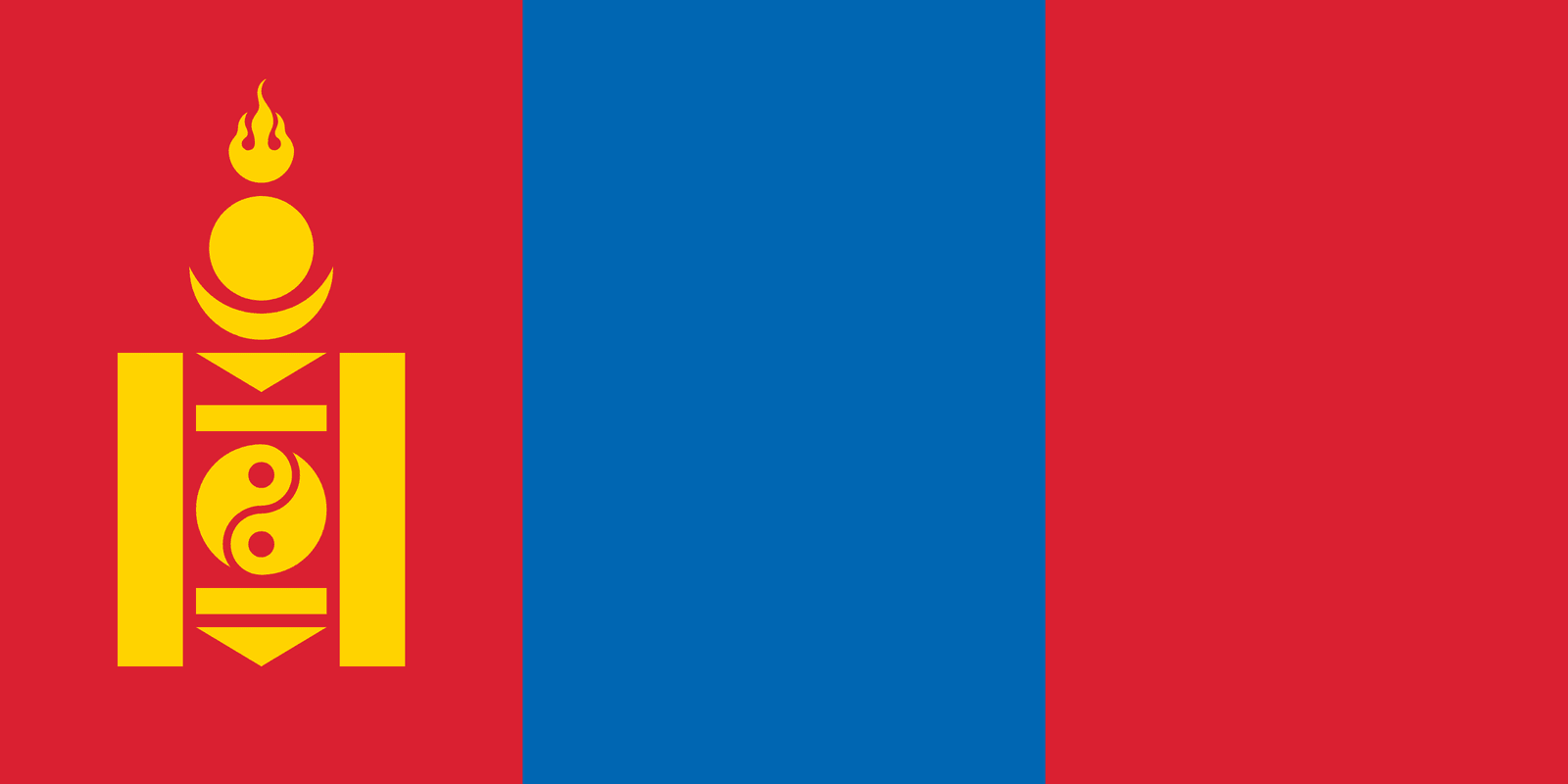
Flag of Mongolia
| Legal Name | Mongolia |
|---|---|
| Flag |
|
| Capital City |
Ulaanbaatar |
| Total Area | 1,564,116 km² |
| Land Area | Approximately 1,553,556 km² |
| Water Area | Approximately 10,560 km² |
| Population | Approximately 3.5 million |
| Major Cities | Ulaanbaatar (1.6 million), Erdenet (100,000), Darkhan (85,000), Choibalsan (45,000) |
| Currency | Mongolian Tögrög (MNT) |
| GDP | Approximately USD 17–18 billion |
| GDP Per Capita | Approximately USD 5,000 (nominal) |
About of Mongolia
Mongolia is a landlocked country located in East and Central Asia, positioned between Russia to the north and China to the south. It is the world’s most sparsely populated sovereign nation, characterized by vast open landscapes, steppe grasslands, deserts, and mountain ranges. Mongolia’s geographic isolation and expansive territory have shaped its nomadic traditions and historical development.
The country shares land borders exclusively with Russia and China and has no maritime borders. Ulaanbaatar, the capital and largest city, serves as the political, economic, and cultural center, housing nearly half of the national population. Other urban centers such as Erdenet and Darkhan function as important industrial and regional hubs.
Mongolia’s population is relatively small but culturally cohesive, with strong historical continuity rooted in nomadic heritage. Internationally, Mongolia is recognized as a sovereign democratic state and plays a strategic role as a neutral buffer between two global powers. Its geopolitical significance lies in its mineral wealth, democratic governance in a region dominated by larger states, and participation in regional diplomacy.
Etymology
The name “Mongolia” derives from the Mongol people, an ethnic group whose identity emerged in the early medieval period. The term “Mongol” is believed to have originated from ancient tribal names recorded in Chinese historical texts. Over time, the name came to represent both the people and the territory they inhabited. The modern name reflects the continuity of Mongol identity from the era of empire to the present nation-state.
History
Prehistoric and Ancient Civilizations
Human habitation in Mongolia dates back to prehistoric times, with evidence of Paleolithic cultures, rock art, and early pastoral societies. Ancient nomadic confederations such as the Xiongnu dominated the region and played a significant role in early Eurasian history.
Classical and Medieval Periods
Various Turkic and Mongolic tribes rose and fell across the steppe, establishing mobile political systems based on clan alliances. These societies controlled major trade routes connecting East Asia with Europe.
Major Empires, Kingdoms, or Dynasties
The most transformative period came in the early 13th century with the rise of Genghis Khan, who unified the Mongol tribes and founded the Mongol Empire. At its height, the empire became the largest contiguous land empire in history, reshaping global trade, warfare, and governance.
Colonial or Imperial Rule
After the decline of the Mongol Empire, Mongolia fell under the influence of the Qing Dynasty of China in the 17th century. This period limited Mongolian autonomy while preserving elements of traditional culture.
Independence Movement
Following the collapse of the Qing Dynasty, Mongolia declared independence in 1911. Full international recognition followed in the 20th century, particularly after the establishment of the Mongolian People’s Republic in 1924 with Soviet support.
Key Post-Independence Events
For most of the 20th century, Mongolia functioned as a socialist state aligned with the Soviet Union. Major social and economic reforms transformed education, healthcare, and infrastructure.
Modern Political Developments
In 1990, Mongolia underwent a peaceful democratic revolution, transitioning to a multiparty democracy and market economy. Since then, it has maintained political pluralism and constitutional governance.
Government and Politics
Mongolia is a democratic republic with a semi-presidential system. The Constitution of 1992 established the legal framework for democratic governance, separation of powers, and protection of fundamental rights.
Executive authority is shared between the President, who serves as head of state, and the Prime Minister, who leads the government. Legislative power rests with the State Great Khural, a unicameral parliament elected by popular vote. The judiciary operates independently, with the Constitutional Court ensuring constitutional compliance.
Administratively, Mongolia is divided into 21 provinces (aimags) and one capital city municipality. The country maintains active foreign relations and is a member of the United Nations, World Trade Organization, and various regional forums. Mongolia’s armed forces are modest in size and focus on national defense and international peacekeeping missions.
Economy
Mongolia is classified as a developing and resource-rich emerging economy. Mining is the backbone of the economy, with major reserves of copper, coal, gold, and rare earth elements. Projects such as large-scale copper and coal mines play a central role in economic growth.
Agriculture remains important, particularly livestock herding, which supports rural livelihoods and exports of meat and cashmere. Manufacturing is limited but growing, while the services sector—including trade, transportation, and finance—has expanded alongside urbanization.
China is Mongolia’s largest trading partner, followed by Russia and other Asian markets. Economic challenges include dependence on commodity exports, infrastructure gaps, environmental degradation, and vulnerability to global price fluctuations. Future prospects focus on diversification, renewable energy, and regional connectivity.
Demographics
Mongolia’s population is predominantly ethnic Mongol, with small minority groups such as Kazakhs, Tuvans, and others. Mongolian is the official language, written in Cyrillic, with increasing use of English and Russian as secondary languages.
Buddhism is the dominant religion, blended with traditional shamanistic practices, while a minority practices Islam or Christianity. Urbanization has accelerated, with a significant portion of the population residing in Ulaanbaatar. Population growth is moderate, with a youthful demographic profile.
Culture and Society
Mongolian culture is deeply rooted in nomadic traditions, emphasizing harmony with nature, hospitality, and resilience. National identity is closely tied to the legacy of Genghis Khan and the historical role of the steppe.
Traditional arts include throat singing, long-song music, epic poetry, and intricate handicrafts. Mongolian cuisine features meat and dairy-based dishes adapted to the harsh climate. Social customs value respect for elders and community solidarity.
Major festivals include Naadam, celebrating wrestling, horse racing, and archery, along with Lunar New Year celebrations. Sports and recreation remain central to cultural life.
Education and Healthcare
Mongolia provides universal access to basic education, with high literacy rates exceeding 95 percent. The education system includes primary, secondary, and tertiary institutions, with universities concentrated in urban areas.
Healthcare is delivered through a public system supplemented by private providers. Mongolia has achieved progress in maternal health and life expectancy, though challenges persist in rural healthcare access, air pollution, and non-communicable diseases.
Geography and Climate
Mongolia’s geography includes vast steppes, the Gobi Desert, mountain ranges such as the Altai, and numerous rivers and lakes. Despite its size, the country has no coastline.
The climate is continental and extreme, with long, cold winters and short, warm summers. Natural hazards include droughts, harsh winters known as dzud, and desertification. Environmental concerns center on climate change, mining impacts, and urban air pollution.
Flora and Fauna
Mongolia hosts diverse ecosystems, ranging from alpine forests to desert plains. Native plant species include grasses, shrubs, and coniferous trees adapted to extreme conditions.
Wildlife includes snow leopards, wild horses, gazelles, wolves, and numerous bird species. National parks and protected areas, such as Gobi Gurvansaikhan and Hustai National Park, support conservation and biodiversity preservation.
Map of Mongolia
National Flag: Red, blue, and red tricolor with the Soyombo symbol
Coat of Arms: Circular emblem featuring national motifs and symbols of statehood
National Anthem: Mongol Ulsiin Turiin Duulal
National Symbols: The horse, the Soyombo symbol, and monuments to Genghis Khan
National Flag (Detailed Section)
The national flag of Mongolia consists of three vertical stripes: red on the hoist and fly sides, and blue in the center. The golden Soyombo symbol on the left red stripe represents independence, unity, and eternal existence. Adopted in its current form in 1992, the flag reflects Mongolia’s sovereignty, sky symbolism, and historical continuity. It is used in all official settings and respected under strict national protocol.
Realted Flags
Flag flying days
| Date | Flag Position | Occasion or Reason |
|---|
| July 11–13 | Full-mast | Naadam National Festival |
| November 26 | Full-mast | Constitution Day |
| March 1 | Full-mast | Armed Forces Day |
| National Mourning Periods | Half-mast | Death of national leaders or national tragedies |