
Flag of Taiwan
| Legal Name | Republic of China (Taiwan) |
|---|---|
| Flag |
|
| Capital City |
Taipei |
| Total Area | 36,197 km² |
| Land Area | 35,808 km² |
| Water Area | 389 km² |
| Population | Approximately 23.5 million |
| Major Cities | Taipei (2.7 million), New Taipei City (4 million metro), Taichung (2.8 million), Kaohsiung (2.7 million), Tainan (1.9 million) |
| Currency | New Taiwan Dollar (TWD) |
| GDP | USD 875 billion |
| GDP Per Capita | USD 63,000 (PPP) |
About of Taiwan
Taiwan is an island nation in East Asia, located in the western Pacific Ocean, off the southeastern coast of China. It is separated from the mainland by the Taiwan Strait and is positioned north of the Philippines, south of Japan’s Ryukyu Islands, and east of the South China Sea. Taiwan’s strategic location places it at the crossroads of key maritime routes in the Asia-Pacific region.
Taipei, the capital, serves as the political, economic, and cultural hub, while other major cities like New Taipei City, Taichung, and Kaohsiung contribute to Taiwan’s urbanized, industrialized economy. Taiwan’s population is highly urbanized, technologically advanced, and exhibits a strong education and healthcare system.
Although Taiwan operates as a sovereign state with its own government, military, and foreign relations, its international recognition is limited due to China’s claim over the territory. Nevertheless, Taiwan maintains informal ties and robust economic and cultural relations with numerous countries. Its geopolitical importance arises from its technological leadership, particularly in semiconductors, and its role in regional security dynamics.
Etymology
The name “Taiwan” derives from the indigenous Siraya language term Tayowan, which referred to a coastal settlement near present-day Tainan. During Dutch colonial rule in the 17th century, the term became associated with the entire island. “Republic of China” reflects the government’s continuity following the relocation from mainland China after 1949, although “Taiwan” is the de facto identifier internationally.
History
Prehistoric and Ancient Civilizations
Archaeological evidence shows human settlement in Taiwan for at least 15,000 years. Indigenous Austronesian peoples developed distinct cultures, languages, and maritime practices.
Classical and Colonial Periods
In the 17th century, the Dutch and Spanish established settlements on the island, followed by the Ming loyalist Koxinga’s expulsion of the Dutch in 1662. Qing China annexed Taiwan in 1683, integrating it into its provincial system.
Japanese Rule
From 1895 to 1945, Taiwan was a Japanese colony following the Treaty of Shimonoseki. Japan implemented infrastructure, education, and industrialization policies, leaving lasting influence.
Post-War Era and Modern Development
After World War II, Taiwan was returned to the Republic of China. The Chinese Civil War led the ROC government to relocate to Taiwan in 1949, establishing a separate administration. Taiwan transitioned from martial law to democracy in the late 20th century, holding its first direct presidential elections in 1996. Modern Taiwan is a stable democracy with a highly developed economy and global technological influence.
Government and Politics
Taiwan is a multiparty democratic republic with a semi-presidential system.
Executive: President serves as head of state and commander-in-chief; Premier leads the Executive Yuan.
Legislature: Unicameral Legislative Yuan enacts laws, approves budgets, and oversees government.
Judiciary: Independent system with the Judicial Yuan as the highest body.
The island is divided into special municipalities, counties, and cities. Taiwan maintains informal international relations and participates in economic and cultural organizations while balancing cross-strait tensions. Its military focuses on territorial defense, modernizing air, naval, and missile capabilities.
Economy
Taiwan is a highly developed, export-oriented economy. Its major industries include electronics, semiconductors, information technology, machinery, petrochemicals, and precision manufacturing. Agriculture contributes a small percentage, producing rice, fruits, and tea. Taiwan’s economy benefits from natural resources such as minerals, though land scarcity limits large-scale extraction.
Key trade partners include China, the United States, Japan, and European Union nations. Taiwan is a global leader in semiconductor production, with companies like TSMC central to worldwide supply chains. Economic challenges include reliance on global trade, demographic aging, and energy import dependence. The outlook emphasizes innovation, green technology, and regional economic integration.
Demographics
Taiwan’s population is ethnically diverse:
Ethnic Groups: Predominantly Han Chinese (including Hoklo, Hakka), with indigenous Austronesian minorities (~2%).
Languages: Mandarin (official), Taiwanese Hokkien, Hakka, indigenous languages.
Religions: Buddhism, Taoism, folk religions, Christianity, and others.
Urbanization: Over 78% urban population, concentrated in major cities and metropolitan areas.
Population Trends: Low birth rates and aging population are ongoing demographic challenges.
Culture and Society
Taiwanese culture blends indigenous, Chinese, Japanese, and Western influences. National identity emphasizes democratic values, technological innovation, and cultural preservation. Traditional arts, calligraphy, and folk music coexist with modern entertainment, pop culture, and cinema.
Cuisine is globally celebrated, featuring dumplings, beef noodles, bubble tea, and night market specialties. Social customs emphasize family, education, and respect for elders. Festivals include Lunar New Year, Dragon Boat Festival, and Mid-Autumn Festival. Sports such as baseball, basketball, and badminton are popular, alongside hiking and outdoor recreation.
Education and Healthcare
Education is compulsory until age 15, with high literacy and widespread tertiary enrollment. Universities like National Taiwan University and National Tsing Hua University lead research and innovation.
Taiwan’s healthcare system, known as National Health Insurance, provides universal coverage with advanced medical facilities. Public health achievements include high life expectancy, effective vaccination programs, and strong disease control infrastructure.
Geography and Climate
Taiwan features rugged mountains in the east, central plains, and western coastal plains. Major rivers include the Zhuoshui, Tamsui, and Gaoping. The island has a subtropical climate in the north and tropical in the south, with hot, humid summers and mild winters. Natural hazards include typhoons, earthquakes, and occasional landslides. Environmental concerns focus on air pollution, deforestation, and habitat protection.
Flora and Fauna
Taiwan hosts rich biodiversity, including subtropical and tropical flora such as camphor, cypress, and endemic orchids. Wildlife includes Formosan black bears, macaques, pangolins, and numerous bird species. Protected areas, including Taroko National Park and Yushan National Park, conserve ecosystems and endemic species.
Map of Taiwan
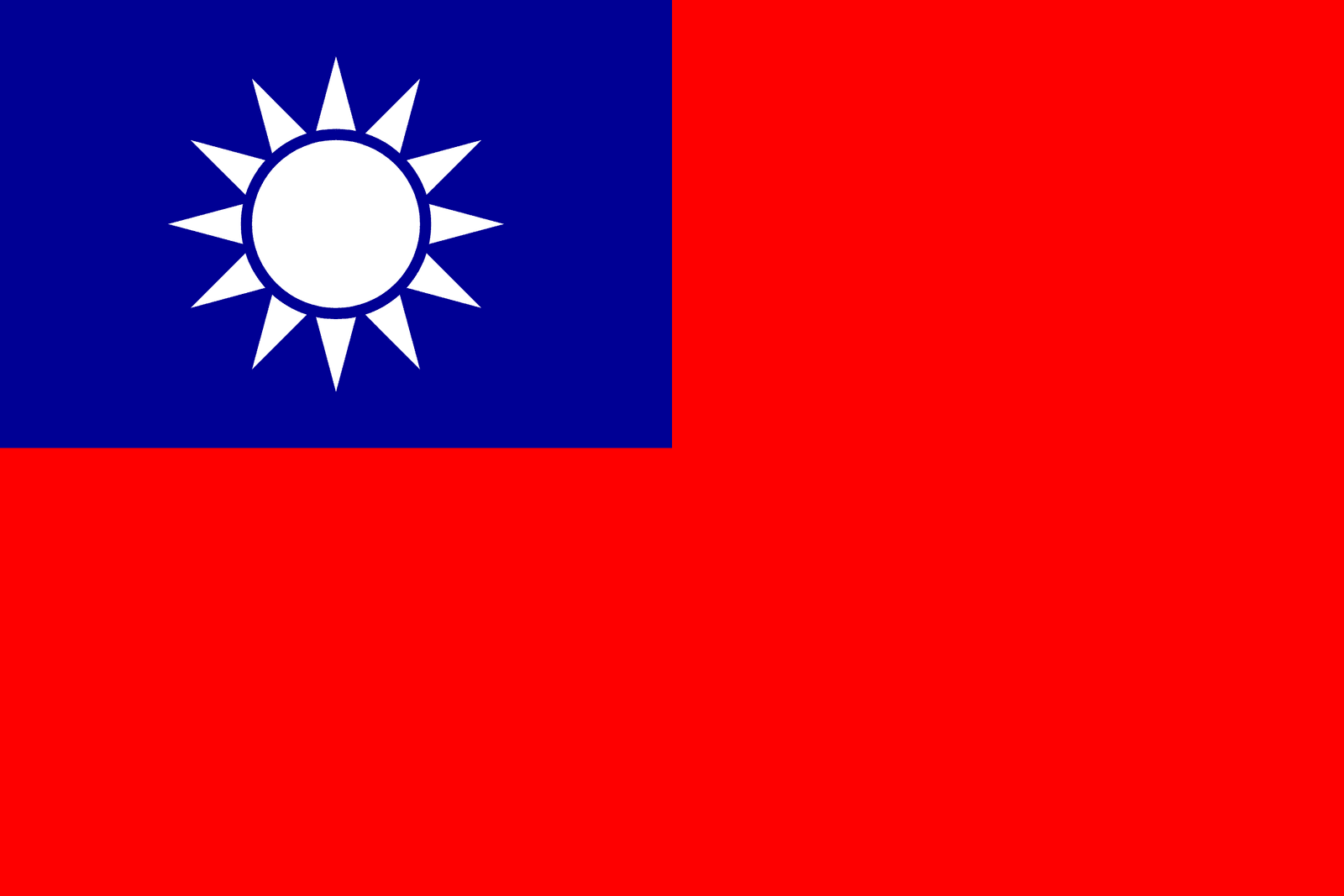
Flag: Red with a blue canton containing a white sun with 12 rays.
Coat of Arms: Features a white sun on a blue field, symbolizing progress and unity.
National Anthem: Zhōnghuá Mínguó Guógē (National Anthem of the Republic of China).
National Animals/Plants: Formosan black bear, Taiwan blue magpie, and Taiwan red cypress.
National Flag (Detailed Section)
The flag, officially known as the “Blue Sky, White Sun, and a Wholly Red Earth,” has a red field symbolizing the blood of revolutionaries, a blue canton representing liberty and justice, and a white sun with 12 rays symbolizing the 12 months and traditional Chinese hours. The design originates from the Kuomintang revolutionary movement and was adopted in 1928. Flag protocol mandates flying the flag at government buildings, schools, and public events.

Flag flying days
| Date | Flag Position | Occasion or Reason |
|---|---|---|
| October 10 | Full-mast | National Day (Double Tenth Day) |
| January 1 | Full-mast | New Year celebrations |
| As Declared | Half-mast | National mourning, death of President, or major tragedy |
| February 28 | Full-mast | Peace Memorial Day (228 Incident |