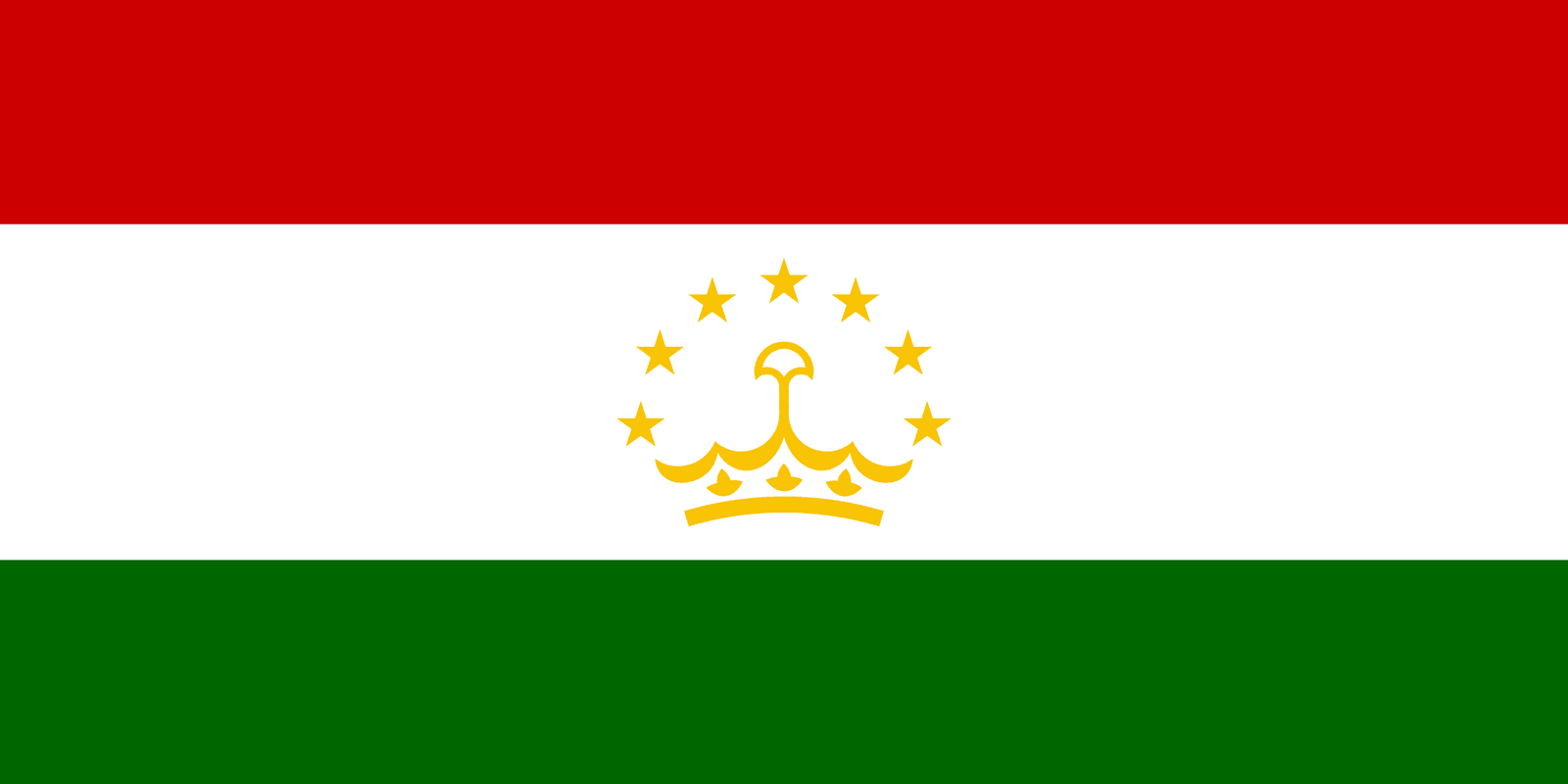
Flag of Tajikistan
| Legal Name | Republic of Tajikistan |
|---|---|
| Flag |
|
| Capital City |
Dushanbe |
| Total Area | 143,100 km² |
| Land Area | 141,510 km² |
| Water Area | 1,590 km² |
| Population | Approximately 10.3 million |
| Major Cities | Dushanbe (1.2 million), Khujand (0.2 million), Kulob (0.1 million), Bokhtar (0.1 million), Istaravshan (0.07 million) |
| Currency | Tajikistani Somoni (TJS) |
| GDP | USD 11 billion |
| GDP Per Capita | USD 1,100 (nominal) |
About of Tajikistan
Tajikistan is a landlocked country located in Central Asia, characterized by rugged mountainous terrain and deep river valleys. It lies at the crossroads of South Asia, East Asia, and the Middle East, giving it historical significance as part of ancient trade routes. The country shares borders with Afghanistan to the south, Uzbekistan to the west, Kyrgyzstan to the north, and China to the east.
Dushanbe, the capital and largest city, serves as the political, economic, and cultural center of the nation. Other important urban areas include Khujand in the north and Kulob in the south. Tajikistan’s population is predominantly rural, with strong ties to agriculture and traditional community life.
Internationally, Tajikistan is a recognized sovereign state and a member of the United Nations, the Commonwealth of Independent States (CIS), the Shanghai Cooperation Organisation (SCO), and other regional bodies. Its geopolitical importance stems from its proximity to Afghanistan, its role in regional security, and its vast hydropower potential.
Etymology
The name “Tajikistan” is derived from the word “Tajik,” which refers to the Persian-speaking people native to the region. The suffix “-stan” means “land” or “place” in Persian and other Iranian languages. Together, the name means “Land of the Tajiks,” reflecting the country’s dominant ethnic and linguistic identity. Historically, the term evolved as Persian-speaking communities distinguished themselves from Turkic populations in Central Asia.
History
Prehistoric and Ancient Civilizations
Archaeological evidence shows human habitation in Tajikistan dating back tens of thousands of years. The region was part of ancient civilizations such as Bactria and Sogdiana, which played key roles in early agriculture, metallurgy, and trade.
Classical and Medieval Periods
Tajikistan became an important part of the Silk Road, facilitating commerce between East and West. It was influenced by Persian empires, including the Achaemenids and later the Samanid dynasty, which is considered a golden age of Persian culture and literature in Central Asia.
Empires and Dynasties
Following the Samanids, the region experienced rule by various powers, including Turkic khanates, the Mongol Empire, and later Timurid and Uzbek states.
Colonial and Soviet Rule
In the 19th century, Tajik territories came under Russian imperial control. After the Russian Revolution, Tajikistan became part of the Soviet Union in 1929 as the Tajik Soviet Socialist Republic. Soviet rule brought industrialization, education, and infrastructure development, but also political repression.
Independence and Post-Independence
Tajikistan gained independence in 1991 following the collapse of the Soviet Union. The early years were marked by a devastating civil war from 1992 to 1997, which deeply affected the country’s economy and society.
Modern Developments
Since the peace agreement, Tajikistan has focused on stability, economic reconstruction, and regional cooperation. Political life has been dominated by strong presidential authority, with gradual but limited reforms.
Government and Politics
Tajikistan is a presidential republic with a centralized political system.
The President serves as head of state and government and holds significant executive power. The Legislature is bicameral, consisting of the National Assembly, which includes the Assembly of Representatives and the National Assembly’s upper chamber. The Judiciary is formally independent and includes the Supreme Court and Constitutional Court.
Administratively, the country is divided into regions, districts, and cities, including the autonomous Gorno-Badakhshan Autonomous Region. Tajikistan maintains active foreign relations, particularly with neighboring Central Asian states, Russia, China, and regional organizations. Its military focuses on border security, counterterrorism, and internal stability.
Economy
Tajikistan has a developing economy with significant structural challenges.
The economy relies heavily on agriculture, hydropower, aluminum production, and labor remittances from citizens working abroad. Major crops include cotton, wheat, fruits, and vegetables. Manufacturing remains limited, while the services sector is gradually expanding.
Natural resources include water resources for hydropower, minerals, and limited fossil fuels. Key trade partners include Russia, China, Kazakhstan, and neighboring Central Asian countries.
Economic challenges include poverty, unemployment, infrastructure gaps, and reliance on remittances. However, future prospects lie in renewable energy, regional trade integration, and improved connectivity.
Demographics
Tajikistan’s population is largely homogeneous:
Ethnic Groups: Predominantly Tajik, with Uzbek, Kyrgyz, Russian, and other minorities.
Languages: Tajik (official), Russian (widely used), and minority languages.
Religions: Majority Muslim, primarily Sunni, with small Shia and non-Muslim communities.
Urban vs Rural: About 27% urban, with most citizens living in rural areas.
Population Trends: High birth rates and a young population structure.
Culture and Society
Tajik culture is deeply rooted in Persian heritage, expressed through poetry, music, and oral traditions. Hospitality, respect for elders, and strong family ties are central social values.
Traditional arts include embroidery, carpet weaving, and classical music such as shashmaqam. Cuisine features bread, rice dishes, meat, and dairy products. Public holidays blend national, cultural, and religious observances, such as Nowruz.
Sports like wrestling, football, and traditional games are popular, while mountain landscapes support hiking and adventure activities.
Education and Healthcare
Education is state-supported, with compulsory primary schooling and a literacy rate exceeding 98%. Higher education institutions are centered in major cities, particularly Dushanbe.
Healthcare is primarily public, with gradual reforms aimed at improving access and quality. Key public health priorities include maternal care, infectious disease control, and rural healthcare access.
Geography and Climate
Tajikistan is one of the most mountainous countries in the world:
Physical Geography: Dominated by the Pamir and Alay mountain ranges, with glaciers and high-altitude plateaus.
Climate: Continental, with hot summers in valleys and cold winters in mountainous areas.
Natural Hazards: Earthquakes, landslides, avalanches, and floods.
Environmental Issues: Glacier retreat, water management challenges, and land degradation.
Flora and Fauna
The country’s varied elevations support diverse ecosystems:
Flora: Alpine meadows, forests, steppe vegetation, and desert plants.
Fauna: Snow leopards, ibex, Marco Polo sheep, brown bears, and numerous bird species.
Conservation: National parks and reserves protect fragile mountain ecosystems and biodiversity.
Map of Tajikistan
National Flag: Red, white, and green tricolor with crown and stars.
Coat of Arms: Features a crown, wheat, cotton branches, and mountains.
National Anthem: Surudi Milli.
National Symbols: Snow leopard, Pamir Mountains, and traditional Persian cultural motifs.
National Flag (Detailed Section)
The national flag consists of three horizontal stripes: red at the top, white in the center, and green at the bottom. A gold crown with seven stars is placed in the center of the white stripe. Adopted in 1992, the red symbolizes unity and history, white represents purity and cotton, and green signifies agriculture and prosperity. The crown and stars reflect sovereignty and cultural heritage. The flag is flown on public buildings, during national celebrations, and official ceremonies.
Flag flying days
| Date | Flag Position | Occasion or Reason |
|---|
| September 9 | Full-mast | Independence Day |
| November 24 | Full-mast | National Flag Day |
| March 21 | Full-mast | Nowruz (Persian New Year) |
| As Declared | Half-mast | National mourning or state funerals |