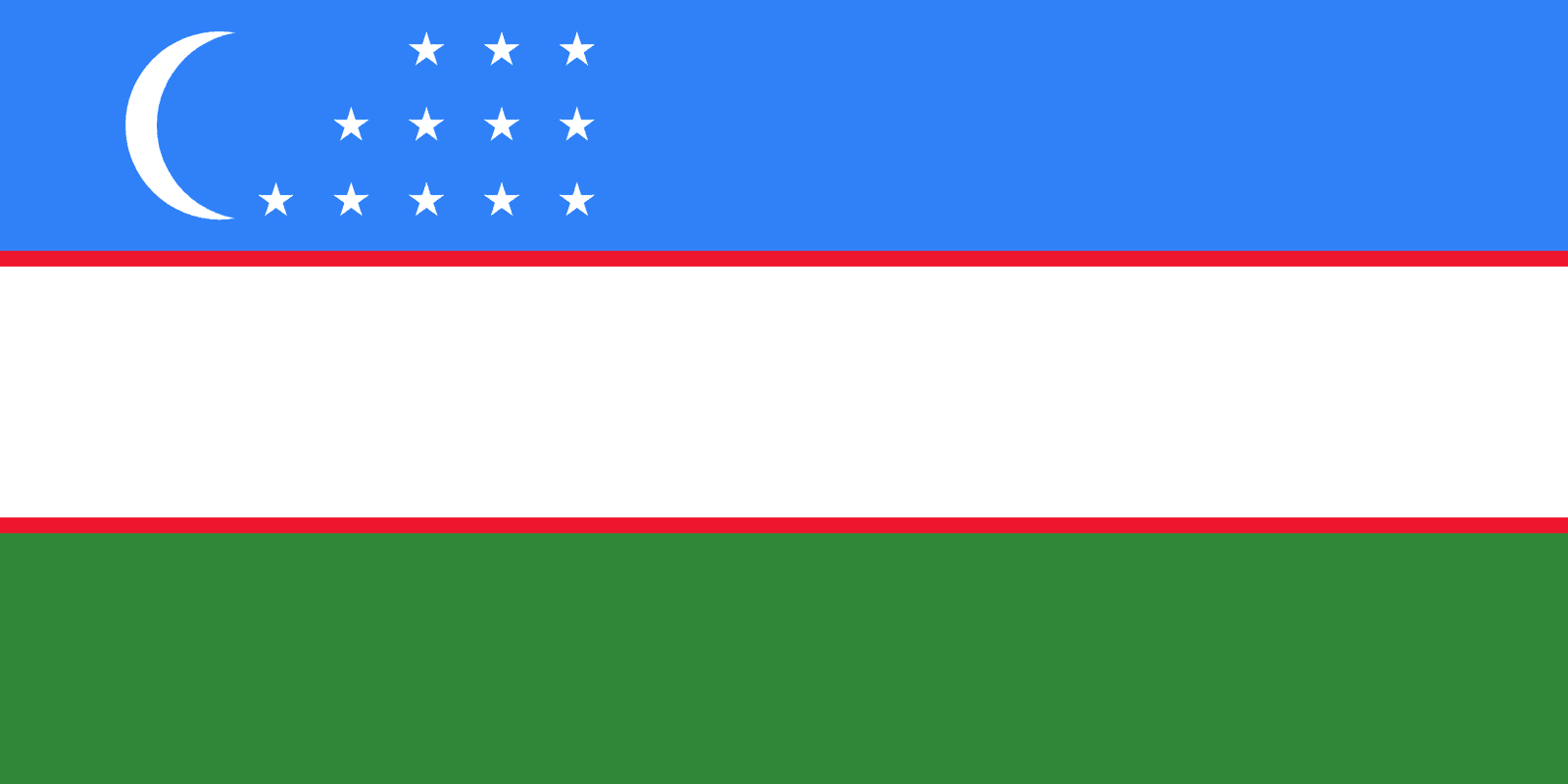
Flag of Uzbekistan
| Legal Name | Republic of Uzbekistan |
|---|---|
| Flag |
|
| Capital City |
Tashkent |
| Total Area | ~447,400 km² |
| Land Area | ~425,400 km² |
| Water Area | ~22,000 km² |
| Population | ~36.7 million |
| Major Cities | Tashkent (~3.0M), Samarkand (~0.6M), Namangan (~0.6M), Andijan (~0.5M), Bukhara (~0.3M) |
| Currency | Uzbek soʻm (UZS) |
| GDP | ~USD 90–95 billion |
| GDP Per Capita | ~USD 2,500 (nominal) |
About of Uzbekistan
Uzbekistan is a landlocked country located in Central Asia, occupying a pivotal position along the historic crossroads between East and West. It lies within the heart of the Eurasian landmass and is notable as one of only two double-landlocked countries in the world, meaning it is surrounded entirely by other landlocked states.
The country shares borders with Kazakhstan to the north and northwest, Kyrgyzstan and Tajikistan to the east and southeast, Afghanistan to the south, and Turkmenistan to the southwest. Tashkent, the capital and largest city, is the political, economic, and cultural center of the nation, while historic cities such as Samarkand, Bukhara, and Khiva serve as enduring symbols of Uzbekistan’s civilizational heritage.
Uzbekistan has a large and youthful population, making it the most populous country in Central Asia. The demographic profile is predominantly ethnic Uzbek, with a mix of minority communities that reflect centuries of migration and imperial rule.
Internationally recognized as a sovereign state since 1991, Uzbekistan has emerged as a key regional actor. Its strategic importance stems from its central location, sizeable population, energy and mineral resources, and its role in regional security, connectivity, and economic integration across Central and South Asia.
Etymology
The name “Uzbekistan” is derived from “Uzbek,” referring to the Uzbek people, and the Persian suffix -stan, meaning “land” or “place of.” The term “Uzbek” is commonly linked to Öz Beg Khan, a 14th-century ruler of the Golden Horde, whose name became associated with Turkic tribes in the region.
Over time, “Uzbek” evolved from a tribal and political designation into an ethnic identity. The name “Uzbekistan” was formally adopted in the 20th century, signifying the homeland of the Uzbek people within a defined territorial state.
History
Human habitation in present-day Uzbekistan dates back to prehistoric times, with early agricultural communities flourishing along river valleys such as the Amu Darya and Syr Darya. Ancient civilizations including Sogdiana, Bactria, and Khwarezm played key roles in regional trade and culture.
During the classical and early medieval periods, the region became a major center of the Silk Road, linking China with the Mediterranean world. It experienced successive rule by Persian empires, Alexander the Great, and later by Kushan and Hephthalite powers.
From the 7th century onward, the Islamic caliphates brought Islam and Arabic scholarship, profoundly shaping the region’s cultural and intellectual life. The medieval era saw the rise of powerful Turkic and Persianate states, culminating in the Timurid Empire under Timur (Tamerlane), with Samarkand as a magnificent capital.
In the 19th century, the territory came under Russian imperial control. Following the Russian Revolution, Uzbekistan became part of the Soviet Union in 1924 as the Uzbek Soviet Socialist Republic.
Uzbekistan declared independence on 31 August 1991 amid the dissolution of the Soviet Union. The post-independence period was marked by strong centralized governance, gradual economic reform, and nation-building. In recent years, political developments have included cautious liberalization, economic opening, and increased regional engagement.
Government and Politics
Uzbekistan is a presidential republic governed under a written constitution adopted in 1992 and subsequently amended. The political system centers on a strong executive branch led by the President, who serves as both head of state and government.
Legislative authority is vested in the Oliy Majlis, a bicameral parliament consisting of the Legislative Chamber and the Senate. The judiciary is formally independent and includes the Constitutional Court, Supreme Court, and lower courts.
Administratively, the country is divided into twelve regions, the autonomous Republic of Karakalpakstan, and the capital city of Tashkent, which has special status.
Uzbekistan conducts an increasingly active foreign policy and is a member of the United Nations, Commonwealth of Independent States, Shanghai Cooperation Organisation, and other international bodies. The armed forces are among the largest in Central Asia and focus on territorial defense, counterterrorism, and regional stability.
Economy
Uzbekistan is classified as a lower-middle-income, emerging economy undergoing transition from state-dominated structures toward market-oriented systems. Economic reforms in recent years have aimed at liberalizing currency, trade, and investment.
Major sectors include agriculture, manufacturing, mining, energy, and services. Agriculture remains significant, particularly cotton, wheat, fruits, and vegetables. Manufacturing has expanded into textiles, automobiles, chemicals, and construction materials.
The country is rich in natural resources, including gold, natural gas, uranium, copper, and coal. It is among the world’s leading gold producers.
Key trade partners include China, Russia, Kazakhstan, Turkey, and the European Union. Exports consist primarily of gold, energy products, textiles, and agricultural goods.
Challenges include job creation, infrastructure modernization, and environmental sustainability. The long-term outlook emphasizes industrial diversification, regional connectivity, and human capital development.
Demographics
Uzbekistan’s population is predominantly ethnic Uzbek, with minorities including Tajiks, Kazakhs, Russians, Karakalpaks, Tatars, and others. The population is young and growing steadily.
Uzbek is the official language and belongs to the Turkic language family. Russian remains widely used in urban areas and business, while Tajik is spoken in certain regions. Islam, primarily Sunni, is the majority religion, alongside small Christian and other religious communities.
Urbanization is moderate, with a substantial rural population engaged in agriculture and local trades.
Culture and Society
Uzbek culture reflects a blend of Turkic, Persian, and Islamic traditions shaped by centuries of Silk Road exchange. Hospitality, family cohesion, and respect for elders are central social values.
Cultural expression includes music, dance, miniature painting, ceramics, and architecture. Uzbek cuisine is renowned for dishes such as plov, samsa, and lagman. Traditional clothing and crafts remain important markers of identity.
National holidays include Nowruz, Independence Day, and religious festivals. Football, wrestling, and traditional sports are widely practiced.
Education and Healthcare
Uzbekistan has a structured education system encompassing primary, secondary, and tertiary levels. Literacy rates are high, reflecting Soviet-era emphasis on education, and universities are expanding in number and scope.
Healthcare is provided through a state system complemented by private services. Major public health priorities include maternal health, infectious disease control, and addressing non-communicable diseases.
Geography and Climate
The country’s geography is dominated by vast plains, deserts such as the Kyzylkum, fertile river valleys, and mountain ranges in the east. There are no coastlines, but major rivers support agriculture and settlement.
Uzbekistan has a continental climate with hot summers and cold winters. Natural hazards include earthquakes, droughts, and environmental degradation linked to water mismanagement, most notably the Aral Sea crisis.
Flora and Fauna
Biodiversity varies from desert and steppe ecosystems to alpine zones. Native plants include saxaul, juniper, and various grasses adapted to arid conditions.
Wildlife includes gazelles, wolves, foxes, and diverse bird species. Conservation efforts focus on protected areas and biodiversity restoration in vulnerable regions.
Map of Uzbekistan
The national flag symbolizes independence and unity. The coat of arms features the mythical Huma bird, representing happiness and freedom. The national anthem reflects patriotism and cultural pride. Symbolic monuments include historic madrasas and mosques of Samarkand and Bukhara.
National Flag (Detailed Section)
The flag of Uzbekistan consists of three horizontal stripes—blue, white, and green—separated by thin red lines. In the upper hoist corner are a white crescent and twelve white stars.
Adopted in 1991, the blue symbolizes sky and water, white represents peace and purity, green signifies nature and renewal, and red denotes vitality. The crescent reflects cultural heritage, while the stars symbolize the nation’s historical and spiritual values.
The flag is displayed on public buildings, during national holidays, and at official ceremonies in accordance with national regulations.
Flag flying days
| Date | Flag Position | Occasion or Reason |
|---|
| 31 August | Full-mast | Independence Day |
| 8 December | Full-mast | Constitution Day |
| 21 March | Full-mast | Nowruz (Persian New Year) |
| As decreed | Half-mast | National mourning or remembrance periods |