
Flag of Yemen
| Legal Name | Republic of Yemen |
|---|---|
| Flag |
|
| Capital City |
Sana’a |
| Total Area | 527,968 km² |
| Land Area | ~527,970 km² |
| Water Area | Negligible |
| Population | ~34 million |
| Major Cities | Sana’a (~3.9 million metro), Aden (~1.0 million), Taiz (~600,000), Al Hudaydah (~500,000), Mukalla (~300,000) |
| Currency | Yemeni Rial (YER) |
| GDP | ~USD 21–23 billion (heavily affected by conflict) |
| GDP Per Capita | ~USD 600–700 (nominal) |
About of Yemen
Yemen is located at the southern end of the Arabian Peninsula in Western Asia, occupying a strategically significant position between the Red Sea and the Arabian Sea. It controls access to the Bab el-Mandeb Strait, a critical maritime chokepoint linking the Indian Ocean to the Mediterranean Sea via the Suez Canal. This location has historically made Yemen a crossroads of trade, culture, and geopolitics.
The country shares land borders with Saudi Arabia to the north and Oman to the east, while its extensive coastline stretches along the Red Sea, the Gulf of Aden, and the Arabian Sea. Yemen also includes numerous islands, most notably the Socotra archipelago, renowned for its unique biodiversity. Sana’a is the constitutional capital and largest city, while Aden has historically served as a major port and former capital of South Yemen.
Yemen’s population is young and predominantly rural, though urbanization has increased over recent decades. The country is internationally recognized as a sovereign state and a member of the United Nations, despite ongoing internal conflict that has fragmented political authority and governance.
Geopolitically, Yemen holds considerable strategic importance due to its location near vital shipping lanes and its role in regional security dynamics in the Middle East and the Horn of Africa. Its stability has direct implications for global trade, energy security, and regional power balances.
Etymology
The name “Yemen” is believed to derive from the Arabic word al-yaman, commonly associated with the concept of “the south,” reflecting Yemen’s position south of the Arabian heartland. Another interpretation links the name to yumn, meaning “prosperity” or “blessing,” possibly referencing the region’s historical fertility and wealth compared to the arid northern Arabian Peninsula.
In classical and medieval sources, Yemen was often referred to as Arabia Felix (Happy or Fortunate Arabia) due to its relative agricultural productivity and thriving trade networks. Over time, the name Yemen became firmly established as the designation for the southwestern portion of the Arabian Peninsula.
History
Human settlement in Yemen dates back to prehistoric times, with early communities benefiting from seasonal rains and fertile highlands. By the first millennium BCE, Yemen was home to advanced South Arabian civilizations, including the Sabaean, Minaean, Qatabanian, and Hadramite kingdoms. These societies developed sophisticated irrigation systems and controlled lucrative incense and spice trade routes.
During classical antiquity, Yemen engaged in trade with the Roman Empire, East Africa, and South Asia. In the late antiquity period, the region experienced religious transformations, including the spread of Judaism and Christianity before the introduction of Islam in the 7th century. Yemen became one of the earliest regions to embrace Islam and played a role in the early Islamic caliphates.
Throughout the medieval period, Yemen was ruled by various dynasties, including the Zaydi Imamate in the north and several Sunni dynasties in the south. The Ottoman Empire exerted influence over parts of Yemen at different times, while the British established control over Aden in the 19th century, making it a key colonial port.
In the 20th century, Yemen was divided into North Yemen and South Yemen, each following distinct political paths. North Yemen became a republic in 1962, while South Yemen gained independence from Britain in 1967 and adopted a socialist system. The two states unified in 1990 to form the Republic of Yemen. Subsequent decades were marked by political tensions, civil conflict, and instability, culminating in a major civil war beginning in 2014 that continues to shape Yemen’s modern political landscape.
Government and Politics
Yemen is constitutionally defined as a republic, though its political system has been severely disrupted by ongoing conflict. The constitution provides for a president, an elected legislature, and an independent judiciary, but in practice, authority is divided among competing factions and administrations.
Executive power is nominally held by a president and government, while legislative authority resides in a bicameral parliament. Judicial institutions are based on a combination of civil law, Islamic law, and customary practices. Administrative divisions consist of governorates, which are further subdivided into districts.
Yemen is a member of the United Nations, the Arab League, the Organization of Islamic Cooperation, and other international bodies. Its defense forces have fragmented due to the conflict, with multiple armed groups exercising control over different regions, complicating national security and governance.
Economy
Yemen is classified as a developing country and is among the poorest nations in the Middle East. Its economy has been heavily damaged by prolonged conflict, political instability, and humanitarian crises. Before the conflict, oil and natural gas exports were central to government revenue, alongside agriculture and remittances.
Agriculture employs a significant portion of the population, producing crops such as sorghum, millet, coffee, fruits, and qat. Manufacturing is limited, while the services sector has been severely disrupted. Yemen possesses modest reserves of oil and gas, as well as mineral resources, though exploitation has declined sharply.
Major trade partners have historically included regional and Asian markets. Current economic challenges include currency instability, food insecurity, damaged infrastructure, and dependence on humanitarian aid. Long-term recovery depends on political resolution, reconstruction, and economic diversification.
Demographics
Yemen’s population is predominantly Arab, with small minorities of African and South Asian descent, particularly in coastal regions. Arabic is the official and dominant language, spoken in various regional dialects.
Islam is the state religion, with the population divided mainly between Sunni and Zaydi Shia communities. Yemen remains largely rural, though cities have expanded rapidly due to internal displacement. Population growth rates are high, resulting in a very young demographic profile.
Culture and Society
Yemeni culture is deeply rooted in tribal traditions, Islamic values, and a strong sense of hospitality. Social structures often emphasize family, community, and tribal affiliation. Traditional music, poetry, and oral storytelling play a significant role in cultural expression.
Yemeni cuisine features dishes such as saltah, mandi, and bint al-sahn, reflecting regional flavors and historical influences. Public festivals are closely tied to the Islamic calendar, while social customs emphasize respect, honor, and communal solidarity.
Education and cultural life have been severely affected by conflict, but Yemen’s cultural heritage remains a vital component of national identity.
Education and Healthcare
Yemen’s education system includes primary, secondary, and tertiary levels, though access has declined due to conflict. Literacy rates remain lower than regional averages, particularly among women. Universities exist in major cities, but many face resource shortages.
Healthcare infrastructure has been heavily strained, with limited access to services, shortages of medical staff, and outbreaks of preventable diseases. Despite challenges, international and local efforts continue to support public health and humanitarian relief.
Geography and Climate
Yemen’s geography is diverse, featuring coastal plains, rugged highlands, interior plateaus, and vast desert regions extending into the Rub’ al Khali. The country’s coastline spans thousands of kilometers along major waterways.
The climate varies from hot and humid along the coast to temperate in the highlands and arid in desert regions. Seasonal monsoon rains affect parts of the country. Natural hazards include droughts, floods, earthquakes, and cyclones, particularly along the southern coast.
Flora and Fauna
Yemen hosts varied ecosystems, especially in the highlands and on Socotra Island, which is recognized for its endemic plant species such as the dragon’s blood tree. Vegetation ranges from desert shrubs to terraced agricultural landscapes.
Wildlife includes gazelles, hyenas, birds of prey, and diverse marine life. Conservation efforts are limited due to conflict but remain important, particularly for protecting unique habitats and endangered species.
Map of Yemen
Yemen’s national flag represents Arab unity and republican ideals. The coat of arms features the Golden Eagle of Saladin with a scroll bearing the country’s name. The national anthem reflects themes of unity and resistance. Architectural landmarks, including the old city of Sana’a, symbolize Yemen’s historical legacy.
National Flag (Detailed Section)
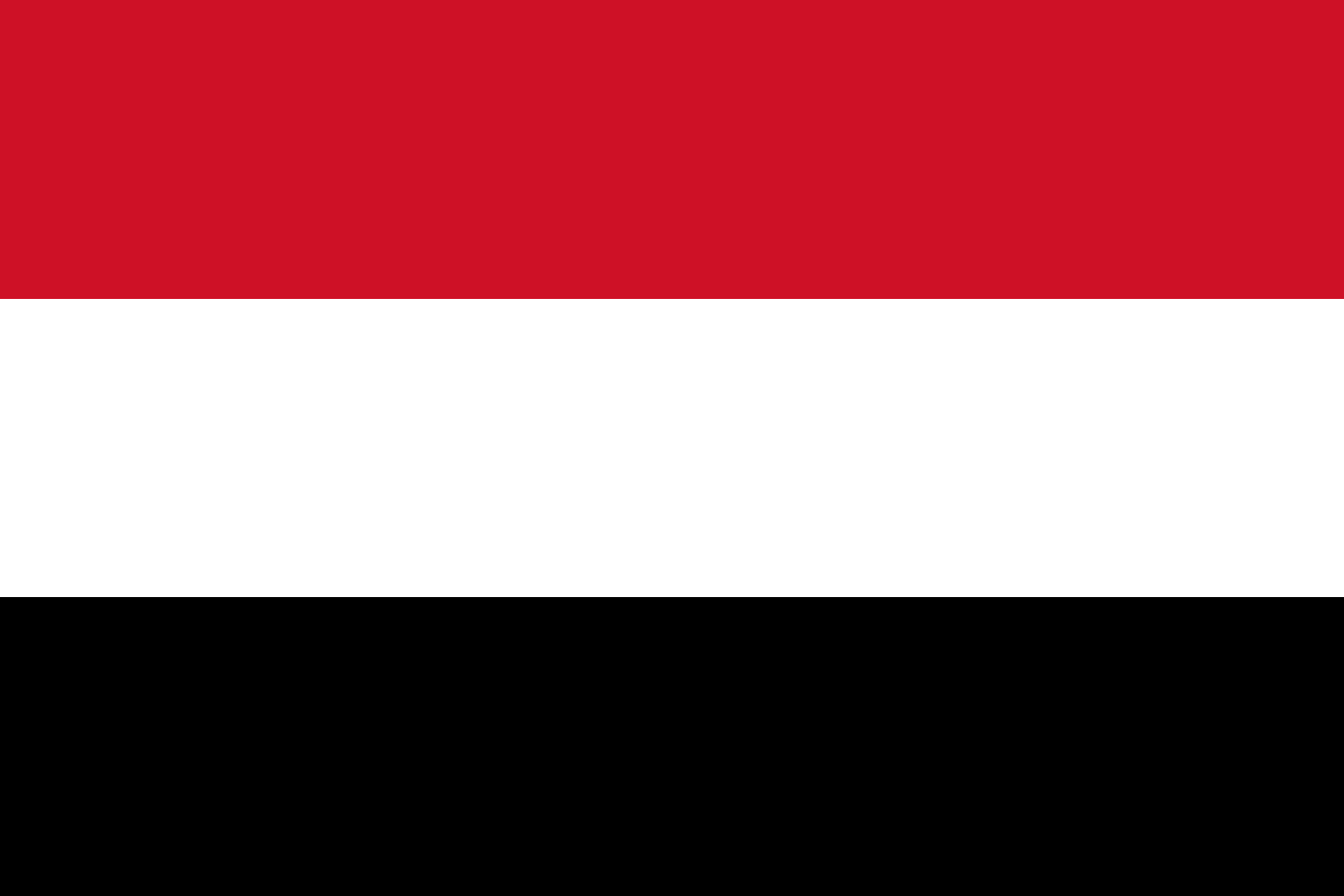
The national flag of Yemen consists of three horizontal stripes: red on top, white in the middle, and black at the bottom. It was officially adopted in 1990 following the unification of North and South Yemen.
The red stripe symbolizes the bloodshed and sacrifices made for freedom, white represents hope and a peaceful future, and black recalls the darker periods of oppression in Yemen’s history. The flag follows the Pan-Arab color tradition shared by many Arab states.
The flag is flown on government buildings, during national celebrations, and at official events in accordance with state protocol.

Flag flying days
| Date | Flag Position | Occasion or Reason |
|---|
| 22 May | Full-mast | National Unity Day |
| 26 September | Full-mast | Revolution Day (North Yemen) |
| 14 October | Full-mast | Revolution Day (South Yemen) |
| As declared | Half-mast | National mourning or remembrance periods |