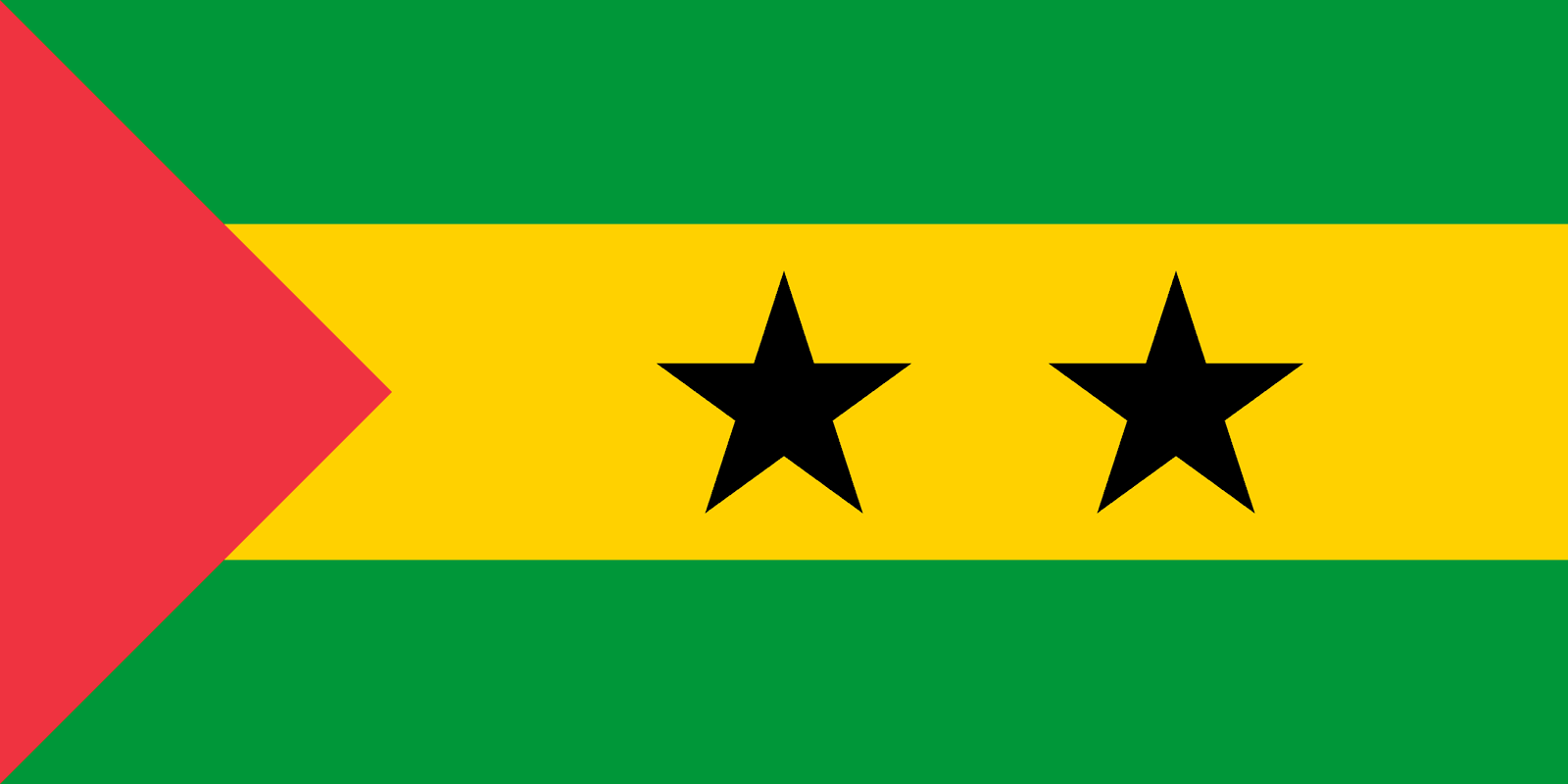
Flag of São Tomé and Príncipe
| Legal Name | Democratic Republic of São Tomé and Príncipe |
|---|---|
| Flag |
|
| Capital City |
São Tomé |
| Total Area | Approximately 964 km² |
| Land Area | Approximately 964 km² |
| Water Area | Negligible |
| Population | About 230,000 |
| Major Cities | São Tomé (70,000+), Santo António on Príncipe (3,000+) |
| Currency | São Tomé and Príncipe Dobra (STN) |
| GDP | Approximately USD 550 million |
| GDP Per Capita | USD 2,400–2,600 (nominal, approx.) |
About of São Tomé and Príncipe
São Tomé and Príncipe is a small island nation located in the Gulf of Guinea off the western equatorial coast of Central Africa. It consists of two main volcanic islands—São Tomé and Príncipe—and several smaller islets. The country lies roughly 250 kilometers west of Gabon and is part of the African island states of the Atlantic Ocean.
The capital, São Tomé, is situated on the northeastern coast of the island of São Tomé and serves as the political, economic, and cultural center of the country. Santo António is the principal town on the island of Príncipe and functions as its regional administrative hub.
With a relatively small population, São Tomé and Príncipe is one of Africa’s least populous countries. It is internationally recognized as a sovereign democratic republic and is known for its political stability compared to many states in the region. Strategically, its location in the Gulf of Guinea gives it importance in maritime routes, regional security, and offshore economic potential.
Etymology
The name “São Tomé and Príncipe” originates from Portuguese exploration during the 15th century. São Tomé was named after Saint Thomas the Apostle, as the island was reportedly discovered on Saint Thomas’s Day. Príncipe was initially named “Ilha do Príncipe” (Prince’s Island) in honor of the Prince of Portugal.
Over time, the combined name came to represent the two main islands as a single political entity. The Portuguese linguistic influence remains strong, shaping both the country’s name and cultural identity.
History
Prior to European contact, the islands of São Tomé and Príncipe were uninhabited. Portuguese explorers discovered them in the late 15th century, during the Age of Exploration, and began colonization shortly thereafter.
During the early colonial period, the islands became a key center for sugar production, relying heavily on enslaved African labor. As sugar production declined, São Tomé and Príncipe transitioned into major producers of coffee and cocoa, becoming one of the world’s leading cocoa exporters by the early 20th century.
Colonial rule under Portugal lasted for nearly five centuries. Nationalist movements gained momentum in the mid-20th century, leading to independence on July 12, 1975. Following independence, the country initially adopted a single-party socialist system before transitioning to multiparty democracy in the early 1990s.
Since then, São Tomé and Príncipe has experienced peaceful political transitions, democratic elections, and gradual institutional development, maintaining one of the most stable political environments in Central Africa.
Government and Politics
São Tomé and Príncipe operates as a semi-presidential democratic republic. The President serves as head of state, while the Prime Minister is head of government and leads the executive branch.
The constitution provides the legal foundation for governance, guaranteeing political pluralism, civil liberties, and the separation of powers. Legislative authority rests with the unicameral National Assembly, whose members are elected through popular vote.
The judiciary is independent and includes the Supreme Court as the highest legal authority. Administratively, the country is divided into districts, with the island of Príncipe enjoying autonomous regional status. Internationally, São Tomé and Príncipe is a member of the United Nations, African Union, Community of Portuguese Language Countries, and other regional and global organizations. Its defense forces are small and focused on national security and maritime surveillance.
Economy
São Tomé and Príncipe has a small, developing, island-based economy. It is heavily dependent on agriculture, external aid, and remittances, with limited industrial capacity.
Agriculture remains central, particularly cocoa production, which accounts for a significant share of exports. Other agricultural products include coffee, palm oil, coconuts, and bananas. The services sector, especially tourism and public administration, has grown steadily in recent years.
The country possesses offshore oil and gas potential, though large-scale commercial production has yet to materialize. Trade partners include European Union countries, Angola, China, and neighboring African states. Economic challenges include limited infrastructure, vulnerability to external shocks, and reliance on imports. Future prospects focus on sustainable tourism, fisheries, renewable energy, and responsible development of offshore resources.
Demographics
The population of São Tomé and Príncipe is primarily of mixed African descent, including Forros (descendants of freed slaves), Angolares, and other ethnic groups with roots across Central and West Africa.
Portuguese is the official language, while several Portuguese-based creole languages are widely spoken. Christianity is the dominant religion, particularly Roman Catholicism, alongside Protestant denominations. The population is increasingly urbanized, with most residents living on the island of São Tomé. Population growth remains moderate, influenced by migration and demographic trends.
Culture and Society
The culture of São Tomé and Príncipe reflects a blend of African traditions and Portuguese heritage. Music, dance, and oral storytelling play important roles in social life, with styles such as ússua and socopé being culturally significant.
National identity emphasizes peaceful coexistence, shared history, and island traditions. Cuisine is based on fish, tropical fruits, root crops, and spices, often prepared with palm oil. Social norms value community ties, hospitality, and respect for elders. Public holidays include Independence Day and religious celebrations. Football is the most popular sport, widely played and followed across the islands.
Education and Healthcare
Education in São Tomé and Príncipe follows a structured system of primary, secondary, and limited tertiary education. Literacy rates have improved significantly over recent decades, supported by government and international programs.
Healthcare is primarily publicly funded, with hospitals and clinics providing basic services. While improvements have been made in maternal health and infectious disease control, challenges remain in specialist care, infrastructure, and workforce capacity.
Geography and Climate
The islands are of volcanic origin, featuring rugged terrain, lush rainforests, and fertile soils. São Tomé is mountainous, with Pico de São Tomé being the highest point, while Príncipe is smaller and less densely populated.
The climate is equatorial, characterized by warm temperatures year-round, high humidity, and seasonal rainfall. Natural hazards include heavy rains, flooding, and occasional landslides. Environmental concerns focus on deforestation, coastal erosion, and climate change impacts.
Flora and Fauna
São Tomé and Príncipe is recognized for its exceptional biodiversity and high level of endemic species. Dense tropical forests host unique plant life, including orchids and hardwood trees.
Wildlife includes numerous endemic bird species, reptiles, and insects. Marine ecosystems are rich in fish and coral species. Conservation efforts are centered on protected areas such as the Ôbo National Park, which safeguards large portions of the islands’ remaining primary forests.
Map of São Tomé and Príncipe
National symbols emphasize independence, unity, and natural heritage. The national flag, coat of arms, and anthem reflect the country’s African identity and historical struggle for self-determination. The islands’ natural landscapes and endemic wildlife are also regarded as symbols of national pride.
National Flag (Detailed Section)
The flag of São Tomé and Príncipe consists of three horizontal stripes—green at the top and bottom, yellow in the center—with a red triangle at the hoist and two black stars on the yellow stripe. Adopted at independence in 1975, the design reflects pan-African symbolism.
Green represents agriculture and natural abundance, yellow symbolizes cocoa and economic potential, red signifies the struggle for independence, and the black stars represent the two main islands. The flag is used in official settings and public ceremonies and is treated with respect in accordance with national protocol.
Flag flying days
| Date | Flag Position | Occasion or Reason |
|---|
| July 12 | Full-mast | Independence Day |
| September 6 | Full-mast | Armed Forces Day |
| National holidays and official events | Full-mast | State celebrations |
| Periods of national mourning | Half-mast | Officially declared mourning |