
Flag of Cabo Verde
| Legal Name | Republic of Cabo Verde |
|---|---|
| Flag |
|
| Capital City |
Praia |
| Total Area | 4,033 km² |
| Land Area | 4,030 km² |
| Water Area | ~3 km² |
| Population | ~600,000 |
| Major Cities | Praia (~160,000), Mindelo (~75,000), Santa Maria (~20,000), Assomada (~13,000) |
| Currency | Cape Verdean Escudo (CVE) |
| GDP | ~US$2.5 billion |
| GDP Per Capita | ~US$4,000 |
About of Cabo Verde
Cabo Verde is an island nation in the central Atlantic Ocean, located approximately 570 kilometers off the western coast of mainland Africa. It forms part of the Macaronesia region, which also includes the Azores, Madeira, and the Canary Islands. The country consists of ten volcanic islands and several smaller islets, divided into the windward (Barlavento) and leeward (Sotavento) island groups.
Unlike many African nations, Cabo Verde has no land borders. Its maritime neighbors include Senegal, Mauritania, and The Gambia across the Atlantic. The capital and largest city, Praia, lies on the island of Santiago and functions as the political, economic, and cultural center. Mindelo, on the island of São Vicente, is known for its vibrant port and music scene.
The population is relatively small but culturally diverse, shaped by centuries of African and European interaction. Cabo Verde enjoys international recognition as a stable democratic republic with strong governance indicators compared to many developing nations. Strategically, its mid-Atlantic position has historically made it important for maritime navigation, aviation routes, and transatlantic trade, and today it holds growing significance in regional security cooperation and oceanic economic zones.
3. Etymology
The name “Cabo Verde” is Portuguese for “Green Cape.” It originates from the nearby Cap-Vert Peninsula on the west coast of Africa, now part of Senegal. Portuguese explorers named the islands after this geographic reference in the 15th century. Although the islands themselves are relatively arid rather than green, the name persisted through colonial and modern periods. In 2013, the government formally requested international use of “Cabo Verde” instead of the English “Cape Verde,” reinforcing linguistic and cultural identity.
4. History
Prehistoric and Early Periods:
The islands were uninhabited before European arrival. There is no evidence of ancient or indigenous civilizations prior to the 15th century.
Portuguese Discovery and Settlement (15th–16th Centuries):
Portuguese navigators discovered the islands around 1456–1460. Soon after, the islands became a hub for the Atlantic slave trade, linking Africa, Europe, and the Americas. Settlements grew, particularly on Santiago.
Colonial Era:
For centuries, Cabo Verde served as a strategic maritime outpost of the Portuguese Empire. The islands experienced economic fluctuations, droughts, and emigration waves, shaping a resilient diaspora culture.
Independence Movement:
In the 20th century, nationalist movements emerged, closely linked with Guinea-Bissau through the African Party for the Independence of Guinea and Cabo Verde (PAIGC). Cabo Verde achieved independence in 1975.
Post-Independence Developments:
Initially governed under a one-party socialist system, Cabo Verde transitioned to multi-party democracy in 1991, marking a significant political transformation.
Modern Era:
The country is widely recognized for political stability, peaceful elections, and economic reforms. Tourism and services have expanded, and Cabo Verde maintains strong ties with both Africa and Europe.
5. Government and Politics
Cabo Verde operates as a unitary semi-presidential republic grounded in democratic principles.
Political Structure:
The President serves as head of state, while the Prime Minister is head of government. Power is balanced between executive leadership and parliamentary oversight.
Legal Framework:
The constitution guarantees civil liberties, multiparty elections, and an independent judiciary.
Branches of Government:
Executive: President and Council of Ministers
Legislative: Unicameral National Assembly
Judicial: Supreme Court and subordinate courts
Administrative Divisions:
The nation is divided into 22 municipalities across its islands.
Foreign Relations:
Cabo Verde is a member of the United Nations, African Union, ECOWAS, and the Community of Portuguese Language Countries (CPLP). It maintains strong diplomatic ties with the European Union and the United States.
Defense:
The country maintains small defense and coast guard forces, primarily focused on maritime security, anti-trafficking efforts, and disaster response.
6. Economy
Cabo Verde is classified as a developing, service-oriented economy with limited natural resources.
Major Industries:
Tourism, transportation services, financial services, fisheries, and light manufacturing dominate the economy.
Agriculture and Manufacturing:
Agriculture is constrained by arid climate and limited arable land, focusing on corn, beans, and livestock. Manufacturing remains small-scale, including food processing and beverages.
Natural Resources:
There are minimal mineral resources, making the country heavily dependent on imports and services rather than extraction industries.
Trade Partners and Exports:
Key partners include the European Union, Portugal, Spain, and the United States. Exports primarily consist of fish products, garments, and footwear.
Economic Challenges and Outlook:
Challenges include water scarcity, import dependence, and vulnerability to global tourism fluctuations. However, investment in renewable energy, digital services, and infrastructure presents long-term growth opportunities.
7. Demographics
Cabo Verde’s population is largely of mixed African and European descent, often referred to as Creole or Mestiço. Smaller communities of West African and European heritage also exist.
Languages:
Portuguese is the official language used in administration and education, while Cape Verdean Creole (Kriolu) is widely spoken in daily life with regional dialects.
Religion:
The majority of the population is Roman Catholic, with small Protestant and other Christian communities.
Urban vs Rural:
A significant portion of the population lives in urban areas, particularly Praia and Mindelo, reflecting migration from rural islands.
Population Trends:
Growth is moderate, with strong diaspora communities abroad contributing through remittances.
8. Culture and Society
Cabo Verdean culture blends African rhythms with Portuguese influences, producing a distinct Creole identity.
Arts and Music:
Music is central, with genres such as Morna, Coladeira, and Funaná gaining international recognition. Cesária Évora remains one of the country’s most celebrated artists.
Cuisine:
Traditional dishes include cachupa, a slow-cooked stew of corn, beans, meat, or fish. Seafood is prominent due to the island environment.
Social Norms:
Community bonds, hospitality, and respect for elders are deeply valued. The diaspora connection shapes family structures and economic support systems.
Festivals and Holidays:
Carnival, Independence Day (5 July), and local island festivals are widely celebrated.
Sports and Recreation:
Football is the most popular sport, along with athletics, water sports, and traditional dance.
9. Education and Healthcare
Education System:
Education is compulsory at the primary level, followed by secondary and vocational pathways. The University of Cabo Verde is the leading higher education institution.
Literacy and Higher Education:
Literacy rates exceed 85%, with steady improvement in tertiary enrollment.
Healthcare:
Public healthcare services are available nationwide, supported by regional hospitals and clinics. Preventive care and maternal health programs have expanded.
Public Health Challenges:
Challenges include limited specialized medical services and reliance on overseas treatment for complex cases, though vaccination and life expectancy indicators have improved significantly.
10. Geography and Climate
Physical Geography:
The islands are volcanic in origin, featuring rugged mountains, rocky coastlines, and limited fertile plains. Pico do Fogo, an active volcano, is the highest point.
Climate:
Cabo Verde experiences a tropical dry climate with minimal rainfall, influenced by Atlantic trade winds. Temperatures remain warm year-round.
Natural Hazards:
Droughts, occasional volcanic activity, and coastal erosion are primary risks.
Environmental Concerns:
Water scarcity, desertification, and sustainable energy management remain central environmental issues.
11. Flora and Fauna
Biodiversity:
Despite arid conditions, Cabo Verde hosts unique plant and animal species adapted to island ecosystems.
Native Plants:
Drought-resistant shrubs, acacia species, and endemic flowering plants dominate vegetation.
Wildlife:
Marine biodiversity is significant, including turtles, dolphins, and migratory birds. Terrestrial wildlife is limited but includes reptiles and small mammals.
Conservation Efforts:
Protected areas and marine reserves aim to preserve fragile ecosystems and promote eco-tourism.
Map of Cabo Verde
National Flag:
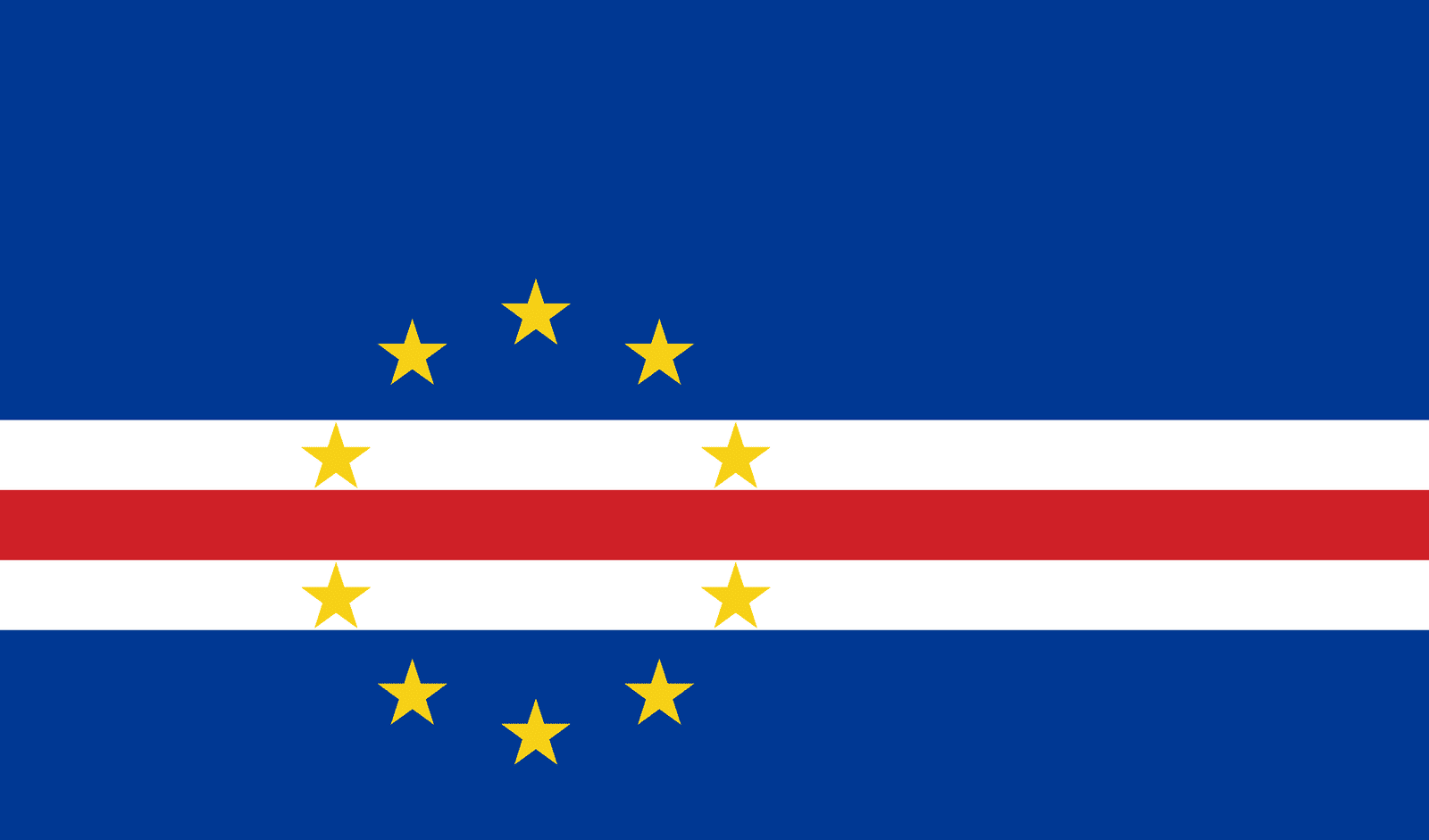
Blue background with ten yellow stars and white-red-white stripes representing unity and the Atlantic setting.
Coat of Arms:
Features a triangle, torch, and maritime symbols reflecting democracy, enlightenment, and seafaring heritage.
National Anthem:
“Cântico da Liberdade” (Song of Freedom).
National Symbols and Monuments:
Pico do Fogo volcano and traditional musical heritage are widely regarded as national icons.
National Flag (Detailed Section)
The flag of Cabo Verde consists of a deep blue field symbolizing the Atlantic Ocean and the sky. A horizontal sequence of white-red-white stripes runs across the lower half, representing peace and the nation’s effort and determination. A circle of ten yellow five-pointed stars stands for the ten main islands and national unity.
Historical Development:
Adopted in 1992, the current flag replaced earlier post-independence designs to emphasize democratic values and maritime identity rather than pan-African symbolism.
Symbolism:
Blue reflects the oceanic environment, white peace, red perseverance, and yellow prosperity and unity.
Protocol and Usage:
The flag is displayed on government buildings, schools, embassies, and during official ceremonies and national holidays. Half-mast positioning is used during periods of mourning.
Flag flying days
| Date | Flag Position | Occasion |
|---|---|---|
| 5 July | Full-mast | Independence Day |
| 13 January | Full-mast | Democracy Day |
| 12 September | Full-mast | National Day |
| State Mourning Periods | Half-mast | National tragedies or death of prominent leaders |
| Official Public Holidays | Full-mast | Government-designated celebrations |