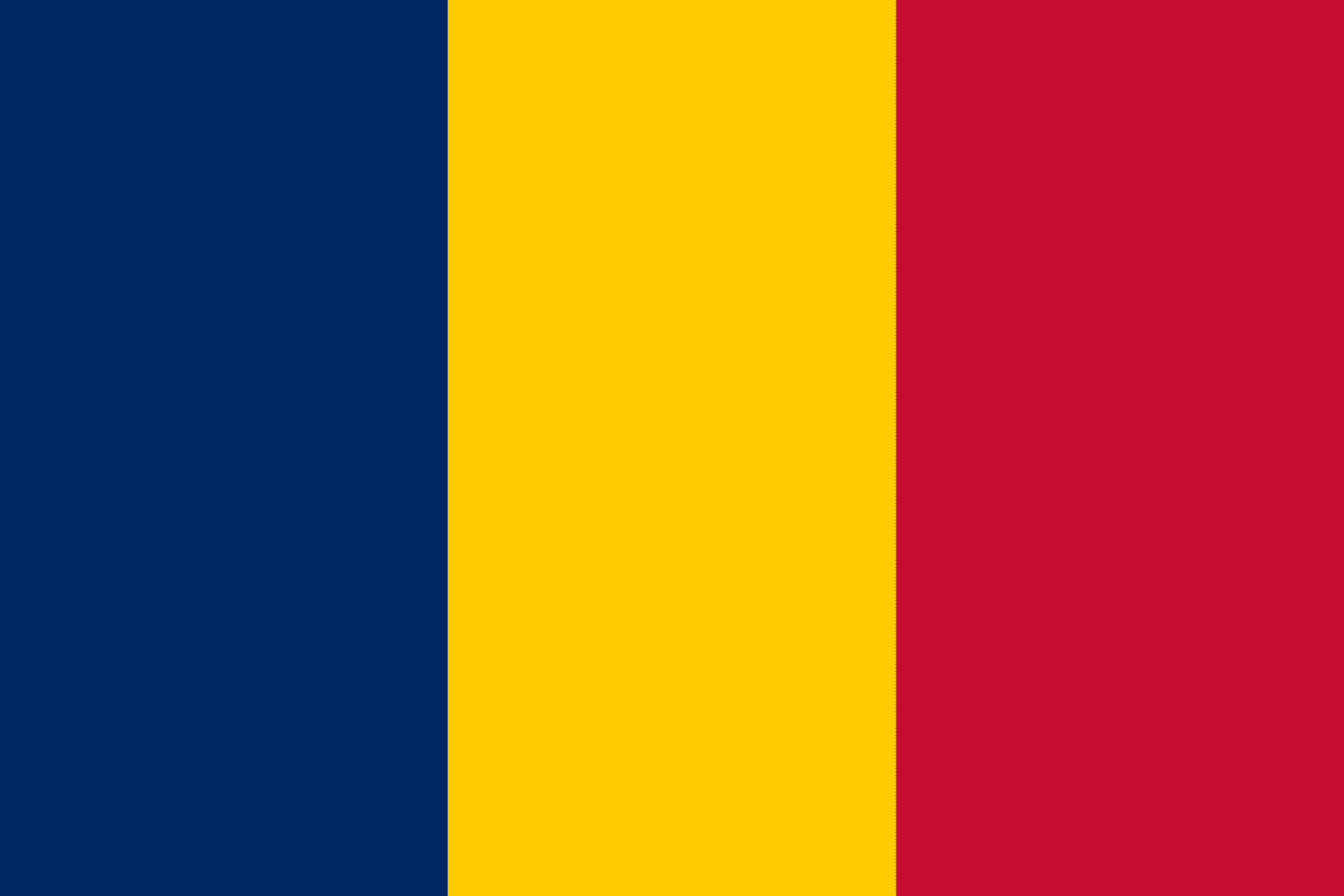
Flag of Chad
| Legal Name | Republic of Chad |
|---|---|
| Flag |
|
| Capital City |
N’Djamena |
| Total Area | ~1,284,000 km² |
| Land Area | ~1,259,200 km² |
| Water Area | ~24,800 km² |
| Population | ~18 million |
| Major Cities | N’Djamena (1.6M), Moundou (300K), Sarh (200K), Abéché (150K), Kélo (120K) |
| Currency | Central African CFA Franc (XAF) |
| GDP | ~US$14–16 billion |
| GDP Per Capita | ~US$800–900 |
About of Chad
Chad is a large, landlocked country situated in north-central Africa, serving as a geographic bridge between North Africa and Sub-Saharan Africa. Its territory stretches from the Sahara Desert in the north to fertile savannas and wetlands in the south, creating striking environmental and cultural contrasts within a single nation. Because of this transitional position, Chad is often described as a crossroads of Arab and African influences.
The country shares borders with Libya to the north, Sudan to the east, the Central African Republic to the south, and Cameroon, Nigeria, and Niger to the west. Although it has no coastline, Lake Chad in the west is one of Africa’s most historically significant inland water bodies, though it has shrunk considerably over recent decades. Major rivers such as the Chari and Logone are essential for agriculture and settlement.
N’Djamena, located near the western border along the Chari River, is both the political capital and the largest urban center. Other cities such as Moundou and Sarh function as regional economic hubs. Chad’s population is diverse and youthful, with most people living in rural areas dependent on agriculture and pastoralism.
Internationally, Chad is recognized as a sovereign state and participates in organizations including the United Nations, African Union, Organisation of Islamic Cooperation, and the Economic Community of Central African States. Geopolitically, Chad holds strategic importance due to its location in the Sahel region, its oil reserves, and its role in regional security and counter-terrorism efforts.
Etymology
The name “Chad” is derived from Lake Chad, which lies on the country’s western border. The word is believed to originate from the Kanuri language, meaning “lake” or “large expanse of water.” European explorers adopted the name during the 19th century, and it later became the official designation during colonial administration and independence.
Historically, the lake served as a vital resource and trading center for surrounding kingdoms and communities, making it a natural symbol for the nation’s identity and geographic heritage.
History
Human habitation in the region dates back thousands of years, with archaeological discoveries indicating early agricultural societies and pastoral communities. Ancient rock art in northern Chad demonstrates long-standing cultural development and adaptation to changing climates.
During the classical and medieval periods, powerful states such as the Kanem-Bornu Empire, Bagirmi Kingdom, and Wadai Sultanate dominated regional trade routes across the Sahara. These empires facilitated commerce in gold, salt, and slaves while promoting Islamic scholarship and governance.
In the late 19th and early 20th centuries, the area fell under French colonial rule and became part of French Equatorial Africa. Colonial administration introduced new political structures, infrastructure, and economic policies focused on resource extraction.
Chad gained independence in 1960, but the post-independence era was marked by civil conflicts, regional divisions, and changes in leadership. The late 20th century saw military governments, rebellions, and peace agreements shaping national politics. In the 21st century, political developments have included constitutional reforms, transitional governments, and ongoing efforts toward national stability and security cooperation in the Sahel.
Government and Politics
Chad is officially a republic with a presidential political system, although governance has evolved through periods of military and transitional leadership. The legal system draws from civil law traditions influenced by French jurisprudence alongside customary laws.
The executive branch is headed by a president and council of ministers. The legislative authority has historically been exercised by a national assembly, while the judiciary includes constitutional and supreme courts tasked with interpreting laws and safeguarding constitutional order.
Administratively, Chad is divided into provinces, departments, and communes, allowing for regional governance. In foreign relations, the country maintains diplomatic ties across Africa, Europe, and the Middle East and is active in multilateral organizations.
The defense sector plays a prominent role in national policy. Chad’s armed forces are considered among the more experienced in the region, often participating in multinational security and peacekeeping missions.
Economy
Chad is classified as a developing, low-income economy heavily dependent on oil production and agriculture. While oil exports generate significant revenue, economic diversification remains limited, making the country vulnerable to fluctuations in global commodity prices.
Agriculture and livestock employ a large portion of the population, with crops such as millet, sorghum, cotton, and peanuts widely cultivated. Pastoralism is particularly important in northern and central regions. The oil sector, centered in the south, represents the main source of foreign exchange.
Natural resources include oil, gold, uranium, limestone, and salt. Trade partners are primarily regional neighbors and European and Asian markets. Key exports consist of crude oil, livestock, and cotton, while imports include machinery, refined fuels, and consumer goods.
Economic challenges include infrastructure deficits, climate variability, limited industrialization, and social inequality. Long-term growth prospects are tied to improved governance, education, and diversification beyond hydrocarbons.
Demographics
Chad’s population is ethnically diverse, comprising over 200 ethnic groups including the Sara, Arab, Kanembu, Toubou, and Zaghawa communities. This diversity contributes to rich cultural traditions but also reflects regional linguistic and social distinctions.
The official languages are French and Arabic, while numerous indigenous languages such as Sara and Kanuri are widely spoken. Religious composition includes Islam, Christianity, and traditional African belief systems, often varying by region.
A majority of the population resides in rural areas, though urbanization is gradually increasing. Population growth rates are relatively high, resulting in a youthful demographic structure that shapes labor markets and social services.
Culture and Society
Chadian culture blends Arab, Saharan, and Sub-Saharan African influences. Traditional music, drumming, and dance play central roles in ceremonies and communal life. Handicrafts such as leatherwork, weaving, and metal artistry reflect regional heritage.
Cuisine commonly features grains like millet and sorghum, accompanied by sauces, meats, and vegetables. Social customs emphasize hospitality, extended family networks, and respect for elders.
Football is the most popular sport, while wrestling and traditional games also hold cultural significance. National and religious festivals provide opportunities for communal celebration and cultural expression.
Education and Healthcare
The education system includes primary, secondary, and tertiary levels, with efforts underway to expand literacy and school enrollment. Universities and technical institutes are mainly located in larger cities, especially N’Djamena and Moundou.
Healthcare services are delivered through public hospitals, clinics, and international aid programs. Public health challenges include access disparities, infectious diseases, and limited medical infrastructure, while progress has been made through vaccination initiatives and maternal health programs.
Geography and Climate
Chad’s geography is highly varied, ranging from the Sahara Desert in the north to savannas and wetlands in the south. The Tibesti Mountains in the northwest contain the country’s highest peaks, while Lake Chad and southern river basins support agriculture and fishing.
The climate shifts from desert conditions in the north to tropical climates in the south, with distinct wet and dry seasons. Natural hazards include droughts, desertification, and occasional flooding. Environmental concerns center on water scarcity and land degradation.
Flora and Fauna
Biodiversity varies by region, with desert flora in the north and savanna and forest vegetation in the south. Wildlife includes antelopes, lions, elephants, giraffes, and numerous bird species, although many populations face pressure from habitat loss and poaching.
National parks and protected areas, such as Zakouma National Park, are central to conservation efforts aimed at preserving ecosystems and endangered species.
Map of Chad
National Symbols
Chad’s national symbols include its flag, coat of arms, and national anthem, all representing unity, independence, and cultural diversity. Emblems often feature shields, animals, and mottos symbolizing strength and sovereignty.
National Flag (Detailed Section)
The flag of Chad consists of three equal vertical stripes of blue, yellow, and red. Adopted in 1959, it closely resembles the Romanian flag but carries distinct symbolism rooted in African identity and national values.
Blue represents the sky, hope, and water resources; yellow symbolizes the sun and desert landscapes of the north; red signifies progress, sacrifice, and national unity. The flag is displayed on government buildings, schools, and official ceremonies and is a key element of national identity.
Flag flying days
| Date | Flag Position | Occasion or Reason |
|---|---|---|
| 11 August | Full-mast | Independence Day |
| 1 January | Full-mast | New Year’s Day |
| 28 November | Full-mast | Republic Day |
| Official Mourning Days | Half-mast | National remembrance or tragedy |