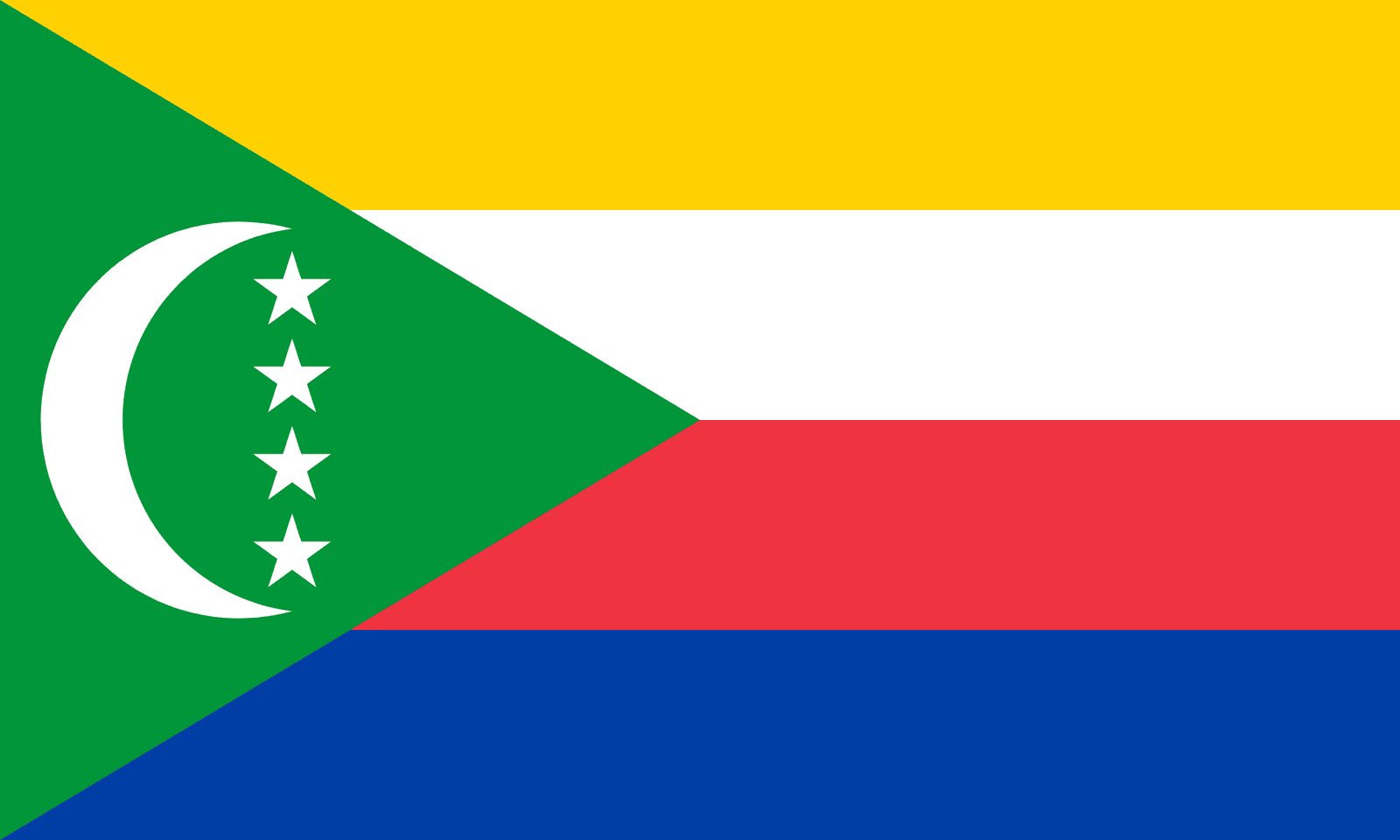
Flag of Comoros
| Legal Name | Union of the Comoros |
|---|---|
| Flag |
|
| Capital City |
Moroni |
| Total Area | ~2,235 km² |
| Land Area | ~2,235 km² |
| Water Area | Negligible |
| Population | ~900,000 |
| Major Cities | Moroni (110,000), Mutsamudu (35,000), Fomboni (20,000) |
| Currency | Comorian Franc (KMF) |
| GDP | ~US$1.3 billion |
| GDP Per Capita | ~US$3,800 (PPP-based) |
About of Comoros
Comoros is a small island nation located in the Indian Ocean, off the southeastern coast of Africa. It lies between Madagascar and Mozambique, at the northern entrance of the Mozambique Channel. The country consists of three main islands—Grande Comore (Ngazidja), Anjouan (Nzwani), and Mohéli (Mwali)—while a fourth island, Mayotte, is claimed by Comoros but administered by France.
The capital and largest city, Moroni, is situated on Grande Comore and serves as the political, economic, and cultural center of the country. Other important urban areas include Mutsamudu on Anjouan and Fomboni on Mohéli.
Comoros has a young and rapidly growing population shaped by African, Arab, and Malagasy influences. It is a fully recognized sovereign state and a member of the United Nations, African Union, and Arab League.
Strategically, Comoros occupies an important maritime location along regional trade routes in the Indian Ocean. Although its geopolitical influence is limited by size and resources, its location gives it regional relevance in East African and Indian Ocean affairs.
Etymology
The name “Comoros” is derived from the Arabic word “al-Qamar,” meaning “the moon.” Early Arab sailors referred to the islands as Juzur al-Qamar (Islands of the Moon), possibly inspired by their crescent-shaped coastlines or navigational associations with the moon.
Over time, European adaptations transformed the name into “Comoros.” The lunar symbolism remains deeply embedded in the country’s national identity and is reflected prominently in the national flag.
History
The islands of Comoros were settled as early as the first millennium CE by Bantu-speaking peoples from mainland Africa, followed by settlers from Madagascar and Arab traders. These early communities established maritime trade links across the Indian Ocean.
During the medieval period, Comoros became part of a broader Swahili-Islamic trading network, influenced by Arab and Persian merchants. Islamic sultanates emerged on the islands, shaping culture, governance, and religion.
In the 19th century, France gradually established control over the islands, eventually making them a French colony. In 1975, Comoros declared independence from France. However, Mayotte chose to remain under French administration, a dispute that continues today.
Post-independence history has been marked by political instability, including numerous coups. Constitutional reforms in the early 2000s introduced a rotating presidency among the islands, improving political balance. Recent decades have seen greater stability, though governance challenges persist.
Government and Politics
Comoros operates as a federal presidential republic under a constitution that emphasizes power-sharing among the islands. The President serves as both head of state and government.
The legislative branch consists of a unicameral Assembly of the Union, while the judiciary is independent, with a Supreme Court overseeing constitutional matters.
Administratively, the country is divided into three autonomous islands, each with its own local government. Comoros maintains diplomatic relations across Africa, the Middle East, and Europe, and is an active member of regional and international organizations.
The country has a small defense force primarily focused on internal security and maritime surveillance, with limited external military capability.
Economy
Comoros is classified as a low-income, developing economy with limited industrialization. Economic activity is heavily dependent on agriculture, remittances, and small-scale trade.
Agriculture employs a large portion of the population, with key products including vanilla, cloves, and ylang-ylang, which are among the country’s main exports. Manufacturing is minimal, and services are largely informal.
Natural resources are limited, and the economy relies on imports for many essential goods. France and regional partners are among the primary trade connections.
Economic challenges include unemployment, infrastructure deficits, population pressure, and vulnerability to external shocks. Future growth prospects depend on political stability, diaspora investment, and improved governance.
Demographics
Comoros has a predominantly African and Arab-descended population, with strong cultural ties to East Africa and the Arab world. The official languages are Comorian (Shikomori), Arabic, and French.
The population is overwhelmingly Muslim, with Islam playing a central role in daily life and social norms. Most people live in rural or coastal communities, though urbanization is gradually increasing.
High fertility rates contribute to rapid population growth, creating challenges for employment, education, and public services.
Culture and Society
Comorian culture is a blend of African, Arab, and Malagasy traditions, strongly influenced by Islam. Family and community ties are central to social life.
Music, oral storytelling, and ceremonial dances play important cultural roles. Traditional cuisine features rice, coconut, fish, and spices, reflecting Indian Ocean trade heritage.
Major religious festivals such as Eid al-Fitr and Eid al-Adha are widely celebrated. Football (soccer) is the most popular sport, followed by athletics and traditional games.
Education and Healthcare
Education in Comoros includes primary, secondary, and limited tertiary levels, with Arabic and French playing key roles in instruction. Literacy rates are improving but remain uneven.
Healthcare services are constrained by limited funding and infrastructure. Public health challenges include maternal health, infectious diseases, and access to clean water, though international partnerships have improved outcomes in recent years.
Geography and Climate
Comoros is entirely volcanic in origin, featuring rugged terrain, fertile soils, and dramatic coastlines. Mount Karthala, an active volcano on Grande Comore, is one of the largest in the region.
The climate is tropical maritime, with a hot, humid rainy season and a cooler, drier season. Natural hazards include volcanic eruptions, cyclones, and coastal erosion.
Environmental protection is increasingly important due to deforestation, overfishing, and climate-related risks.
Flora and Fauna
The islands host diverse ecosystems, including rainforests, mangroves, and coral reefs. Native plant species include aromatic trees used for essential oils.
Wildlife includes endemic birds, reptiles, and marine species. Conservation efforts focus on marine protection and preserving remaining forest habitats, though resources remain limited.
Map of Comoros
Comoros’ national symbols reflect its Islamic identity and island heritage. These include the national flag, coat of arms, and national anthem, as well as cultural symbols linked to the moon and the sea.
National Flag (Detailed Section)
The flag of Comoros consists of four horizontal stripes—yellow, white, red, and blue—representing the four islands claimed by the nation. A green triangle at the hoist contains a white crescent and four stars.
Adopted in its current form in the early 21st century, the flag reflects both Islamic identity and national unity. Green symbolizes Islam, while the crescent and stars represent faith and the islands.
The flag is flown on public buildings, during official ceremonies, and on national holidays according to established protocol.
Flag flying days
| Date | Flag Position | Occasion or Reason |
|---|---|---|
| 6 July | Full-mast | Independence Day |
| Eid al-Fitr | Full-mast | End of Ramadan |
| Eid al-Adha | Full-mast | Festival of Sacrifice |
| National Mourning Days | Half-mast | Official periods of mourning |
| Constitution Day | Full-mast | Commemoration of constitutional governance |