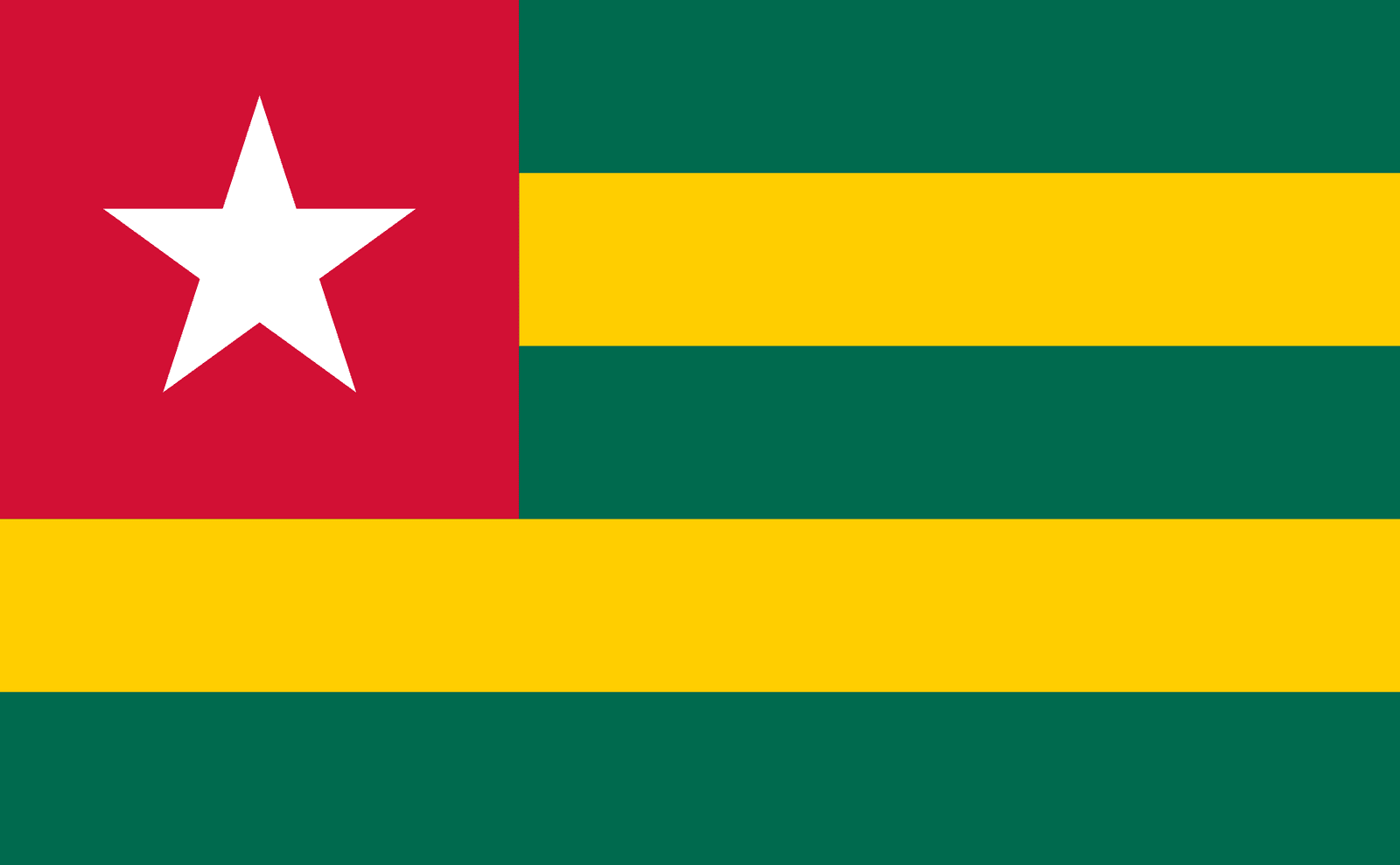
Flag of Togo
| Legal Name | Togolese Republic |
|---|---|
| Flag |
|
| Capital City |
Lomé |
| Total Area | 56,785 km² |
| Land Area | 54,385 km² |
| Water Area | 2,400 km² |
| Population | Approximately 8.9 million |
| Major Cities | Lomé (1.8 million metro), Sokodé (150,000), Kara (120,000), Kpalimé (100,000), Atakpamé (90,000) |
| Currency | West African CFA franc (XOF) |
| GDP | USD 8.5 billion |
| GDP Per Capita | USD 960 (nominal) |
About of Togo
Togo is a narrow West African nation stretching from the Gulf of Guinea in the south to the savannas of the Sahel in the north. Despite its small size, the country displays remarkable geographic diversity, ranging from coastal lagoons and sandy beaches to rolling hills, plateaus, and semi-arid plains. Its strategic coastal location has historically connected it to regional and global trade networks.
Togo is bordered by Ghana to the west, Benin to the east, and Burkina Faso to the north, with maritime access to the Atlantic Ocean along its southern coast. The capital city, Lomé, is the country’s largest urban center and serves as its political, economic, and cultural hub. Other important cities include Sokodé and Kara, which anchor the central and northern regions.
The population is ethnically and culturally diverse, with strong local identities shaped by language, tradition, and geography. Togo is internationally recognized as a sovereign state and plays an active role in West African regional affairs. Its port in Lomé is one of the most important deep-water ports in the region, giving the country strategic importance for landlocked neighboring states.
Etymology
The name “Togo” is derived from the Ewe word tɔ́gɔ, meaning “behind the river” or “beyond the river.” It originally referred to a settlement near Lake Togo and was later adopted by European colonial administrators to describe the surrounding territory. Over time, the name came to represent the entire country, symbolizing both its geographic identity and its Ewe cultural roots.
History
Prehistoric and Ancient Periods
Archaeological evidence indicates that the region now known as Togo has been inhabited for thousands of years. Early communities practiced agriculture, ironworking, and trade, forming small chiefdoms connected to broader West African networks.
Classical and Medieval Periods
Various ethnic groups, including the Ewe, Kabye, and Gur-speaking peoples, established societies based on kinship, agriculture, and local trade. The region interacted with powerful West African states through commerce rather than direct political control.
Colonial Rule
In the late 19th century, Togo became a German protectorate known as Togoland. After Germany’s defeat in World War I, the territory was divided between British and French administrations. The eastern portion, administered by France, later became the modern state of Togo.
Independence Movement
Togo gained independence from France on April 27, 1960. Sylvanus Olympio became the country’s first president, marking the beginning of self-rule.
Post-Independence and Modern Developments
Following a military coup in 1963 and another in 1967, Gnassingbé Eyadéma came to power and ruled for nearly four decades. After his death in 2005, his son, Faure Gnassingbé, assumed the presidency. In recent years, Togo has experienced gradual political reforms alongside ongoing debates about governance, democracy, and civil liberties.
Government and Politics
Togo operates as a presidential republic.
The President serves as both head of state and head of government, holding significant executive authority. The Legislative Branch consists of a unicameral National Assembly whose members are elected through a combination of proportional and constituency-based systems. The Judiciary is constitutionally independent, with the Constitutional Court acting as the highest authority on constitutional matters.
Administratively, Togo is divided into regions, prefectures, and communes. The country maintains diplomatic relations worldwide and is a member of the United Nations, African Union, Economic Community of West African States (ECOWAS), and West African Economic and Monetary Union (UEMOA). The armed forces are relatively small and focused on national defense and internal security.
Economy
Togo is classified as a developing economy.
Agriculture employs a large portion of the population and includes crops such as maize, cassava, yams, millet, and coffee. The country is one of the world’s leading producers of phosphate, which remains its most significant export. Manufacturing is limited but includes cement, food processing, and textiles.
The service sector, particularly transport and trade linked to the Port of Lomé, plays an increasingly important role. Togo’s main trading partners include other West African states, Europe, and Asia. Economic challenges include poverty, youth unemployment, infrastructure gaps, and dependence on commodity exports. Long-term prospects focus on logistics, agricultural modernization, and regional trade integration.
Demographics
Togo’s population is young and growing steadily.
The country is home to more than 40 ethnic groups, with the Ewe dominant in the south and Kabye prominent in the north. French is the official language, while Ewe, Kabye, and several other indigenous languages are widely spoken. Religious affiliation is diverse, including Christianity, Islam, and traditional African belief systems.
Urbanization is increasing, though a significant share of the population still lives in rural areas. Population growth places pressure on employment, education, and healthcare services.
Culture and Society
Togolese culture reflects a blend of ethnic traditions, colonial influences, and modern West African identity. Music, dance, drumming, and storytelling are central to cultural life, often performed during festivals and communal events. Traditional crafts such as weaving, pottery, and wood carving remain important.
National identity emphasizes unity across ethnic lines, reinforced by shared history and symbols. Football is the most popular sport, followed by athletics and traditional wrestling. Public holidays celebrate independence, cultural heritage, and religious diversity.
Education and Healthcare
The education system includes primary, secondary, and tertiary levels, with French as the language of instruction. Literacy rates are improving, though disparities persist between urban and rural areas and between genders. Higher education institutions are expanding, particularly in Lomé and Kara.
Healthcare services are a mix of public and private provision, with a focus on primary care. Progress has been made in vaccination coverage and maternal health, though challenges remain in access, funding, and rural healthcare delivery.
Geography and Climate
Togo’s geography transitions from a narrow coastal plain in the south to forested hills and plateaus in the center, and savanna grasslands in the north.
The climate is tropical, with two rainy seasons in the south and one in the north. Natural hazards include flooding and drought. Environmental concerns involve deforestation, coastal erosion, and soil degradation linked to population pressure and agricultural practices.
Flora and Fauna
Togo hosts varied ecosystems despite its small size.
Vegetation ranges from mangroves and coastal lagoons to tropical forests and savannas. Wildlife includes antelope, monkeys, reptiles, and numerous bird species. Conservation efforts focus on protected areas such as Fazao-Malfakassa National Park, which preserves biodiversity and supports eco-tourism.
Map of Togo
National Flag: Represents unity, hope, and independence.
Coat of Arms: Symbolizes strength, vigilance, and national pride.
National Anthem: Salut à toi, pays de nos aïeux.
National Symbols: Traditional drums and historic independence monuments.
National Flag (Detailed Section)
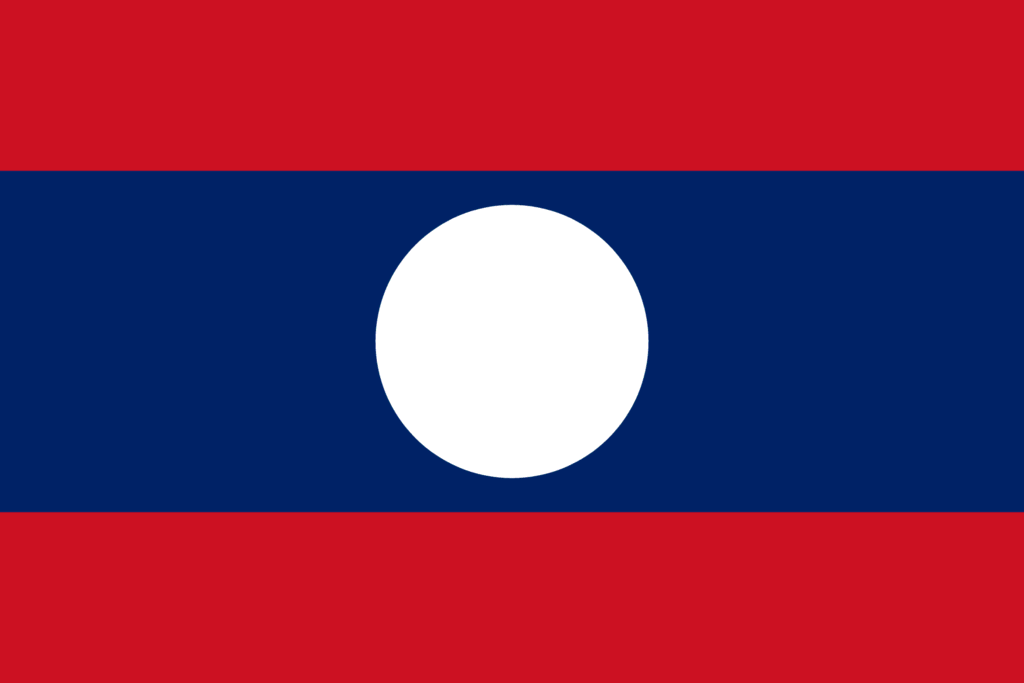
The flag of Togo features five horizontal stripes alternating green and yellow, symbolizing agriculture, hope, and national prosperity. A red square in the upper hoist contains a single white star, representing purity, peace, and guidance. Adopted at independence in 1960, the flag reflects Pan-African ideals and the country’s aspiration for unity and progress. It is flown at government institutions, schools, and during national celebrations in accordance with official protocol.
Flag flying days
| Date | Flag Position | Occasion or Reason |
|---|
| April 27 | Full-mast | Independence Day |
| January 13 | Full-mast | National Liberation Day |
| May 1 | Full-mast | Labour Day |
| As Declared | Half-mast | National mourning or remembrance |