Flag of Afghanistan
| Legal Name | Islamic Emirate of Afghanistann |
|---|---|
| Flag |
|
| Capital City |
Kabul |
| Total Area | ~652,230 km² |
| Land Area | ~652,000 km² |
| Water Area | ~230 km² |
| Population | ~41–42 million |
| Major Cities | Kabul (~5 million), Kandahar (~650,000), Herat (~600,000), Mazar-i-Sharif (~500,000), Jalalabad (~300,000) |
| Currency | Afghan Afghani (AFN) |
| GDP | ~US$70–80 billion (est.) |
| GDP Per Capita | US$350–500 (nominal est.) |
About Afghanistan
Afghanistan is a landlocked country in Asia, positioned at the intersection of Central Asia, South Asia, and the Middle East. It shares borders with Pakistan to the east and south, Iran to the west, Turkmenistan, Uzbekistan, and Tajikistan to the north, and a narrow northeastern border with China. Its terrain is dominated by rugged mountains and high plateaus, making transportation and infrastructure development historically challenging.
The capital and largest city, Kabul, functions as the administrative, economic, and cultural hub of the country. Other significant urban centers include Kandahar, Herat, and Mazar-i-Sharif, each serving as regional trade and cultural centers. Despite urban growth, a large portion of the population continues to reside in rural communities.
Afghanistan holds a complex position in international affairs. While the country is widely recognized as a sovereign state, its current governing authority has limited formal diplomatic recognition. Its geographic location has historically made it a strategic crossroads for trade routes, empires, and military campaigns, contributing to its enduring geopolitical significance in regional and global security matters.
2. Etymology
The name “Afghanistan” derives from the ethnonym “Afghan,” historically used to describe the Pashtun people, combined with the Persian suffix “-stan,” meaning “land of.” Thus, Afghanistan translates to “Land of the Afghans.” The term appeared in various historical records and gradually became the official name for the region in the 18th and 19th centuries as political boundaries consolidated and a unified state began to emerge.
3. History
Afghanistan’s history spans thousands of years and reflects its role as a meeting point of civilizations. Archaeological evidence indicates early human settlement dating back to prehistoric times, with ancient trade routes linking the region to Mesopotamia, India, and Central Asia.
During the classical era, the territory came under the influence of the Achaemenid Persian Empire, followed by conquest by Alexander the Great in the 4th century BCE. Subsequent centuries saw the rise of the Kushan Empire, which played a key role in the spread of Buddhism along the Silk Road.
In the medieval period, the region experienced waves of Islamic expansion and became part of several powerful dynasties, including the Ghaznavids, Ghurids, and later the Timurid Empire. In the 18th century, Ahmad Shah Durrani established what is often regarded as the foundation of the modern Afghan state.
During the 19th and early 20th centuries, Afghanistan served as a buffer state between the British and Russian Empires in the geopolitical rivalry known as the “Great Game.” It maintained formal independence after the Third Anglo-Afghan War in 1919. The 20th century brought political modernization efforts, constitutional reforms, and periods of monarchy, republic, and socialist governance.
The late 20th and early 21st centuries were marked by prolonged conflict, including the Soviet invasion (1979–1989), civil war, the rise of the Taliban movement, and international military involvement after 2001. In 2021, the Taliban regained control of Kabul, leading to a major political transformation and ongoing shifts in governance and international relations.
4. Government and Politics
Afghanistan’s political structure has undergone significant changes in recent decades. The previous constitutional framework established a presidential republic with an elected executive, legislature, and independent judiciary. Following the political transition in 2021, the country is governed by the Islamic Emirate under Taliban leadership, which operates without a widely recognized constitution or electoral system.
Administrative divisions consist of provinces, districts, and municipalities. Foreign relations vary, with some countries maintaining limited diplomatic engagement while others withhold formal recognition. Afghanistan remains a member of the United Nations, though its representation has been subject to international debate.
Defense and security responsibilities are primarily managed by the current governing authorities, with evolving internal security structures and regional security considerations shaping policy.
5. Economy
Afghanistan is classified as a developing and low-income economy, heavily reliant on agriculture, small-scale trade, and international aid. Decades of conflict and political instability have constrained economic growth and infrastructure development.
Agriculture remains the backbone of the economy, employing a large share of the population. Key agricultural products include wheat, fruits, nuts, and livestock. The services sector, particularly retail trade and transportation, contributes significantly to urban economic activity, while manufacturing remains limited.
The country possesses substantial natural resources, including copper, iron ore, lithium, rare earth elements, and gemstones. However, extraction and commercialization face logistical, financial, and regulatory challenges. Economic issues include unemployment, inflation, limited foreign investment, and dependency on humanitarian assistance. Long-term prospects depend on political stability, infrastructure expansion, and integration into regional trade networks.
6. Demographics
Afghanistan’s population is ethnically diverse. Major ethnic groups include Pashtuns, Tajiks, Hazaras, Uzbeks, and several smaller communities. This diversity is reflected in language, culture, and regional traditions.
Pashto and Dari are the principal and officially recognized languages, while numerous regional languages are also spoken. Islam is the predominant religion, shaping social norms and legal traditions. The country has a relatively young population, and urbanization has gradually increased, though rural living remains widespread. Population growth continues at a moderate rate compared to global averages.
7. Culture and Society
Afghan culture blends Persian, Central Asian, and South Asian influences, rooted in centuries of history and tribal heritage. Traditional music, poetry, and storytelling play an important role in cultural expression. Handicrafts such as carpets, embroidery, and calligraphy are internationally recognized.
Cuisine often features rice dishes, bread, kebabs, and dairy products, reflecting regional agricultural practices. Social customs emphasize hospitality, family cohesion, and respect for elders. Major religious festivals such as Eid al-Fitr and Eid al-Adha are widely celebrated. Traditional sports, including buzkashi, hold cultural significance alongside football and cricket.
8. Education and Healthcare
Afghanistan’s education system has experienced fluctuations due to political and economic conditions. Literacy rates have improved over time but remain uneven, particularly in rural areas. Access to higher education and vocational training varies across regions.
Healthcare services consist of public clinics, private facilities, and international humanitarian support. Challenges include limited infrastructure, shortages of medical professionals, and uneven access to services. Public health initiatives focus on maternal care, vaccination programs, and disease prevention.
9. Geography and Climate
Afghanistan’s landscape is characterized by the Hindu Kush mountain range, high plateaus, deserts, and fertile valleys. Major rivers include the Amu Darya, Helmand, and Kabul River systems, which are vital for irrigation and agriculture.
The climate is largely continental and arid, with cold winters in mountainous areas and hot summers in lowland deserts. Seasonal variations can be extreme, and natural hazards such as earthquakes, droughts, and floods pose recurring challenges. Environmental concerns include deforestation, water scarcity, and land degradation.
10. Flora and Fauna
The country’s varied topography supports diverse ecosystems ranging from alpine forests to desert shrublands. Native plant species include pistachio trees, juniper forests, and steppe vegetation. Wildlife includes snow leopards, wolves, ibex, Marco Polo sheep, and numerous bird species. Several national parks and protected areas aim to preserve biodiversity and natural habitats despite environmental pressures.
Map of Afghanistan
Afghanistan’s national symbols have evolved alongside political changes. Historical emblems often featured mosques, wheat sheaves, and rising suns symbolizing prosperity and faith. The national anthem and official insignia have varied over time with shifts in governance. Traditional cultural symbols, architectural landmarks, and historical monuments continue to represent national heritage.
National Flag (Detailed)
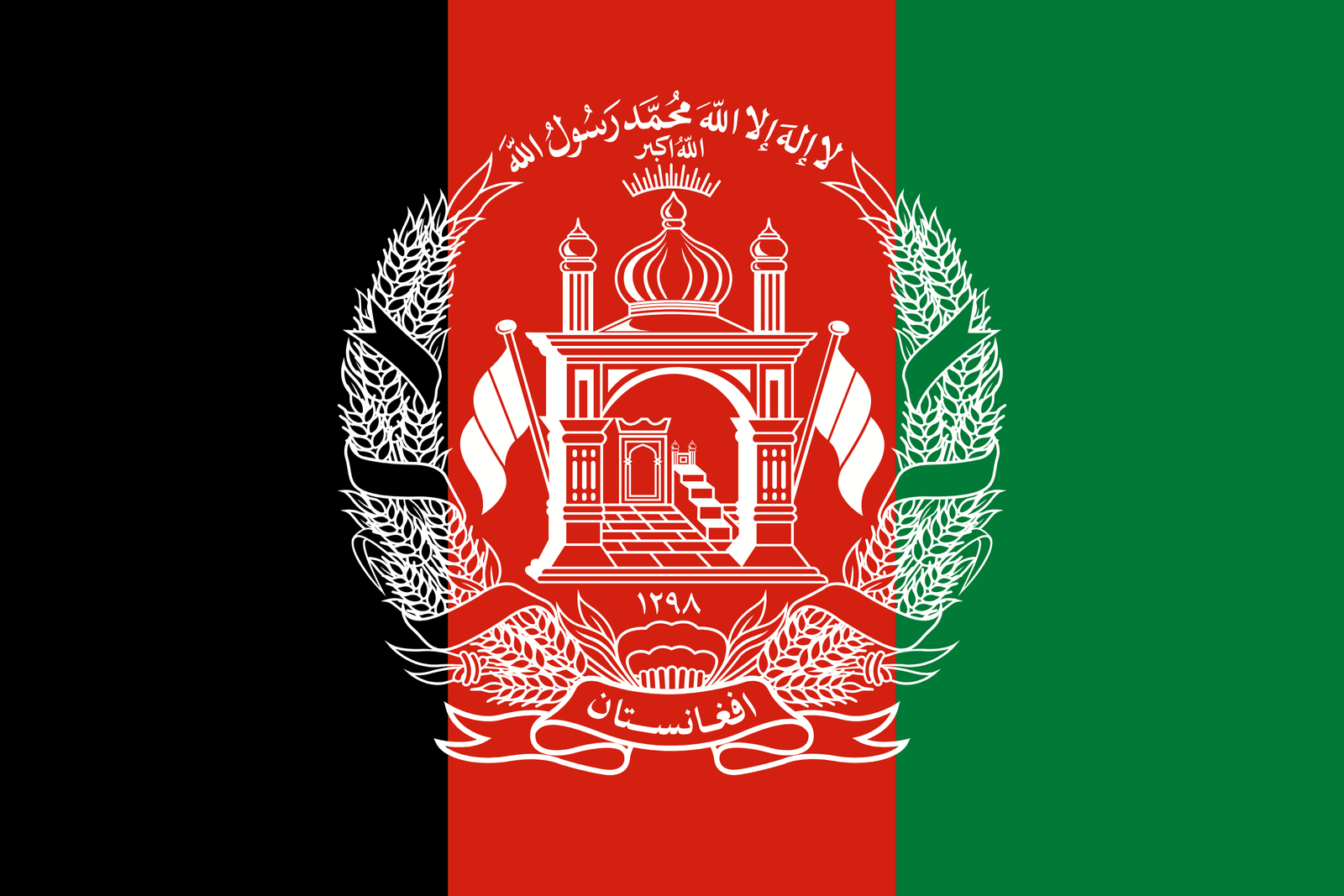
Afghanistan has used multiple flag designs throughout its modern history. The black-red-green tricolor with a central emblem was widely recognized internationally for much of the 20th and early 21st centuries, symbolizing past struggles, independence, and hope for the future. Since 2021, the governing authorities have used a white flag with black Arabic script, reflecting religious symbolism and political identity. Flag usage and protocol vary according to governmental directives and international representation contexts.
Realted Flags
Flag flying days
| Date | Flag Position | Occasion / Reason |
|---|---|---|
| August 19 | Full-mast | Independence Day (historically observed) |
| Religious holidays (varies) | Full-mast | Major Islamic celebrations |
| National mourning days | Half-mast | Periods of remembrance or tragedy |