Flag Albania
| Legal Name | Republic of Albania |
|---|---|
| Flag |
|
| Capital City |
Tirana |
| Total Area | ~28,748 km² |
| Land Area | ~27,398 km² |
| Water Area | ~1,350 km² |
| Population | ~2.8 million |
| Major Cities | Tirana (~500,000+), Durrës (~200,000), Vlorë (~130,000), Shkodër (~135,000), Elbasan (~120,000) |
| Currency | Albanian Lek (ALL) |
| GDP | ~US$25–30 billion |
| GDP Per Capita | ~US$8,500–10,000 (nominal est.) |
About of Albania
Albania is a sovereign country in Southeastern Europe, situated on the western part of the Balkan Peninsula. It faces the Adriatic Sea to the northwest and the Ionian Sea to the southwest, giving it an extensive coastline that has historically supported maritime trade and tourism. Albania shares land borders with Montenegro to the northwest, Kosovo to the northeast, North Macedonia to the east, and Greece to the south. Across the Adriatic Sea to the west lies Italy, making Albania geographically close to Western Europe.
The capital and largest city, Tirana, serves as the political, economic, and cultural heart of the nation. Other major urban centers such as Durrës, Vlorë, and Shkodër contribute to regional commerce and cultural life. Albania’s population is relatively small compared to other European countries, with a significant portion residing in urban areas, though rural communities remain important to the national economy and cultural identity.
Albania is internationally recognized as an independent republic and a member of major global and regional organizations. Its strategic location along the Mediterranean routes has historically made it an important gateway between Western Europe and the Balkans. In recent decades, Albania has increased its integration with European and transatlantic institutions, strengthening its geopolitical relevance in Southeastern Europe.
2. Etymology
The name “Albania” is derived from the Latin term Albania, which was used by ancient geographers to describe the region inhabited by the Albanoi, an Illyrian tribe. The country’s native name, “Shqipëria,” is believed to come from the Albanian word shqip meaning “to speak clearly” or “understand one another,” or from shqiponjë meaning “eagle.” Over time, the dual naming tradition persisted, with “Albania” used internationally and “Shqipëria” used domestically, symbolizing national identity and linguistic heritage.
3. History
Albania’s history dates back to prehistoric settlements and the ancient Illyrian civilizations, which occupied much of the western Balkans. The region later came under the influence of the Roman Empire, followed by the Byzantine Empire, leaving lasting cultural and architectural legacies.
During the medieval period, Albania experienced shifting control among regional powers, including the Bulgarian and Serbian states. The 15th century marked a significant chapter with the resistance led by Gjergj Kastrioti Skanderbeg, a national hero who fought against Ottoman expansion. Despite prolonged resistance, the region eventually became part of the Ottoman Empire, remaining under Ottoman rule for nearly five centuries.
The early 20th century saw the rise of nationalist movements that culminated in independence in 1912. Albania experienced political instability during the interwar period and was later occupied during World War II. Following the war, the country became a communist state under Enver Hoxha, characterized by isolationist policies and centralized governance.
In the early 1990s, Albania transitioned from communism to a multiparty democracy, undergoing economic and social reforms. Modern Albania continues to develop democratic institutions, strengthen its economy, and pursue closer ties with European structures.
4. Government and Politics
Albania operates as a parliamentary republic with a constitutional framework that defines the separation of powers among executive, legislative, and judicial branches. The President serves as head of state, while the Prime Minister leads the government and exercises executive authority. The unicameral Parliament is responsible for legislation and oversight.
The judiciary functions independently under constitutional law, with the Constitutional Court and Supreme Court serving as the highest legal authorities. Administratively, Albania is divided into counties and municipalities, facilitating regional governance and public administration.
In foreign relations, Albania maintains active diplomatic engagement and is a member of the United Nations, NATO, the Council of Europe, and other international organizations. Its defense policy is aligned with collective security frameworks, and its armed forces participate in international peacekeeping and cooperation initiatives.
5. Economy
Albania is classified as a developing and emerging market economy within Europe. Over recent decades, it has transitioned from a centrally planned system to a market-oriented economy characterized by privatization, foreign investment, and service sector growth.
Key economic sectors include tourism, energy production, agriculture, construction, and services. Agriculture remains important, producing olives, fruits, vegetables, and livestock products. The services sector, particularly tourism along the Adriatic and Ionian coasts, has become a major contributor to national income.
Natural resources include chromium, copper, oil, and hydropower potential, with energy production being a significant economic asset. Albania’s primary trade partners are European countries, reflecting its economic integration with regional markets. Economic challenges include reducing unemployment, improving infrastructure, and maintaining sustainable growth while strengthening institutional transparency.
6. Demographics
Albania’s population is predominantly ethnic Albanian, with minority communities including Greeks, Macedonians, Roma, and others. The official and national language is Albanian, which has two primary dialects: Gheg and Tosk.
Religious affiliation is diverse, with Islam, Christianity (both Orthodox and Catholic), and secular identities coexisting. Urbanization has increased steadily, with many citizens residing in cities, while rural areas continue to preserve traditional lifestyles. Population growth has slowed in recent years, influenced by migration trends and demographic shifts.
7. Culture and Society
Albanian culture is shaped by Balkan, Mediterranean, and Ottoman influences, producing a rich blend of traditions and artistic expressions. Folklore, music, dance, and traditional costumes play an important role in national celebrations and regional identities.
Cuisine emphasizes fresh ingredients, olive oil, vegetables, and grilled meats, reflecting Mediterranean culinary traditions. Social customs highlight hospitality, family bonds, and respect for elders. Major public holidays include Independence Day and National Flag Day, alongside religious celebrations observed by various communities.
Sports such as football (soccer) are widely popular, while basketball, weightlifting, and traditional dances also hold cultural significance.
8. Education and Healthcare
Albania’s education system consists of primary, secondary, and tertiary levels, supported by both public and private institutions. Literacy rates are high, and universities in Tirana and other cities contribute to higher education and professional training.
Healthcare services are provided through a combination of public hospitals and private clinics. While improvements have been made in infrastructure and access, challenges remain in ensuring consistent quality and resource availability across regions. Public health initiatives focus on preventive care, maternal health, and disease control.
9. Geography and Climate
Albania’s landscape is predominantly mountainous and hilly, with narrow coastal plains along the Adriatic and Ionian Seas. Major rivers such as the Drin, Vjosa, and Shkumbin traverse the country, supporting agriculture and ecosystems.
The climate is Mediterranean along the coast, characterized by mild winters and warm summers, while inland and mountainous areas experience more continental conditions with colder winters. Natural hazards include earthquakes, floods, and occasional landslides. Environmental concerns involve deforestation, pollution, and sustainable resource management.
10. Flora and Fauna
Albania hosts a diverse range of ecosystems due to its varied topography and climate. Forests of oak, beech, and pine cover large areas, while coastal wetlands support migratory birds. Wildlife includes wolves, bears, lynx, deer, and numerous bird species. National parks and protected reserves aim to conserve biodiversity and promote eco-tourism.
Map of Albania
Albania’s national symbols reflect its historical and cultural heritage. The double-headed eagle is a central emblem representing sovereignty and strength. The national anthem celebrates unity and independence, while monuments, historic castles, and traditional attire serve as enduring cultural identifiers.
12. National Flag (Detailed)
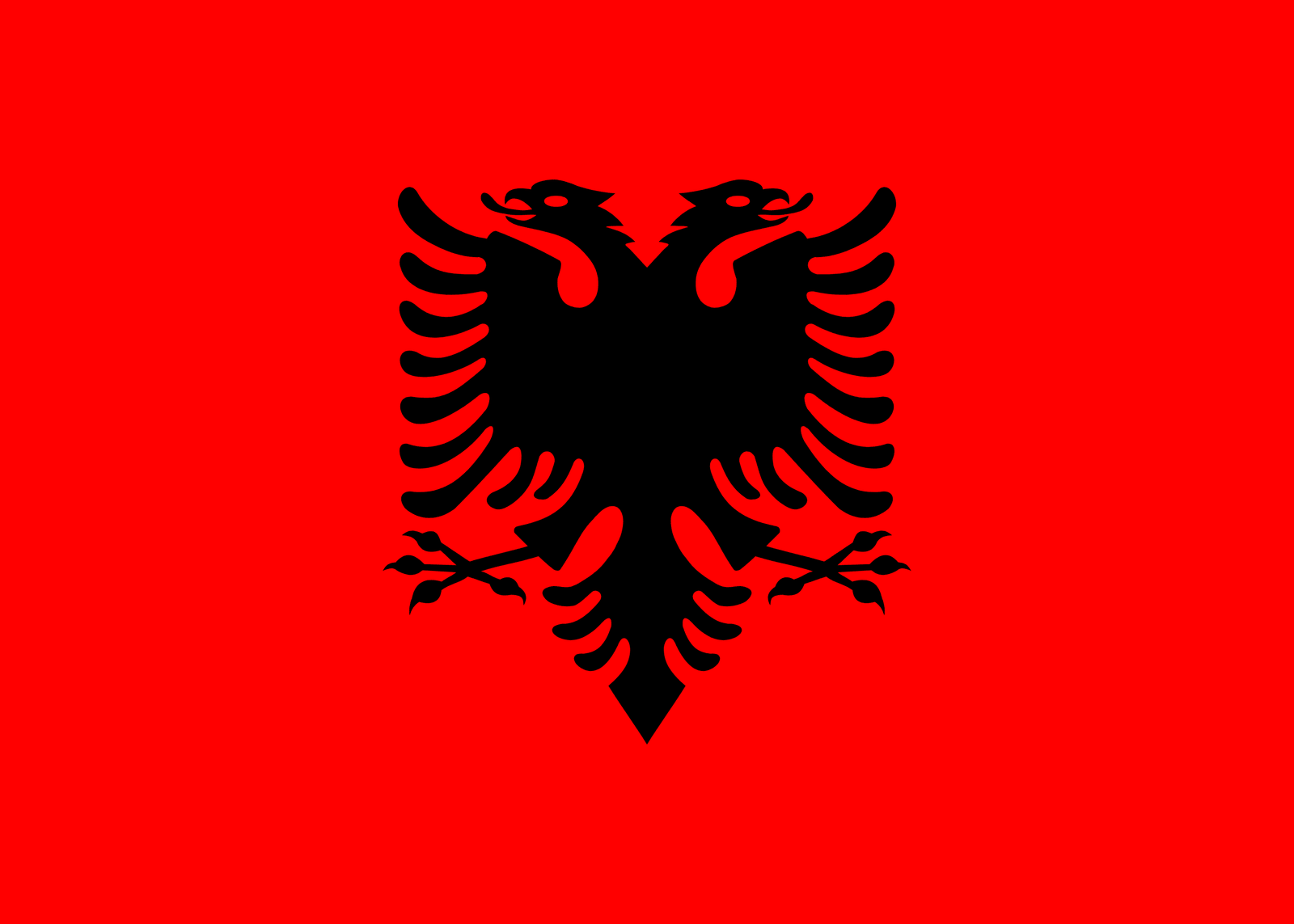
The Albanian flag features a black double-headed eagle on a red background. The design dates back to medieval heraldry associated with Skanderbeg and symbolizes bravery, independence, and vigilance. The red color represents courage and sacrifice, while the eagle signifies freedom and national pride. Flag protocol dictates respectful display on government buildings, public institutions, and national celebrations.
Flag flying days
| Date | Flag Position | Occasion / Reason |
|---|---|---|
| November 28 | Full-mast | Independence and Flag Day |
| March 14 | Full-mast | Summer Day (Traditional Festival) |
| National mourning days | Half-mast | Official remembrance occasions |