Flag Algeria
| Legal Name | People’s Democratic Republic of Algeria |
|---|---|
| Flag |
|
| Capital City |
Algiers |
| Total Area | ~2,381,741 km² |
| Land Area | ~2,381,740 km² |
| Water Area | ~1,000 km² (approx.) |
| Population | ~45 million |
| Major Cities | Algiers (~3.5 million metro), Oran (~1 million), Constantine (~700,000), Annaba (~350,000), Blida (~300,000) |
| Currency | Algerian Dinar (DZD) |
| GDP | ~US$230–250 billion |
| GDP Per Capita | ~US$5,000–5,500 (nominal est.) |
About of Algeria
Algeria is a North African nation and the largest country on the African continent by land area. It occupies a vast territory stretching from the Mediterranean coastline in the north deep into the Sahara Desert in the south. The country lies at the crossroads of North Africa and the Sahel region, giving it both Mediterranean and trans-Saharan characteristics.
Algeria shares land borders with Tunisia and Libya to the east, Niger and Mali to the south, Mauritania to the southwest, Western Sahara to the west, and Morocco to the northwest, while its northern boundary is defined by the Mediterranean Sea. This combination of maritime and desert frontiers has historically influenced its trade routes, defense strategies, and cultural exchanges.
The capital and largest city, Algiers, sits along the Mediterranean coast and serves as the administrative, economic, and cultural center of the country. Other significant urban areas include Oran, Constantine, and Annaba, each contributing to regional industry and commerce. Algeria’s population is concentrated primarily in the northern coastal and highland regions, while the southern Sahara remains sparsely populated.
Internationally, Algeria is recognized as a sovereign republic and plays an influential role in African, Arab, and Mediterranean affairs. Its extensive natural gas and oil reserves, combined with its geographic position, grant it notable geopolitical and economic importance in regional energy markets and diplomatic relations.
2. Etymology
The name “Algeria” is derived from the French Algérie, which in turn originates from “Algiers,” the country’s capital city. The name Algiers stems from the Arabic phrase “Al-Jazā’ir” meaning “The Islands,” referring to a group of small islands that once existed off the city’s coastline. Over time, the name expanded from the city to represent the entire territory, eventually becoming the official designation of the modern nation following independence.
3. History
Algeria’s history stretches back to prehistoric times, with evidence of early human settlements and rock art found throughout the Sahara. In antiquity, the region was inhabited by Berber (Amazigh) civilizations and later came under the influence of the Phoenicians, Carthaginians, and ultimately the Roman Empire, which established major cities and infrastructure.
During the medieval era, Algeria became part of the expanding Islamic world, witnessing the rise of several dynasties and cultural flourishing. The region later came under Ottoman rule in the 16th century, functioning as a semi-autonomous regency centered in Algiers.
In 1830, France invaded and colonized Algeria, initiating over a century of colonial rule that reshaped its demographics, economy, and political landscape. Resistance movements persisted throughout this period, culminating in the Algerian War of Independence (1954–1962). After a prolonged and costly conflict, Algeria achieved independence in 1962.
Post-independence Algeria adopted a socialist-oriented political and economic system. The late 20th century was marked by economic reforms and political unrest, including a civil conflict in the 1990s. In the 21st century, Algeria has pursued gradual modernization, constitutional amendments, and political reforms while navigating regional and domestic challenges.
4. Government and Politics
Algeria is a presidential republic with a constitution that establishes the framework for executive, legislative, and judicial authority. The President serves as both head of state and head of government, supported by a council of ministers. The Parliament is bicameral, consisting of the National People’s Assembly and the Council of the Nation.
The judiciary operates independently under constitutional provisions, with the Supreme Court and Constitutional Court overseeing legal interpretation and governance. Administratively, Algeria is divided into provinces (wilayas), further subdivided into districts and municipalities.
In foreign relations, Algeria is an active member of the United Nations, African Union, Arab League, and Organization of Islamic Cooperation, among other international organizations. Its defense and security policies emphasize regional stability, border security, and counter-terrorism cooperation, supported by one of the largest military forces in Africa.
5. Economy
Algeria possesses a developing, upper-middle-income economy heavily reliant on hydrocarbons, particularly oil and natural gas exports. Energy resources form the backbone of government revenue and foreign exchange earnings. The country is a major supplier of natural gas to European markets through pipeline and liquefied natural gas infrastructure.
Beyond hydrocarbons, Algeria’s economy includes agriculture, manufacturing, construction, and services. Agricultural production centers on cereals, olives, fruits, and livestock, primarily in the northern fertile regions. The manufacturing sector encompasses food processing, chemicals, and construction materials, while services and tourism are gradually expanding.
Natural resources include petroleum, natural gas, iron ore, phosphates, and renewable energy potential, particularly solar power in the Sahara. Economic challenges involve diversifying revenue sources, reducing unemployment, encouraging private sector growth, and balancing public spending with long-term sustainability. Future outlooks focus on economic diversification and infrastructure investment.
6. Demographics
Algeria’s population is composed primarily of Arab and Berber (Amazigh) communities, with cultural and linguistic diversity across regions. Arabic and Tamazight are official languages, while French is widely used in business, education, and media.
The majority of the population adheres to Islam, predominantly Sunni, with small Christian and Jewish minorities. Urbanization has increased steadily, with major cities attracting internal migration, although rural and desert communities remain integral to national identity. Population growth has moderated in recent years compared to earlier decades.
7. Culture and Society
Algerian culture blends Arab, Berber, Mediterranean, and Islamic influences, creating a rich heritage reflected in music, art, architecture, and literature. Traditional music styles such as Raï and Chaabi have gained international recognition, while crafts like pottery, weaving, and jewelry remain culturally significant.
Cuisine features dishes such as couscous, tagines, and grilled meats, emphasizing grains, vegetables, and spices. Social customs value hospitality, family cohesion, and respect for tradition. National and religious festivals, including Independence Day and Islamic holidays, play an important role in public life. Football (soccer) is the country’s most popular sport, with strong regional and international participation.
8. Education and Healthcare
Algeria maintains a public education system that provides free schooling at primary and secondary levels, with numerous universities and technical institutes offering higher education. Literacy rates have improved significantly over recent decades, supported by government investment in educational infrastructure.
Healthcare services are provided through a network of public hospitals and private clinics. While access has expanded, challenges remain in ensuring consistent quality across urban and rural areas. Public health initiatives address vaccination coverage, maternal care, and chronic disease management.
9. Geography and Climate
Algeria’s geography is dominated by the Sahara Desert, which covers the majority of its territory, contrasted by fertile coastal plains and the Atlas Mountain ranges in the north. Major rivers are limited due to arid conditions, with seasonal waterways playing a role in agriculture.
The climate ranges from Mediterranean in the northern regions, with mild, wet winters and hot summers, to arid and desert climates in the interior and south. Natural hazards include droughts, sandstorms, and occasional earthquakes. Environmental concerns focus on desertification, water scarcity, and sustainable resource management.
10. Flora and Fauna
Algeria’s diverse ecosystems support a range of plant and animal life, from Mediterranean forests and steppe grasslands to desert flora adapted to arid conditions. Wildlife includes Barbary macaques, gazelles, desert foxes, and numerous migratory bird species. National parks and protected reserves aim to preserve biodiversity and promote conservation.
Map of Algeria
Algeria’s national symbols emphasize independence, unity, and cultural heritage. The national emblem incorporates Islamic and agricultural motifs, while the national anthem reflects the country’s struggle for liberation and sovereignty. Historic landmarks and traditional attire also serve as cultural identifiers.
National Flag (Detailed)
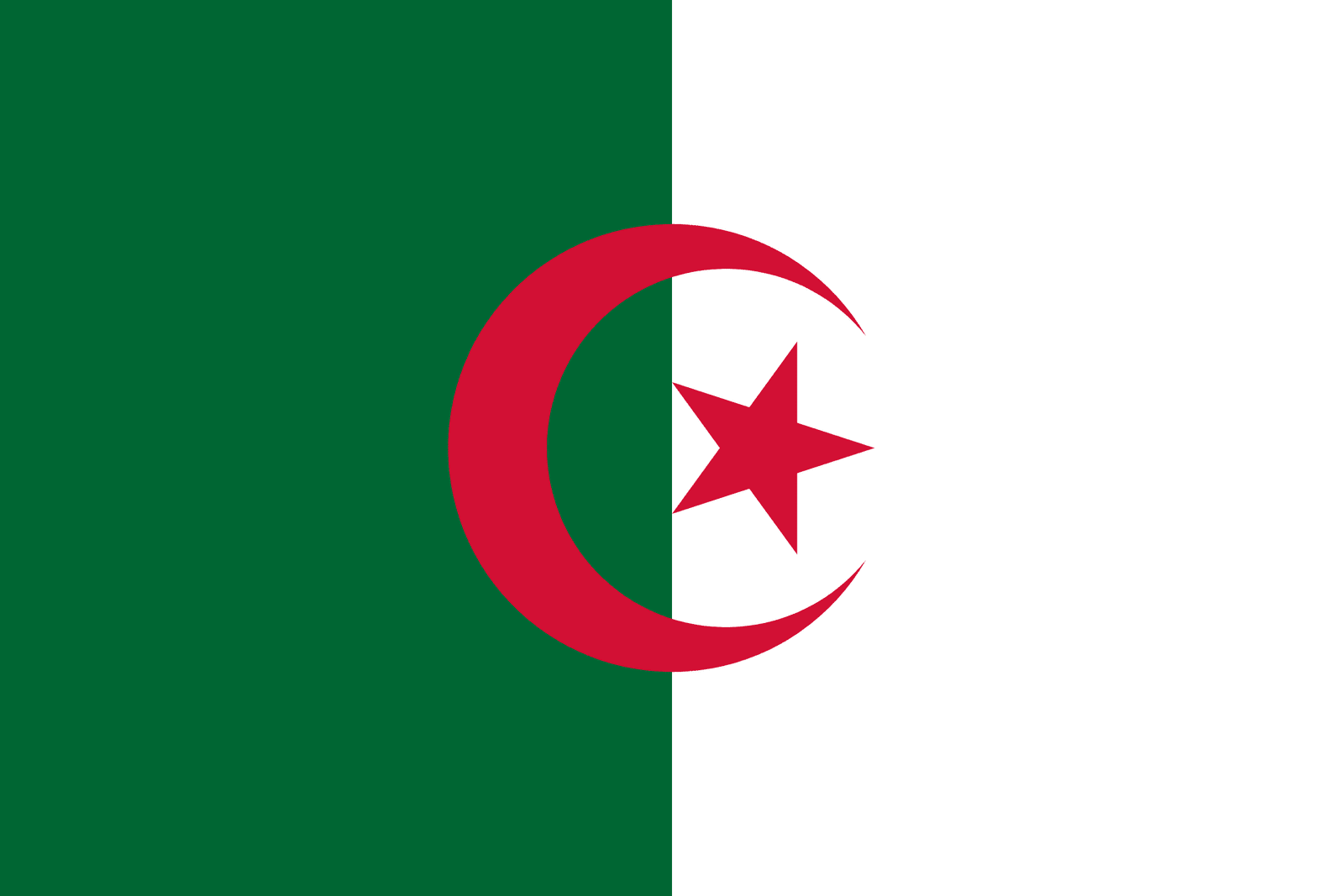
The Algerian flag consists of two vertical halves—green and white—with a red crescent and star centered between them. The green color symbolizes Islam and hope, the white represents peace and purity, and the red crescent and star signify faith and sacrifice. The design was officially adopted at independence and is displayed prominently during national celebrations and official functions.
Flag flying days
| Date | Flag Position | Occasion / Reason |
|---|---|---|
| July 5 | Full-mast | Independence Day |
| November 1 | Full-mast | Revolution Day |
| National mourning days | Half-mast | Official remembrance occasions |