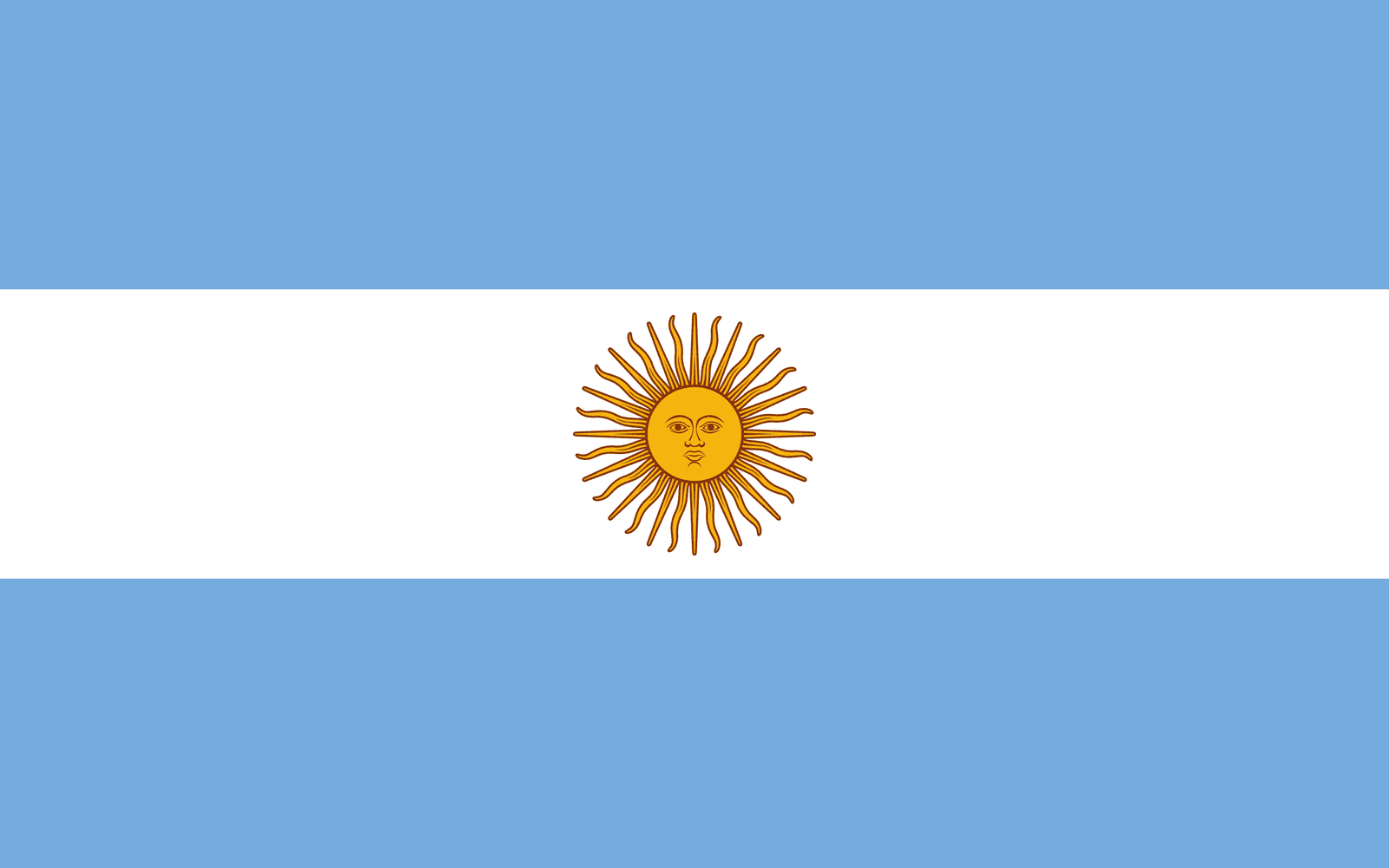
Flag of Argentina
| Legal Name | Argentine Republic |
|---|---|
| Flag |
|
| Capital City |
Buenos Aires |
| Total Area | ~2,780,400 km² |
| Land Area | ~2,736,700 km² |
| Water Area | ~43,700 km² |
| Population | ~46 million |
| Major Cities | Buenos Aires (~15 million metro), Córdoba (~1.5 million), Rosario (~1.3 million), Mendoza (~1.2 million), La Plata (~800,000) |
| Currency | Argentine Peso (ARS) |
| GDP | ~US$650 billion |
| GDP Per Capita | ~US$14,000 (PPP) |
About of Argentina
Argentina is a vast South American nation stretching from the tropical north to the subpolar south, encompassing diverse landscapes, climates, and ecosystems. It is the eighth-largest country in the world by area and the second-largest in South America after Brazil. Its territory spans from the Andes Mountains on the western border to the Atlantic Ocean on the east, including fertile plains, plateaus, deserts, and glaciers.
Argentina shares borders with Chile to the west, Bolivia and Paraguay to the north, Brazil and Uruguay to the northeast, and has extensive maritime access to the South Atlantic Ocean. The capital, Buenos Aires, is a global city and economic hub, blending European architecture with Latin American culture. Other major cities like Córdoba, Rosario, Mendoza, and La Plata are centers of industry, education, and culture.
Argentina is internationally recognized as a sovereign republic, a member of the United Nations, Mercosur, G20, Organization of American States, and various other international bodies. Its geopolitical significance stems from its size, natural resources, agricultural output, and strategic maritime location in the South Atlantic, including proximity to Antarctica.
2. Etymology
The name “Argentina” comes from the Latin word argentum, meaning “silver,” inspired by early European explorers’ belief in rich silver deposits in the region. Early Spanish settlers called the territory “Tierra Argentina” (“Land of Silver”), a name which gradually evolved into “Argentina.” The term reflects the region’s historical importance in trade, European exploration, and the Spanish colonial era.
3. History
Human settlement in Argentina dates back at least 13,000 years, with nomadic hunter-gatherers occupying the Pampas, Andes, and Patagonia. The Diaguita, Guaraní, Mapuche, and Tehuelche peoples formed significant cultural groups prior to European arrival.
Spanish explorers arrived in the early 16th century, establishing settlements along the Río de la Plata. Argentina remained part of the Spanish Viceroyalty of the Río de la Plata until the Independence movement, influenced by the broader Latin American revolutions. On July 9, 1816, Argentina declared independence, initiating decades of internal conflict among federalist and centralist factions.
During the 19th century, Argentina expanded its territory, consolidating national borders through campaigns in Patagonia and the Pampas. The 20th century saw waves of European immigration, economic modernization, military coups, and periods of democratic and authoritarian rule. Key events include the Falklands War (1982), democratic restoration in 1983, and recent economic and social reforms aimed at stabilizing growth and reducing inequality.
4. Government and Politics
Argentina is a federal presidential republic with three branches of government:
Executive: The President is both head of state and government, elected for a four-year term with a possible re-election. The Cabinet assists in policy implementation.
Legislative: Bicameral Congress consists of the Senate and the Chamber of Deputies, responsible for lawmaking, budgeting, and oversight.
Judiciary: Independent, headed by the Supreme Court, responsible for constitutional and federal law enforcement.
The country comprises 23 provinces and the autonomous city of Buenos Aires, each with its governor and legislature. Argentina actively engages in international diplomacy, regional organizations like Mercosur, and global initiatives while maintaining a well-structured military for defense and peacekeeping.
5. Economy
Argentina is classified as an emerging market economy, historically based on agriculture, livestock, and mining, and increasingly diversified into manufacturing, services, and technology. Key sectors include:
Agriculture: Soybeans, maize, wheat, beef, and wine production dominate.
Industry: Food processing, automobiles, textiles, and petrochemicals.
Services: Finance, tourism, and IT services contribute significantly to GDP.
The country is rich in natural resources, including fertile plains (Pampas), oil, natural gas, lithium, and minerals. Major trade partners are Brazil, China, the United States, and the European Union. Economic challenges include inflation, currency volatility, and debt management, while growth prospects focus on energy exports, technology, and sustainable agriculture.
6. Demographics
Argentina’s population is predominantly of European descent, with significant communities of Italian, Spanish, German, and other European origins, along with mestizo and indigenous groups. Spanish is the official language, with minor indigenous languages recognized regionally.
Most Argentines are Christian, mainly Roman Catholic, with Protestant, Jewish, and other religious communities present. Urbanization is high, with nearly 92% of the population living in urban areas, concentrated in the Buenos Aires metropolitan region and other major cities. Population growth has slowed in recent decades, reflecting lower fertility rates and emigration patterns.
7. Culture and Society
Argentina has a rich cultural heritage, blending European and indigenous influences. Tango music and dance are iconic, alongside folk music like zamba and chacarera. Literature boasts globally renowned writers such as Jorge Luis Borges and Julio Cortázar. Cuisine emphasizes beef, empanadas, pasta, and wine, reflecting both local and European traditions.
Social norms value family, education, and civic participation, while sports—especially football, rugby, and field hockey—play a central role. National identity is closely tied to independence, cultural pride, and regional influence.
8. Education and Healthcare
Argentina offers free primary, secondary, and public university education, with high literacy rates (~99%). Major universities, such as the University of Buenos Aires, attract students regionally and internationally.
Healthcare is a combination of public, private, and social security services. Public health achievements include vaccination programs and maternal care, though challenges remain in rural access, health infrastructure, and chronic disease management.
9. Geography and Climate
Argentina’s geography is highly diverse, including:
Andes Mountains in the west.
Pampas plains in the central region.
Patagonian plateaus in the south.
Extensive rivers (Paraná, Uruguay, Colorado) and coastal plains.
Climates range from subtropical in the north, temperate in central areas, to cold and arid in the south. Natural hazards include floods, droughts, earthquakes, and occasional volcanic activity. Environmental concerns include deforestation, soil degradation, and glacial retreat.
10. Flora and Fauna
Argentina hosts diverse ecosystems, from tropical forests to temperate grasslands and Andean highlands. Native flora includes ceibo (national flower), ombú, and lenga trees, while fauna includes guanacos, jaguars, Andean condors, pumas, and rheas. National parks such as Iguazú, Los Glaciares, and Nahuel Huapi protect biodiversity and promote tourism.
Map of Argentina
In 1942, the Pakistan National Movement published a pamphlet, “The Millat of Islam and the menace of ‘Indianism'”, by the founder of the Pakistan Movement, Choudhry Rahmat Ali, depicting on its cover a flag of a proposed Pakistan with a thin white crescent and five white stars on a green field.[5] A graphic illustration of Ali’s flag in a critical work from 1946 more clearly portrays the stars in a pentagonal arrangement.[6] Each star apparently represented a constituent nation of the proposed state: Punjab, Afghania (NWF), Kashmir, Sindh, and Balochistan.[5] Ali also apparently designed a flag for an envisioned association of independent Muslim states distributed across South Asia, a ‘Pak Commonwealth of Nations’. This flag featured a smaller crescent and ten stars.[7]
The design eventually adopted as the Flag of Pakistan was based on the flag of the Muslim League. In 1937, the Muslim League began using a solid green banner charged with white descending crescent and star. In the early 1920s, during the era of the Khilafat Movement, Muslims had begun using a green banner with crescent and star, but as a religious rather than national symbol.[8] By the 1930s, Muslims in India had become leery of the acceptance of the tricolor flag of the Congress Party as the national flag of India, in significant part because the discourses and rituals of hoisting the flag invoked explicitly Hindu religious themes.[9] In 1940, Muhammad Ali Jinnah, leader of the Muslim League and future founder of the state of Pakistan, declared the League’s flag the ‘national flag of Muslim India’.[10] By 1944, Muhammad Ali Jinnah was publicly declaring that they intended it to be the flag of Pakistan.[11] This would become the flag of Pakistan, albeit charged with a white heraldic side or flank at the hoist. The resulting flag bears a striking resemblance to the various iterations of the Saudi flag from 1744 to 1937 which featured a white heraldic side or flank at the hoist and a green field charged with white calligraphic text (the Shahada).
Realted Flags
Flag flying days
| Date | Position | Reason[18] |
|---|---|---|
| 23 March | Full-mast | Pakistan Day: Adoption of the Lahore Resolution (1940) and declaration of the Islamic Republic (1956) |
| 21 April | Half-mast | Death Anniversary of the National Poet, Muhammad Iqbal (1938) |
| 14 August | Full-mast | Independence Day (1947) |
| 11 September | Half-mast | Death Anniversary of the Father of the Nation, Muhammad Ali Jinnah (1948) |
| 9 November | Full-mast | Birthday of Muhammad Iqbal |
| 25 December | Full-mast | Birthday of Muhammad Ali Jinnah |