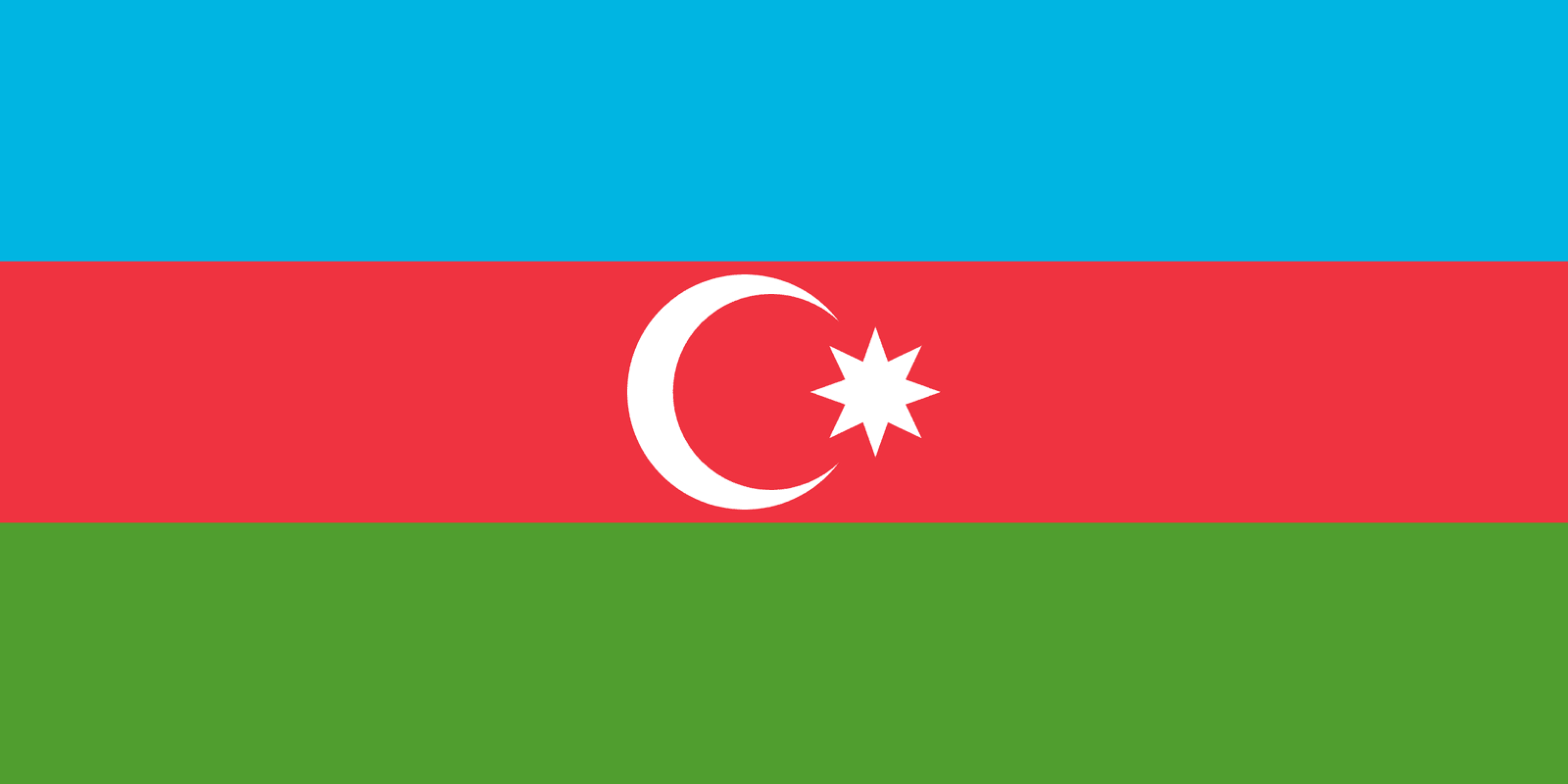
Flag of Azerbaijan
| Legal Name | Republic of Azerbaijan |
|---|---|
| Flag |
|
| Capital City |
Baku |
| Total Area | ~86,600 km² |
| Land Area | ~82,629 km² |
| Water Area | ~3,971 km² |
| Population | ~10.3 million |
| Major Cities | Baku (2.3M), Ganja (340K), Sumqayit (340K), Mingachevir (105K), Lankaran (90K) |
| Currency | Azerbaijani Manat (AZN) |
| GDP | ~USD 75 billion |
| GDP Per Capita | ~USD 7,200 (nominal) |
About of Azerbaijan
Azerbaijan is a transcontinental country located at the crossroads of Eastern Europe and Western Asia in the South Caucasus region. It lies along the western shore of the Caspian Sea, the world’s largest inland body of water. The nation occupies a strategically significant position between Russia to the north, Georgia to the northwest, Armenia to the west, Iran to the south, and Turkey to the southwest through the Nakhchivan Autonomous Republic.
The capital and largest city, Baku, is situated on the Absheron Peninsula along the Caspian coast and serves as the political, economic, and cultural center of the country. Other important urban areas such as Ganja and Sumqayit contribute to regional economic development and industrial production. Azerbaijan’s population is moderately urbanized, with a significant portion living in and around Baku.
Internationally, Azerbaijan is recognized as a sovereign republic and a member of the United Nations, the Organization of Islamic Cooperation, the Council of Europe, and other regional institutions. Its geopolitical importance is closely tied to its energy resources, transit corridors, and role as a bridge between Europe and Asia. The country plays a significant part in regional energy security and transportation networks connecting the Caspian basin to global markets.
3. Etymology
The name “Azerbaijan” is widely believed to originate from Atropates, a Persian satrap who ruled the region in the 4th century BCE. The ancient term “Atropatene” gradually evolved through linguistic transformations into “Azerbaijan.” Another interpretation connects the name to Middle Persian roots meaning “Land of Fire,” reflecting the region’s historical association with natural gas fires and Zoroastrian worship practices. Over centuries, phonetic adaptations in Persian, Arabic, and Turkic languages shaped the modern form of the country’s name.
4. History
Human settlement in present-day Azerbaijan dates back tens of thousands of years, with archaeological evidence of early agricultural and pastoral societies. In antiquity, the region was influenced by Median and Persian civilizations and later became part of the Achaemenid Empire. During classical periods, Caucasian Albania emerged as a notable kingdom distinct from the Balkan Albania.
Following the spread of Islam in the 7th century, the area became integrated into successive Islamic caliphates and later Turkic dynasties, which contributed to the linguistic and cultural foundations of modern Azerbaijani identity. In the medieval era, local khanates and regional powers governed the territory amid shifting imperial influences.
By the early 19th century, following wars between Persia and the Russian Empire, the territory was incorporated into the Russian Empire. After the collapse of imperial rule in 1918, the Azerbaijan Democratic Republic briefly emerged as one of the first secular democratic republics in the Muslim world. In 1920, the region was absorbed into the Soviet Union as the Azerbaijan Soviet Socialist Republic.
Azerbaijan regained independence in 1991 following the dissolution of the Soviet Union. The early post-independence years were marked by economic restructuring and armed conflict over the Nagorno-Karabakh region. Subsequent decades saw political consolidation, economic growth driven by energy exports, and renewed regional tensions. Modern Azerbaijan continues to navigate domestic development and regional diplomacy.
5. Government and Politics
Azerbaijan is a unitary semi-presidential republic with a strong executive branch. The President serves as both head of state and head of government, wielding significant executive authority. The Prime Minister and cabinet assist in administrative governance.
The Constitution establishes the framework for governance and outlines civil rights, institutional structures, and separation of powers. The legislative branch is the unicameral National Assembly, responsible for passing laws and overseeing national policy. The judicial branch includes the Constitutional Court, Supreme Court, and subordinate courts intended to operate independently.
Administratively, the country is divided into districts and cities, with the Nakhchivan Autonomous Republic enjoying a special autonomous status. Azerbaijan maintains diplomatic relations worldwide and is active in organizations such as the United Nations, the Non-Aligned Movement, and regional energy partnerships. The armed forces consist of land, air, and naval components, with defense policy focused on territorial security and regional stability.
6. Economy
Azerbaijan is generally classified as an upper-middle-income developing economy with strong reliance on the energy sector. Oil and natural gas production dominate national revenue and exports, making the country one of the key energy suppliers in the Caspian region.
The services sector, including banking, telecommunications, and tourism, has expanded in recent decades. Agriculture remains important in rural areas, producing cotton, fruits, vegetables, and livestock products. Manufacturing includes petrochemicals, food processing, and construction materials.
Major trading partners include European Union states, Turkey, China, and regional neighbors. Economic challenges involve diversification away from hydrocarbons, price volatility in energy markets, and sustainable development. Long-term strategies emphasize renewable energy, logistics corridors, and digital innovation.
7. Demographics
Azerbaijan’s population is predominantly ethnic Azerbaijani, with minority communities such as Lezgins, Talysh, Russians, and others contributing to cultural diversity. Azerbaijani, a Turkic language written in Latin script, is the primary language of communication.
Islam is the majority religion, with both Shia and Sunni communities present, alongside smaller Christian and Jewish populations. Urbanization continues to increase, particularly around Baku and industrial centers. Population growth is moderate, supported by relatively stable birth rates compared to many European countries.
8. Culture and Society
Azerbaijani culture reflects a blend of Turkic, Persian, and Caucasian influences. Traditional music such as mugham, carpet weaving, and poetry form key elements of national heritage. Hospitality and family ties hold strong social importance, while tea culture and communal dining are integral aspects of daily life.
Cuisine features dishes like plov, kebabs, dolma, and fresh herbs, reflecting regional agricultural abundance. Festivals and public celebrations include Novruz, marking the Persian New Year and symbolizing renewal and seasonal change. Sports such as wrestling, chess, and football are widely popular, with international events hosted in Baku enhancing the country’s global profile.
9. Education and Healthcare
Azerbaijan maintains a structured education system comprising primary, secondary, and tertiary levels. Literacy rates are high, and universities in Baku serve as central hubs for higher education and research. Educational reforms increasingly emphasize science, technology, and multilingual instruction.
Healthcare operates through a combination of public and private institutions. Government initiatives aim to modernize infrastructure, expand insurance coverage, and improve rural medical access. Public health priorities include preventive care, maternal health, and modernization of medical facilities.
10. Geography and Climate
Azerbaijan’s terrain is diverse, encompassing the Greater and Lesser Caucasus mountain ranges, fertile lowlands, semi-deserts, and extensive Caspian coastlines. Major rivers such as the Kura and Aras support agriculture and settlement patterns.
The climate varies from humid subtropical conditions along the coast to alpine climates in mountainous areas and arid conditions inland. Natural hazards include earthquakes, landslides, and occasional flooding. Environmental concerns focus on water management, air quality in industrial zones, and conservation of the Caspian ecosystem.
11. Flora and Fauna
The country hosts rich biodiversity due to varied climates and elevations. Forests of oak, beech, and hornbeam cover mountainous regions, while steppe and semi-desert vegetation dominate lowlands. Wildlife includes species such as wolves, lynxes, gazelles, and numerous bird varieties.
Protected areas and national parks, including Shirvan and Hirkan National Parks, play an important role in preserving endangered species and ecological balance. Conservation programs seek to protect rare flora, migratory birds, and unique habitats.
Map of Azerbaijan
Azerbaijan’s national symbols include its tricolor flag, the State Coat of Arms featuring a flame motif, and the national anthem “March of Azerbaijan.” The flame symbol reflects historical associations with fire worship and natural gas flames, often earning the country the nickname “Land of Fire.”
National Flag (Detailed Section)
The national flag of Azerbaijan consists of three equal horizontal stripes: blue, red, and green. Centered on the red band are a white crescent and an eight-pointed star. Blue symbolizes Turkic heritage, red represents progress and modernization, and green reflects Islamic cultural identity.
The flag was first adopted in 1918 during the Azerbaijan Democratic Republic and later reinstated after independence in 1991. The crescent signifies Islamic tradition, while the eight-pointed star is often interpreted as representing the eight letters of “Azerbaijan” in the Arabic script or the eight Turkic peoples. The flag is displayed on government institutions, national holidays, and international events according to established ceremonial protocols.
Flag flying days
| Date | Flag Position | Occasion / Reason |
|---|---|---|
| 28 May | Full-mast | Independence Day |
| 15 June | Full-mast | National Salvation Day |
| 18 October | Full-mast | Restoration of Independence Day |
| 9 November | Full-mast | State Flag Day |
| 20 January | Half-mast | National Day of Mourning |
| Various Official Events | Half-mast | State funerals or national mourning periods |