
Flag of Belize
| Legal Name | Belize |
|---|---|
| Flag |
|
| Capital City |
Belmopan |
| Total Area | ~22,966 km² |
| Land Area | ~22,806 km² |
| Water Area | ~160 km² |
| Population | ~420,000 |
| Major Cities | Belize City (~75,000), San Ignacio (~20,000), Orange Walk Town (~18,000), Dangriga (~12,000), Belmopan (~25,000 metro) |
| Currency | Belize Dollar (BZD) |
| GDP | ~US$3.5 Billion |
| GDP Per Capita | ~US$8,000 (PPP approx. US$13,000) |
About of Belize
Belize is a small Caribbean and Central American nation located on the northeastern coast of Central America. It is bordered by Mexico to the north, Guatemala to the west and south, and the Caribbean Sea to the east. Despite its relatively small size, Belize is known for its ecological diversity, tropical climate, and extensive coral reef system, which includes the Belize Barrier Reef—one of the largest reef systems in the world.
The country’s capital city is Belmopan, a planned administrative center established after a major hurricane damaged Belize City in 1961. Belize City remains the largest urban and commercial hub, serving as the country’s primary port and economic center. Other important towns such as San Ignacio, Orange Walk, and Dangriga play regional roles in trade, tourism, and agriculture.
Belize has a diverse demographic composition influenced by Indigenous Maya communities, Afro-Caribbean heritage, European colonial history, and Latin American migration. It is internationally recognized as a sovereign state and is a member of the United Nations, Commonwealth of Nations, Caribbean Community (CARICOM), and other regional organizations.
Strategically, Belize occupies an important position between the Caribbean and Central America. Its coastline, marine resources, and tourism industry contribute to regional economic networks, while its political stability and English-speaking population make it distinctive among its Spanish-speaking neighbors.
3. Etymology
The name “Belize” is widely believed to have originated from the Maya word “Belix,” meaning “muddy water,” referring to the Belize River. Another theory suggests it may derive from the name of a European buccaneer, Peter Wallace, whose surname may have been pronounced similarly by Spanish speakers. Over time, the pronunciation evolved through colonial usage into the modern name “Belize.” The name reflects both Indigenous linguistic roots and colonial adaptation.
4. History
Human settlement in the region dates back thousands of years, with early inhabitants belonging to the ancient Maya civilization. The Maya established advanced cities, trade networks, and agricultural systems long before European arrival. Sites such as Caracol, Altun Ha, and Lamanai remain important archaeological landmarks.
During the classical and medieval periods, Maya city-states flourished but gradually declined due to environmental, social, and political factors. Spanish explorers arrived in the 16th century, but Spain never fully colonized the territory. Instead, British settlers known as Baymen established logging settlements, focusing on timber extraction.
Belize became formally known as British Honduras in the 19th century and was administered as a British colony. The independence movement gained momentum in the mid-20th century, leading to internal self-government in 1964 and full independence on 21 September 1981. Territorial disputes with Guatemala continued for decades but have been addressed through diplomatic and legal channels.
In the post-independence era, Belize developed democratic institutions, expanded tourism, and strengthened regional ties. Modern political developments focus on economic diversification, environmental conservation, and social development.
5. Government and Politics
Belize operates as a parliamentary constitutional monarchy within the Commonwealth. The British monarch serves as head of state, represented locally by a Governor-General, while executive authority is exercised by the Prime Minister and Cabinet.
The country’s legal framework is based on English common law. The National Assembly consists of two chambers: the House of Representatives and the Senate. The judiciary is independent, with the Caribbean Court of Justice serving as the final appellate court.
Belize is divided into six administrative districts: Belize, Cayo, Corozal, Orange Walk, Stann Creek, and Toledo. Foreign relations emphasize regional cooperation, environmental diplomacy, and trade partnerships. The Belize Defence Force handles national security and disaster response, maintaining a relatively small but professional military presence.
6. Economy
Belize is classified as a developing, upper-middle-income economy with strong reliance on tourism, agriculture, and services. Tourism is the primary economic driver, supported by marine attractions, eco-tourism, and cultural heritage sites.
Agriculture remains important, with sugar, citrus fruits, bananas, and seafood exports forming a large share of foreign revenue. Manufacturing is modest but includes food processing and beverage production. Natural resources such as timber and marine biodiversity contribute economically.
Key trade partners include the United States, United Kingdom, Mexico, and Caribbean nations. Economic challenges include vulnerability to hurricanes, climate change, and reliance on a limited number of export industries. Future outlook centers on sustainable tourism, renewable energy, and digital services expansion.
7. Demographics
Belize has a multicultural population composed of Mestizo, Creole, Maya, Garifuna, East Indian, Mennonite, and European communities. English is the official language, but multilingualism is common, with Spanish and Kriol widely spoken.
Religious affiliation is predominantly Christian, alongside smaller communities practicing other faiths. Urban populations are concentrated in Belize City and surrounding towns, though rural agricultural communities remain significant. Population growth has been moderate, with migration influencing demographic trends.
8. Culture and Society
Belizean culture reflects a blend of Caribbean, Latin American, African, and Indigenous traditions. Music styles such as punta and reggae are popular, while cuisine features rice and beans, seafood, plantains, and regional spices.
National identity emphasizes diversity, community celebration, and respect for cultural heritage. Festivals such as Independence Day (21 September) and Garifuna Settlement Day (19 November) are major public events. Sports, particularly football and basketball, play a significant recreational role.
9. Education and Healthcare
Belize maintains a structured education system consisting of primary, secondary, and tertiary institutions. English-language instruction provides access to international academic resources. Literacy rates are relatively high, and higher education institutions continue to expand.
Healthcare is provided through a mix of public and private services. Public health initiatives focus on maternal care, infectious disease control, and rural medical outreach. Challenges include limited infrastructure in remote areas, though gradual improvements continue.
10. Geography and Climate
Belize features coastal plains, dense rainforests, and low mountain ranges such as the Maya Mountains. Numerous rivers and lagoons shape its landscape, while the Caribbean coastline supports coral reefs and mangroves.
The climate is tropical, characterized by wet and dry seasons. Hurricanes and tropical storms pose natural hazards, particularly between June and November. Environmental concerns include deforestation, coral reef preservation, and climate-related sea-level rise.
11. Flora and Fauna
Belize is recognized for high biodiversity, hosting tropical hardwood forests, mangroves, and savannas. Native plant species include mahogany and ceiba trees. Wildlife ranges from jaguars and tapirs to diverse bird and marine species.
Protected areas such as Cockscomb Basin Wildlife Sanctuary and numerous marine reserves highlight the country’s conservation efforts, promoting eco-tourism and environmental stewardship.
Map of Belize
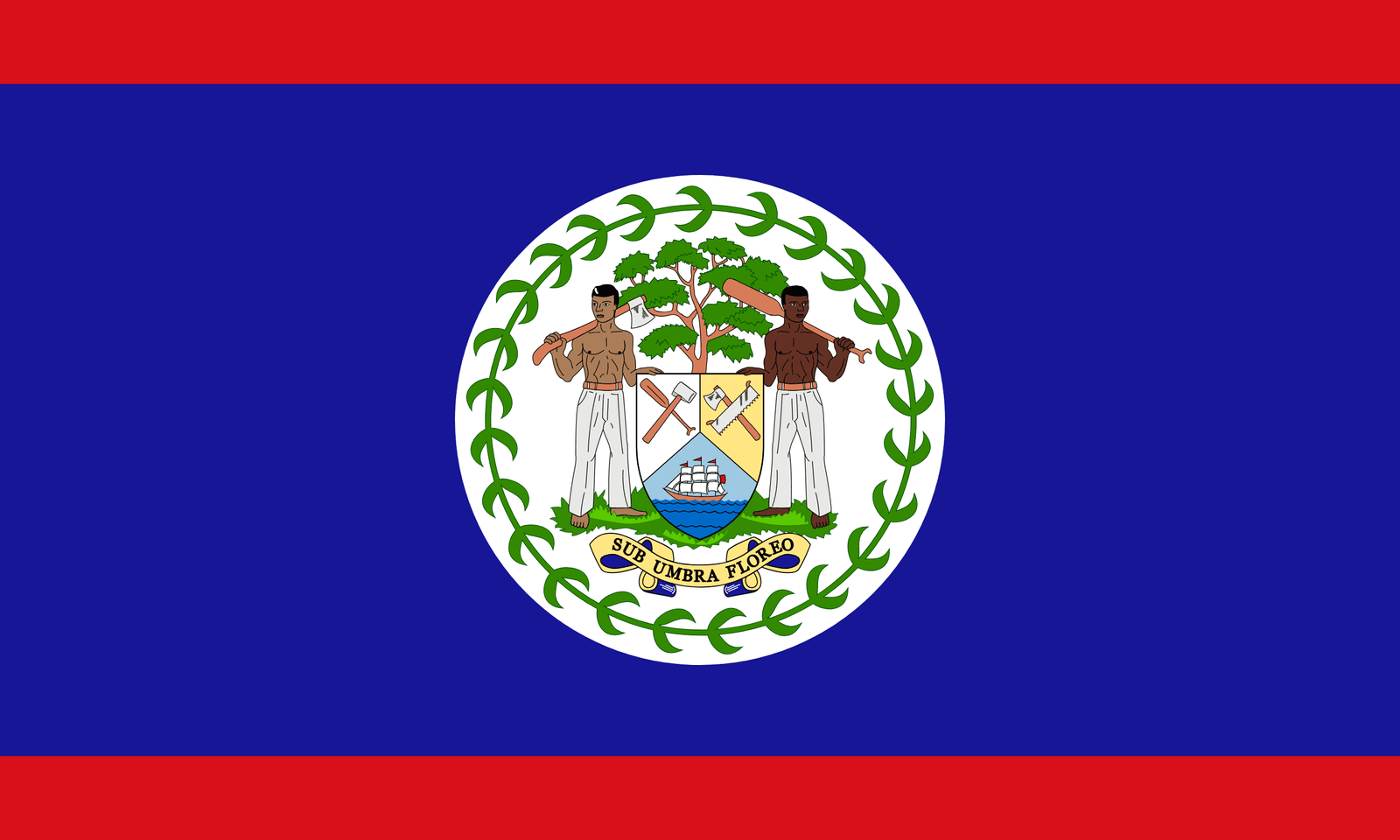
Belize’s national symbols include its blue and red flag, a detailed coat of arms featuring woodcutting tools and maritime elements, and the national anthem “Land of the Free.” The national animal is the Baird’s tapir, and the national tree is the mahogany.
National Flag (Detailed Section)
The Belizean flag consists of a royal blue background bordered by red horizontal stripes at the top and bottom. At the center lies a white circle containing the national coat of arms, which depicts two woodcutters, a shield with tools and a sailing ship, and a mahogany tree above.
Historically, the design evolved from colonial emblems into a national symbol adopted at independence in 1981. The blue represents unity and the people, the red symbolizes political inclusivity, and the coat of arms reflects forestry heritage and maritime trade. Flag protocol includes formal display on national holidays and government buildings.
Realted Flags
Flag flying days
| Date | Flag Position | Occasion |
|---|---|---|
| 1 January | Full-mast | New Year’s Day |
| 9 March | Full-mast | Baron Bliss Day |
| 1 May | Full-mast | Labour Day |
| 21 September | Full-mast | Independence Day |
| 19 November | Full-mast | Garifuna Settlement Day |
| National Mourning Days | Half-mast | State funerals or official mourning periods |