
Flag of Eswatini
| Legal Name | Kingdom of Eswatini |
|---|---|
| Flag |
|
| Capital City |
Mbabane (administrative), Lobamba (royal & legislative) |
| Total Area | ~17,364 km² |
| Land Area | ~17,204 km² |
| Water Area | ~160 km² |
| Population | ~1.2 million |
| Major Cities | Manzini (~110k), Mbabane (~95k), Big Bend (~25k), Malkerns (~10k), Siteki (~7k) |
| Currency | Lilangeni (SZL), pegged to the South African Rand |
| GDP | ~USD 5 billion |
| GDP Per Capita | ~USD 4,000 (nominal) |
About of Eswatini
Eswatini is a small, landlocked country in Southern Africa, situated between South Africa and Mozambique. Despite its modest size, the country features remarkable geographic diversity, ranging from mountainous highlands in the west to low-lying savannas in the east. Its location places it within one of Africa’s most economically dynamic regions.
The country has two capitals reflecting its dual governance structure. Mbabane serves as the administrative capital, housing most government ministries, while Lobamba is the royal and legislative capital, home to the monarchy and Parliament. Manzini, the largest city, functions as the commercial and industrial center.
Eswatini’s population is relatively small and predominantly rural, with strong community ties and cultural continuity. The majority of citizens belong to the Swazi ethnic group, contributing to a high level of cultural homogeneity compared to many other African states.
Internationally, Eswatini is recognized as one of the world’s last remaining absolute monarchies. Its political system, traditional institutions, and cultural preservation give it a distinctive global profile. Strategically, Eswatini’s importance lies in its regional connectivity, economic integration with South Africa, and role in Southern African diplomacy.
Etymology
The name “Eswatini” means “land of the Swazis” in the siSwati language. It derives from King Mswati II, a 19th-century ruler who played a central role in consolidating the Swazi state and expanding its territory.
For much of the colonial and post-colonial period, the country was known internationally as Swaziland. In 2018, the name Eswatini was officially adopted to reflect indigenous identity and linguistic heritage, and to reduce confusion with similarly named countries.
The change reaffirmed national pride and emphasized continuity with pre-colonial Swazi history.
History
Human settlement in present-day Eswatini dates back thousands of years, with early communities engaged in hunting, gathering, and later agriculture. Over time, Bantu-speaking peoples migrated into the region, establishing organized societies.
The Swazi nation emerged in the 18th and 19th centuries under strong leadership, particularly during the reign of King Mswati II. Through diplomacy, warfare, and alliances, the Swazi consolidated their territory and political institutions.
In the late 19th century, European influence increased, and Eswatini eventually became a British protectorate. Unlike many colonies, traditional leadership structures were preserved under indirect rule.
Eswatini gained independence in 1968, retaining the monarchy as the central political institution. In the decades following independence, the monarchy strengthened its authority, culminating in the suspension of political parties in the 1970s.
In modern times, Eswatini has experienced gradual political reforms alongside public debate over governance, democracy, and social development, while maintaining its traditional system.
Government and Politics
Eswatini is an absolute monarchy, with the King serving as head of state, head of government, and supreme authority. Political power is centralized in the monarchy, supported by traditional advisory structures.
The country operates under a constitution that recognizes both modern state institutions and customary law. Executive authority is exercised by the King through appointed ministers and officials.
The legislative branch consists of a bicameral Parliament, with members partly elected and partly appointed by the monarch. The judiciary is formally independent and combines Roman-Dutch law with customary Swazi law.
Administratively, Eswatini is divided into four regions: Hhohho, Manzini, Lubombo, and Shiselweni. Each region is further subdivided into local chiefdoms.
Eswatini maintains diplomatic relations worldwide and is a member of the United Nations, African Union, Southern African Development Community, and the Commonwealth. Its defense forces are relatively small and focused on internal security and regional cooperation.
Economy
Eswatini has a developing, lower-middle-income economy closely linked to South Africa. The country uses a currency pegged to the South African Rand, which stabilizes trade and financial flows.
Major economic sectors include agriculture, manufacturing, and services. Sugar production is a cornerstone of the economy, alongside forestry, citrus farming, and livestock. Manufacturing focuses on food processing, beverages, textiles, and wood products.
Natural resources include fertile agricultural land, forests, and limited mineral deposits. Eswatini’s main trading partners are South Africa and other Southern African countries, with exports dominated by sugar, soft drink concentrates, timber, and textiles.
Economic challenges include high unemployment, income inequality, and vulnerability to external shocks. Future growth depends on diversification, investment in human capital, and sustainable use of natural resources.
Demographics
Eswatini’s population is predominantly ethnic Swazi, making it one of Africa’s more culturally homogeneous countries. Small minority communities include people of European, Mozambican, and South African descent.
SiSwati and English are the official languages, with siSwati widely spoken in daily life. Christianity is the dominant religion, often practiced alongside traditional beliefs and customs.
Most of the population lives in rural areas under traditional land tenure systems, though urbanization is slowly increasing. Population growth is moderate, influenced by health challenges and migration patterns.
Culture and Society
Swazi culture is deeply rooted in tradition, monarchy, and communal values. Respect for authority, elders, and family structures plays a central role in daily life.
Traditional music, dance, and attire are integral to national identity. Ceremonies such as Umhlanga (Reed Dance) and Incwala (Kingship Ceremony) are major cultural events that attract international attention.
Cuisine is based on maize, meat, vegetables, and dairy products, reflecting rural agricultural life. Social customs emphasize hospitality, modesty, and collective responsibility.
Sports such as football and athletics are popular, alongside traditional games and dance performances.
Education and Healthcare
Eswatini’s education system includes primary, secondary, and tertiary levels, with growing emphasis on access and quality. Literacy rates are relatively high by regional standards, and higher education institutions serve both domestic and regional students.
Healthcare services are provided through a mix of public and private facilities. The country has made progress in combating infectious diseases but continues to face challenges related to HIV/AIDS, healthcare funding, and rural access.
Geography and Climate
Eswatini’s geography is divided into four distinct regions: the Highveld, Middleveld, Lowveld, and Lubombo Plateau. These zones vary in elevation, rainfall, and vegetation.
The climate is generally subtropical, with wet summers and dry winters. Rainfall is highest in the western highlands and lowest in the eastern lowlands.
Natural hazards include droughts and occasional floods. Environmental concerns focus on land degradation, deforestation, and water management.
Flora and Fauna
Despite its size, Eswatini hosts diverse ecosystems. Indigenous plant species range from grasslands to forested highlands. Wildlife includes antelope, elephants, rhinos, and a variety of bird species.
The country has several protected areas and game reserves dedicated to conservation, biodiversity protection, and ecotourism.
Map of Eswatini
Eswatini’s national symbols reflect its monarchy, heritage, and resilience. The national flag, coat of arms, and anthem emphasize unity, tradition, and sovereignty.
Animals such as the lion and elephant symbolize strength and royal authority, while cultural monuments and royal residences serve as enduring national icons.
National Flag (Detailed Section)
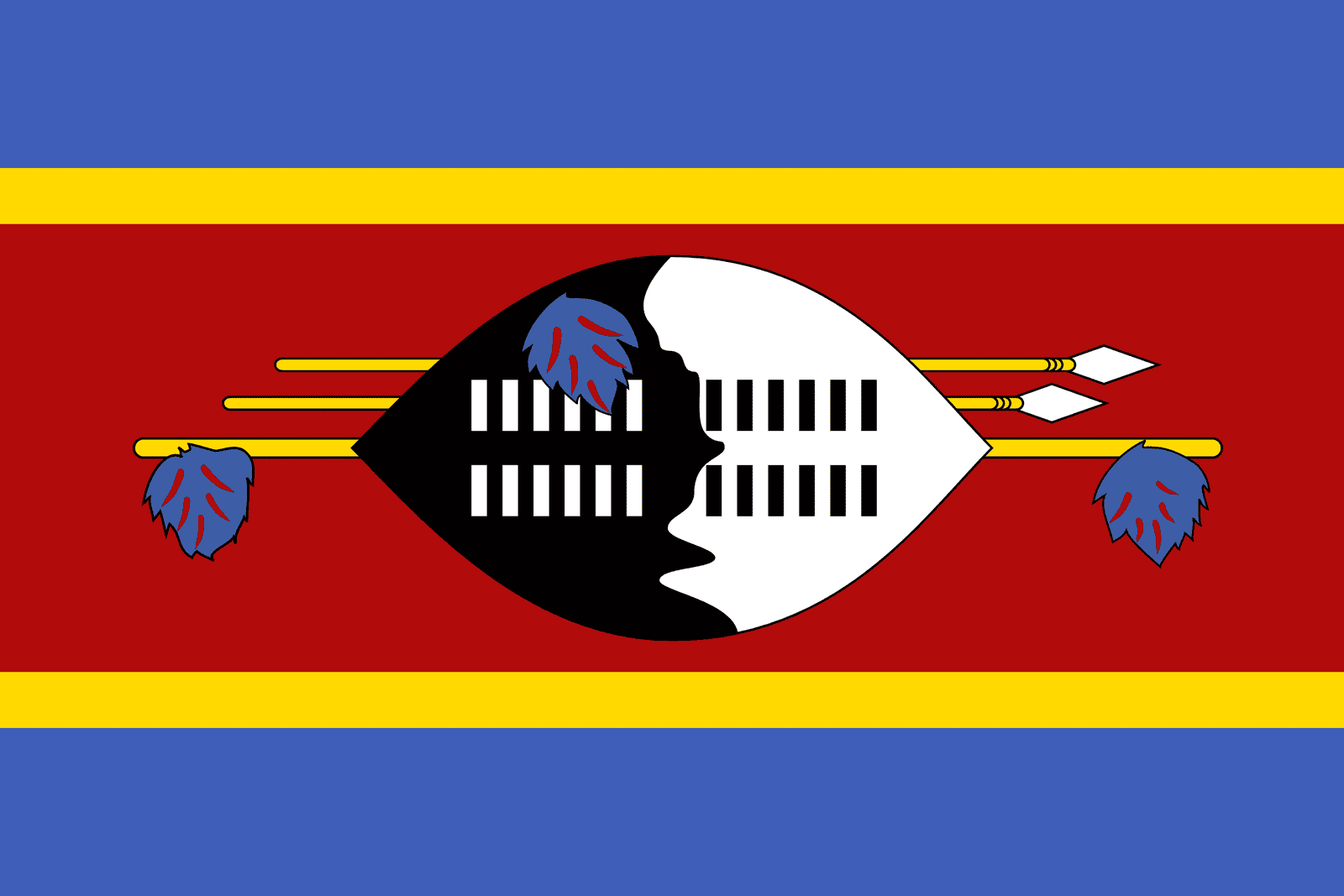
The flag of Eswatini features three horizontal stripes: blue at the top and bottom, symbolizing peace and stability; red in the center, representing past struggles; and thin yellow lines symbolizing mineral wealth.
At the center is a traditional Nguni shield with spears and a staff, representing protection, unity, and defense of the nation. The design reflects both military heritage and cultural identity.
The flag is displayed on government buildings, during national ceremonies, and on official flag days, following established protocol and respect.
Realted Flags
Flag flying days
| Date | Flag Position | Occasion or Reason |
|---|
| April 19 | Full-mast | King’s Birthday |
| April 25 | Full-mast | National Flag Day |
| September 6 | Full-mast | Independence Day |
| Official Mourning Days | Half-mast | State or national mourning period |