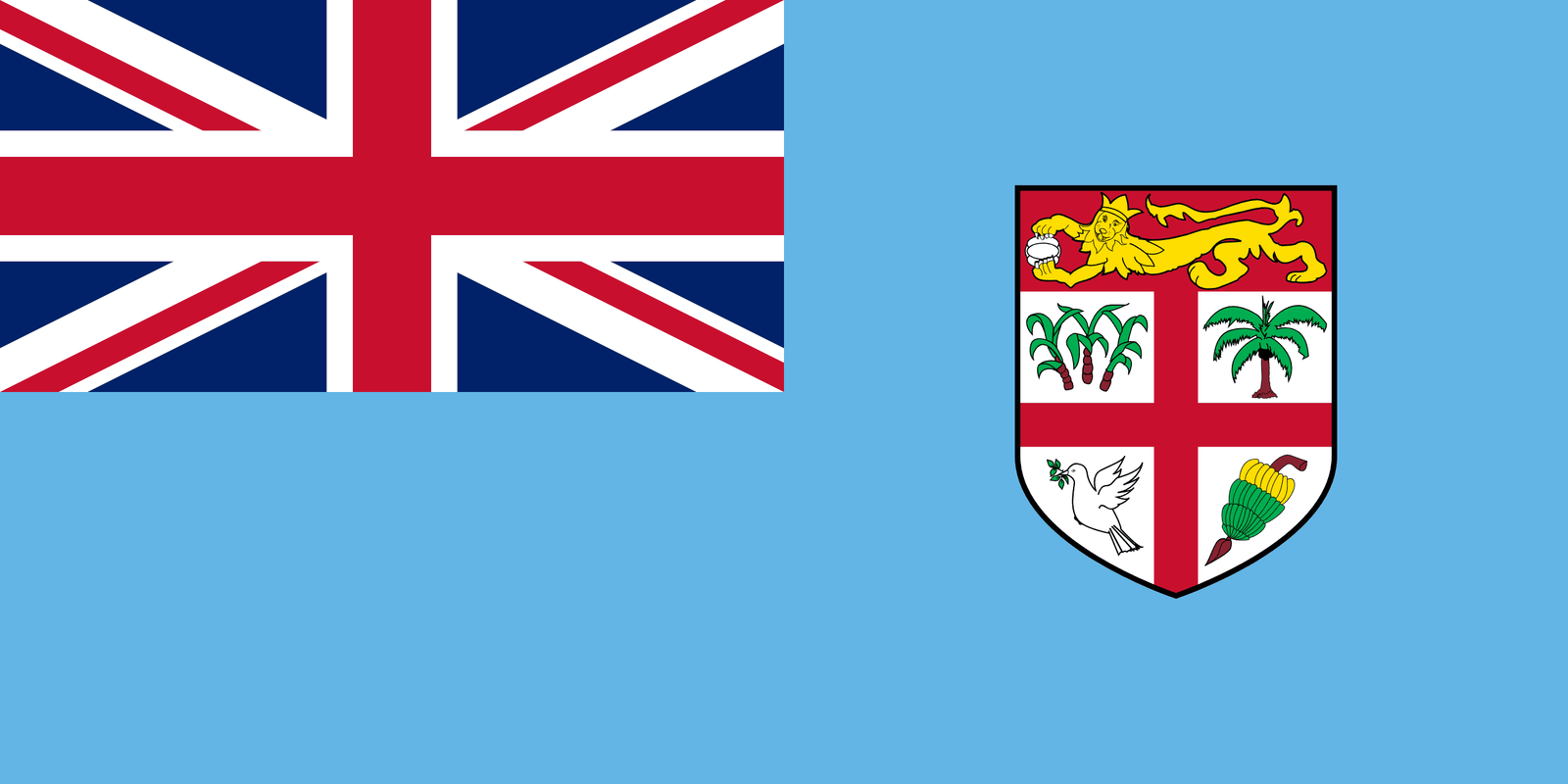
Flag of Fiji
| Legal Name | Republic of Fiji |
|---|---|
| Flag |
|
| Capital City |
Suva |
| Total Area | ~18,274 km² |
| Land Area | ~18,272 km² |
| Water Area | ~2 km² (inland waters) |
| Population | ~930,000 |
| Major Cities | Suva (~180k metro), Lautoka (~75k), Nadi (~70k), Labasa (~30k), Ba (~15k) |
| Currency | Fijian Dollar (FJD) |
| GDP | ~USD 5.5 billion |
| GDP Per Capita | ~USD 6,000 (nominal) |
About of Fiji
Fiji is an island nation located in the South Pacific Ocean, forming part of the Melanesian subregion of Oceania. It lies east of Vanuatu, west of Tonga, and south of Tuvalu. The country consists of more than 330 islands, of which around 110 are permanently inhabited, spread across a vast area of ocean.
The capital city, Suva, is situated on the southeastern coast of Viti Levu, the largest and most populous island. Other major urban centers include Lautoka, an important industrial and port city, and Nadi, which serves as Fiji’s main transportation hub due to its international airport. Settlement and economic activity are concentrated mainly on Viti Levu and Vanua Levu.
Fiji’s population is ethnically diverse, reflecting both Indigenous Fijian communities and descendants of Indian laborers brought during the colonial era. This diversity shapes the country’s social structure, politics, and cultural life.
Internationally, Fiji is recognized as a sovereign island state and an influential voice among Pacific Island nations. Its strategic location in the South Pacific, combined with its role in regional diplomacy, peacekeeping, and climate advocacy, gives Fiji importance beyond its size.
Etymology
The name “Fiji” originates from the Tongan word Fisi, which referred to the islands and their people. European explorers adopted this name in the 18th century, adapting it into the English form “Fiji.”
In the Indigenous Fijian language, the country is known as Viti, a term used by early Polynesian visitors and neighboring cultures. Over time, the English name “Fiji” became internationally accepted, while Viti remains deeply rooted in local identity and language.
The evolution of the name reflects Fiji’s historical connections with neighboring Pacific cultures and the influence of European contact.
History
Archaeological evidence suggests that Fiji was first settled over 3,000 years ago by Austronesian-speaking peoples associated with the Lapita culture. These early settlers developed sophisticated seafaring skills, agriculture, and social systems.
Prior to European contact, Fiji was characterized by complex chiefdoms and inter-island trade networks. While not part of classical or medieval empires, Fiji maintained regional influence through warfare, alliances, and cultural exchange within the Pacific.
European explorers arrived in the 17th and 18th centuries, followed by traders, missionaries, and settlers. In 1874, Fiji became a British colony. During colonial rule, the British introduced plantation agriculture, particularly sugarcane, and brought indentured laborers from India, permanently reshaping Fiji’s demographic composition.
Fiji gained independence from the United Kingdom in 1970. The post-independence period saw political tension related to ethnic representation and land ownership. Several coups occurred between 1987 and 2006, disrupting democratic governance.
In recent years, Fiji has returned to constitutional government, holding elections and re-engaging with international partners. Modern Fiji focuses on political stability, economic development, and leadership on regional and global issues, particularly climate change.
Government and Politics
Fiji operates as a parliamentary republic under a written constitution. The President serves as head of state, while executive authority is exercised by the Prime Minister and Cabinet.
The legislative branch consists of a unicameral Parliament elected through a proportional representation system. The judiciary is independent and based on common law traditions, with higher courts ensuring constitutional oversight.
Administratively, Fiji is divided into divisions, provinces, and local government areas. Traditional leadership structures coexist with modern state institutions, particularly in Indigenous land administration.
Fiji maintains active foreign relations and is a member of the United Nations, the Commonwealth, the Pacific Islands Forum, and other regional organizations. Its military, though relatively small, is highly regarded for international peacekeeping contributions.
Economy
Fiji is classified as a developing, upper-middle-income economy with a mixed economic system. The economy relies heavily on services, particularly tourism, which is a major source of foreign exchange and employment.
Agriculture remains important, with sugarcane, coconuts, root crops, and fisheries forming key components. Manufacturing is limited but includes food processing, beverages, and light industry.
Natural resources include fertile land, forests, fisheries, and mineral deposits such as gold. Fiji’s main trading partners include Australia, New Zealand, the United States, and Asian markets. Key exports include sugar, gold, fish, and tourism services.
Economic challenges include vulnerability to natural disasters, global economic shocks, and climate change. Future growth strategies emphasize sustainable tourism, renewable energy, and regional trade integration.
Demographics
Fiji’s population is ethnically diverse. Indigenous iTaukei (Fijians) form the majority, alongside a significant Indo-Fijian community and smaller groups of Pacific Islanders, Europeans, and Chinese.
English, Fijian, and Hindi are widely spoken, with English serving as the primary language of government and education. Christianity is the dominant religion, followed by Hinduism and Islam, reflecting the country’s multicultural heritage.
Urbanization is increasing, particularly around Suva and Nadi. Population growth has slowed in recent years due to migration and declining birth rates.
Culture and Society
Fijian culture places strong emphasis on community, respect for elders, and traditional customs. Indigenous traditions such as ceremonies, dance, and storytelling remain central to national identity.
Arts, music, and crafts draw from both Indigenous and Indo-Fijian influences. Cuisine features seafood, root vegetables, coconut-based dishes, and spices introduced through Indian heritage.
Social norms emphasize hospitality and communal living. Public holidays and festivals reflect religious and cultural diversity, including Christian, Hindu, and national celebrations. Rugby is the most popular sport, with Fiji achieving global recognition in rugby sevens.
Education and Healthcare
Fiji has a structured education system with compulsory primary education and expanding access to secondary and tertiary levels. Literacy rates are high by regional standards, and the country hosts several universities and technical institutions.
The healthcare system provides public services supplemented by private facilities. Fiji has achieved improvements in life expectancy and maternal health, though challenges remain related to non-communicable diseases and access in remote areas.
Geography and Climate
Fiji’s geography is defined by volcanic islands, coral reefs, mountains, rivers, and extensive coastlines. Viti Levu and Vanua Levu account for the majority of land area and population.
The climate is tropical maritime, with a warm season and a cooler, drier season. Cyclones, floods, and landslides are the main natural hazards.
Environmental concerns include rising sea levels, coral reef degradation, and deforestation. Conservation and climate resilience are national priorities.
Flora and Fauna
Fiji hosts rich biodiversity, including many endemic plant and animal species. Tropical rainforests support diverse flora, while surrounding waters contain vibrant coral reefs and marine life.
Wildlife includes birds, reptiles, and marine species, with limited native mammals. National parks and marine protected areas aim to preserve ecosystems and promote sustainable use of natural resources.
Map of Fiji
Fiji’s national symbols reflect its history and natural environment. The flag incorporates elements of colonial heritage and national identity. The coat of arms features symbols of agriculture, peace, and unity.
The national anthem, “God Bless Fiji,” expresses loyalty and national pride. Natural symbols such as the coconut tree and the hibiscus flower hold cultural significance.
National Flag (Detailed Section)
The flag of Fiji features a light blue background symbolizing the Pacific Ocean. The Union Jack in the upper hoist canton reflects historical ties to the United Kingdom, while the shield on the fly displays elements from the national coat of arms.
The flag was adopted at independence and has remained in use, representing continuity and national identity. The imagery combines Indigenous, colonial, and Christian symbolism.
Flag usage follows official protocol, with display on government buildings, during national events, and on designated flag days. Respectful handling of the flag is emphasized.
Realted Flags

Flag flying days
| Date | Flag Position | Occasion or Reason |
|---|
| January 1 | Full-mast | New Year’s Day |
| September 7 | Full-mast | Constitution Day |
| October 10 | Full-mast | Fiji Day (Independence Day) |
| National Mourning Days | Half-mast | Official state mourning period |