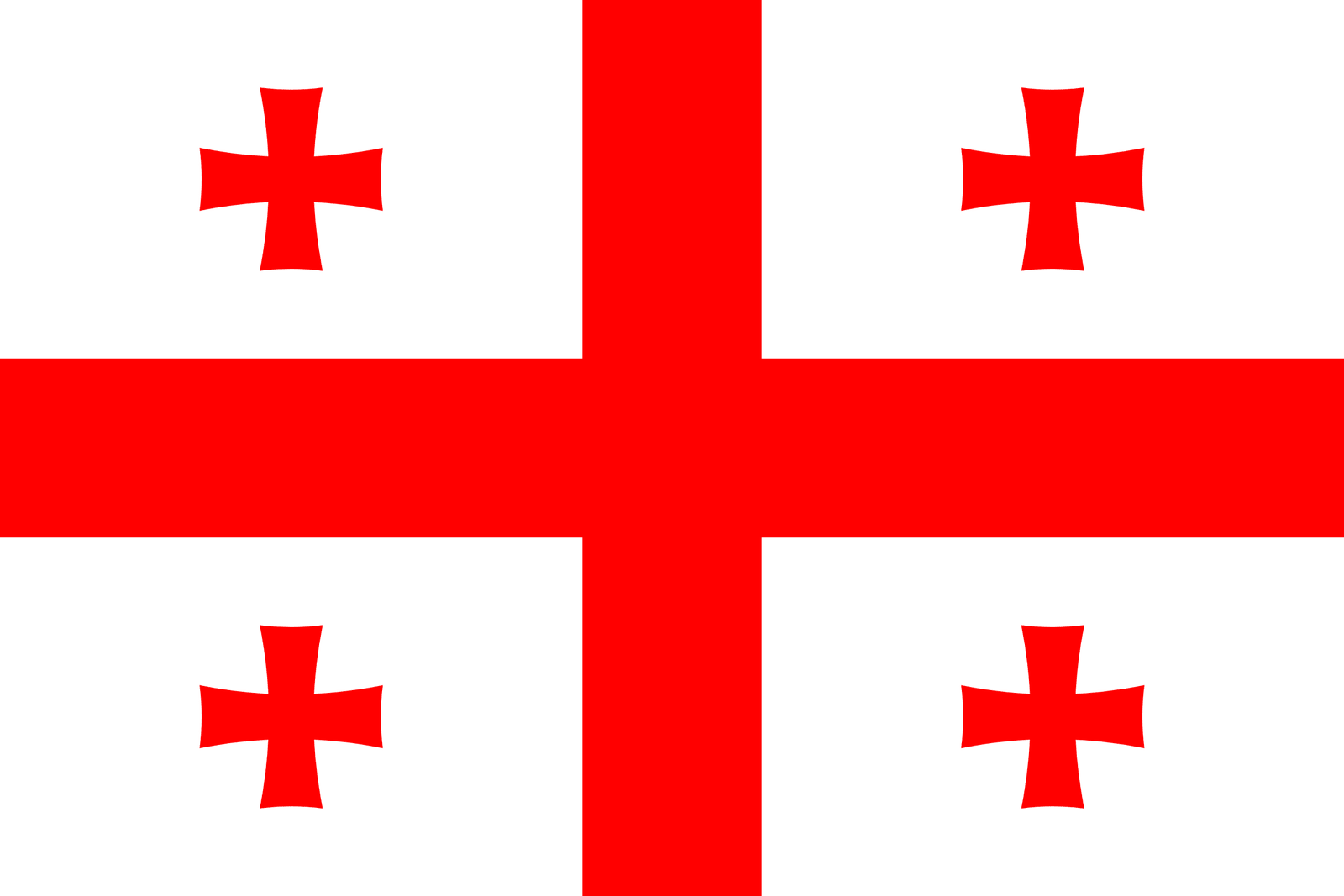
Flag of Georgia
| Legal Name | Georgia |
|---|---|
| Flag |
|
| Capital City |
Tbilisi |
| Total Area | 69,700 |
| Land Area | 69,700 |
| Water Area | Minimal inland water bodies; ~0.2% of total area |
| Population | ~3.7 million |
| Major Cities | Tbilisi (~1.2 million), Kutaisi (~200,000), Batumi (~160,000), Rustavi (~130,000) |
| Currency | Georgian Lari (GEL) |
| GDP | ~USD 20.7 billion |
| GDP Per Capita | ~USD 18,400 (PPP) |
About of Georgia
Georgia is a transcontinental country located at the intersection of Eastern Europe and Western Asia, in the South Caucasus region. It is bounded by the Black Sea to the west, Russia to the north, Azerbaijan to the southeast, Armenia to the south, and Turkey to the southwest. Its location makes it a strategic bridge between Europe and Asia, with vital energy corridors and transportation routes passing through its territory.
The country’s topography is highly varied, from the rugged Caucasus Mountains in the north to fertile plains and coastal areas along the Black Sea. Tbilisi, the capital and largest city, serves as the cultural, political, and economic hub. Other significant cities include Kutaisi, Batumi, and Rustavi. Georgia has a diverse population concentrated primarily in urban areas, with a rich mix of ethnic Georgians, Armenians, Azeris, and other minorities. The nation is internationally recognized as a sovereign state, though it faces ongoing challenges related to the breakaway regions of Abkhazia and South Ossetia, which have limited recognition.
Georgia’s strategic importance lies in its geographic position along the historical Silk Road, its energy pipelines connecting the Caspian Sea to Europe, and its proximity to both Russia and the Middle East, making it central to regional trade and security.
Etymology
The name “Georgia” likely originates from the Persian word Gurj, later adopted into European languages. In the native Georgian language, the country is called Sakartvelo, which derives from the core central region of Kartli (Kartvelebi being the people). Historically, the name reflects both geographic and cultural identity, with roots tracing back to early medieval Christian kingdoms and regional dynasties. Over time, the Western exonym “Georgia” became widely used internationally.
History
Prehistoric and Ancient Civilizations
Georgia has been inhabited since the Paleolithic era. Archaeological finds indicate early human settlement and complex societies in the Kolkheti and Kura-Araxes regions. The ancient kingdoms of Colchis and Iberia emerged around the first millennium BCE, with Colchis famously associated with the Greek myth of Jason and the Argonauts.
Classical and Medieval Periods
From the 4th century CE, Georgia embraced Christianity, establishing itself as one of the earliest Christian states. Medieval Georgia saw the consolidation of multiple principalities and the rise of the unified Kingdom of Georgia under King David IV and Queen Tamar, during which the country experienced political stability and cultural flourishing.
Major Empires and Dynasties
Georgia’s territory was contested by the Byzantine Empire, Persians, Arabs, Mongols, and Ottomans. Despite invasions, the Georgian monarchy preserved local culture and governance until fragmentation in the late medieval period.
Colonial or Imperial Rule
In the 19th century, Georgia became part of the Russian Empire, which introduced modern administrative and infrastructure developments while limiting national sovereignty. The early 20th century saw brief independence following the Russian Revolution.
Independence Movement
The Democratic Republic of Georgia declared independence in 1918, only to be incorporated into the Soviet Union in 1921. Soviet rule lasted until Georgia’s restoration of independence on April 9, 1991.
Key Post-Independence Events
Since independence, Georgia has faced civil unrest, territorial disputes in Abkhazia and South Ossetia, and economic transitions. Reforms and modernization efforts accelerated in the 2000s, alongside increasing international cooperation with Europe and the United States.
Modern Political Developments
Georgia operates as a democratic republic with elections, constitutional reforms, and active civil society. Its foreign policy emphasizes Euro-Atlantic integration, including aspirations for NATO and EU membership.
Government and Politics
Georgia is a unitary parliamentary republic. The constitution outlines separation of powers among executive, legislative, and judicial branches. The president serves primarily as a ceremonial head of state, while the prime minister holds executive authority. The unicameral Parliament legislates on national policy and budgets. The judiciary is independent, with a Supreme Court overseeing legal compliance.
Administratively, Georgia is divided into nine regions (mkhare), plus autonomous republics of Abkhazia and Adjara. The country maintains diplomatic relations globally, participates in the UN, Council of Europe, and GUAM, and engages in regional security and energy initiatives. The Georgian Defense Forces protect national sovereignty and collaborate with international military partners.
Economy
Georgia is classified as an emerging market economy. Key sectors include agriculture, wine production, tourism, mining, energy, and services. The country produces wine, tea, citrus fruits, and hazelnuts. Mining focuses on manganese, copper, and gold. The service sector, including tourism, finance, and transport, is a growing economic driver.
Trade partners include Russia, Turkey, the European Union, and China. Challenges include political instability, regional conflicts, and vulnerability to global market fluctuations. Economic reform programs emphasize infrastructure, investment, and regional connectivity.
Demographics
Georgia’s population is predominantly ethnic Georgian (~86%), with significant Armenian, Azeri, Russian, and minority groups. Georgian is the official language, with regional languages like Russian, Armenian, and Azeri widely spoken. The country is predominantly Orthodox Christian (Georgian Orthodox Church), with Muslim, Catholic, and other religious communities. Roughly 58% of the population is urban, concentrated in Tbilisi, Batumi, and Kutaisi. Population growth is modest, with declining fertility rates and emigration affecting demographic trends.
Culture and Society
Georgia has a rich cultural heritage blending ancient traditions with European and Middle Eastern influences. Folk music, polyphonic singing, and traditional dance are central to national identity. Georgian literature and calligraphy have a long history, while wine-making traditions date back millennia. Cuisine emphasizes bread, cheese, meat, and spices, with signature dishes such as khachapuri and khinkali. Social norms are rooted in hospitality, family ties, and respect for elders. Festivals include Tbilisoba, Orthodox religious holidays, and national independence celebrations. Football, rugby, and wrestling are popular sports.
Education and Healthcare
The education system consists of primary, secondary, and higher education, with notable universities in Tbilisi and Kutaisi. Literacy exceeds 99%. Healthcare is provided through public and private institutions, with ongoing reforms to improve access, quality, and rural healthcare delivery. Public health challenges include non-communicable diseases and maintaining infrastructure in remote regions.
Geography and Climate
Georgia’s geography ranges from the Greater Caucasus Mountains in the north to the fertile lowlands and subtropical Black Sea coast. Major rivers include the Kura and Rioni. Climate varies from alpine in the mountains to humid subtropical on the coast, with continental patterns inland. Natural hazards include earthquakes, landslides, floods, and occasional severe weather. Environmental concerns involve deforestation, water management, and biodiversity conservation.
Flora and Fauna
Georgia is highly biodiverse, home to temperate forests, alpine meadows, and coastal wetlands. Native plant species include oak, hornbeam, and endemic alpine flora. Wildlife includes brown bears, lynx, Caucasian tur, wolves, and various bird species. National parks and protected areas, such as Borjomi-Kharagauli and Tusheti, safeguard ecosystems and promote ecotourism.
Map of Georgia
Georgia’s flag, the Five Cross Flag, symbolizes Christian heritage and national unity. The coat of arms depicts Saint George slaying a dragon, representing courage and freedom. The national anthem, Tavisupleba (“Freedom”), celebrates independence and sovereignty. Other symbols include the Caucasian leopard, oak tree, and national monuments such as Gelati Monastery and Svetitskhoveli Cathedral.
National Flag (Detailed Section)
The Georgian flag consists of a large central cross dividing the white field into four quadrants, each with a smaller cross. Adopted in 2004, it symbolizes Georgia’s Christian history, unity, and resilience. The white background represents purity and peace, while the red signifies bravery and sacrifice. The flag is displayed on national holidays, government buildings, and international events, with half-mast protocol for mourning.

Flag flying days
| Date | Flag Position | Occasion or Reason |
|---|---|---|
| May 26 | Full-mast | Independence Day (from Russia, 1918) |
| April 9 | Full-mast | National Day of Memory (Soviet-era independence restoration, 1991) |
| Orthodox Christian Holidays | Full-mast | National religious observances |
| National Mourning Days | Half-mast | Death of prominent leaders or national tragedies |