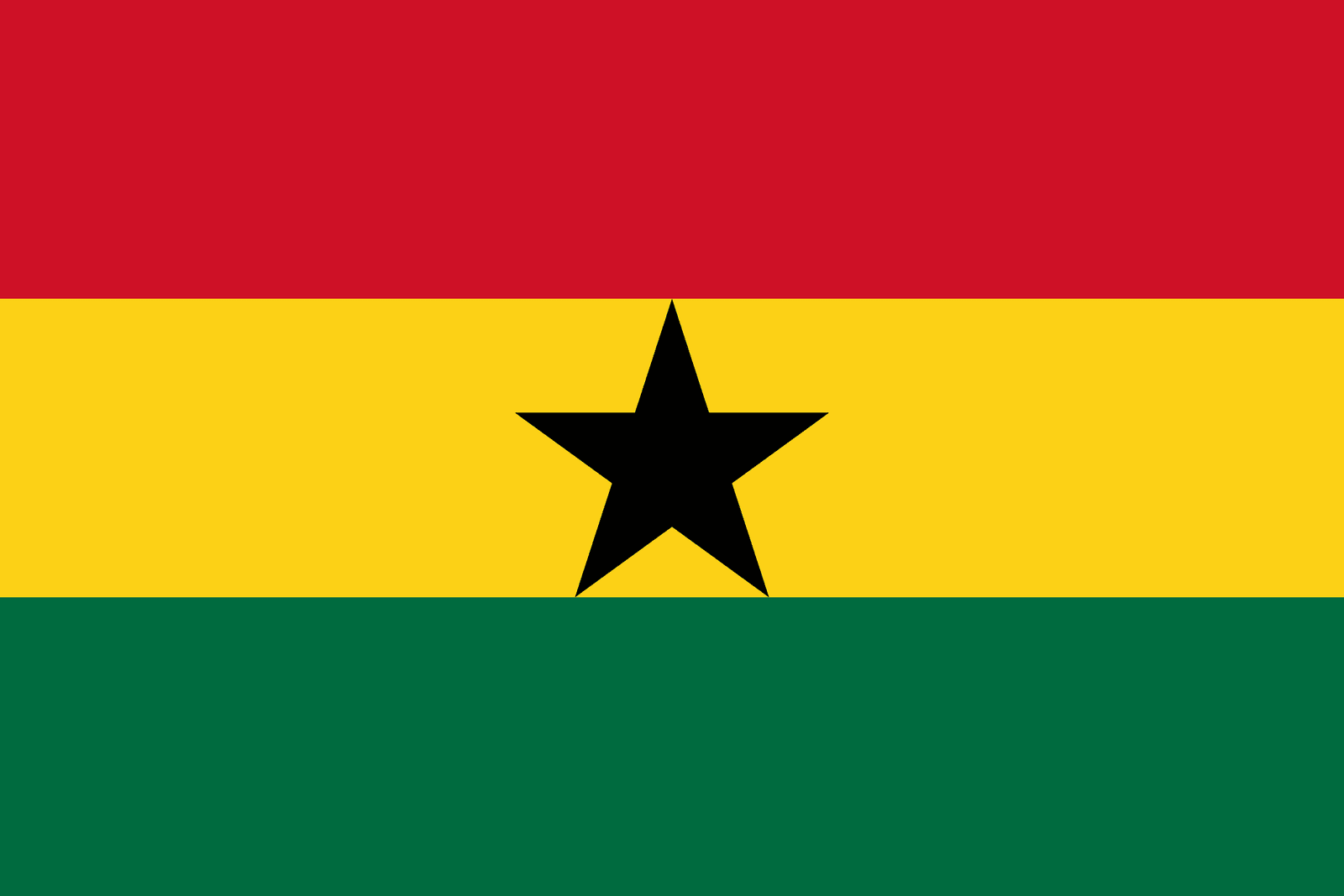
Flag of Ghana
| Legal Name | Republic of Ghana |
|---|---|
| Flag |
|
| Capital City |
Accra |
| Total Area | 238,533 km² |
| Land Area | 227,533 km² |
| Water Area | 11,000 km² |
| Population | Approximately 34 million |
| Major Cities | Accra (~2.3 million), Kumasi (~3 million metropolitan), Tamale (~600,000), Takoradi (~500,000), Sekondi (~400,000) |
| Currency | Ghanaian cedi (GHS) |
| GDP | Approximately USD 82 billion |
| GDP Per Capita | Approximately USD 2,400 (nominal) |
About of Ghana
Ghana is a West African country situated along the Gulf of Guinea and the Atlantic Ocean. It occupies a strategic position in West Africa, bordered by Côte d’Ivoire to the west, Burkina Faso to the north, Togo to the east, and the Atlantic coastline to the south. Its geography includes coastal plains, tropical forests, and savannah regions, contributing to rich biodiversity and varied agricultural opportunities.
Accra, the capital, is the political, economic, and cultural center of Ghana, while Kumasi serves as a major hub of commerce and cultural heritage. The population is ethnically diverse, with a mixture of Akan, Mole-Dagbani, Ewe, Ga-Dangme, and other groups. Ghana is internationally recognized as a stable democracy in Africa, with a strong commitment to human rights and regional cooperation. Strategically, Ghana plays a significant role in ECOWAS (Economic Community of West African States) and serves as a gateway for trade and investment in West Africa.
Etymology
The name “Ghana” derives from the medieval Ghana Empire, which once flourished several hundred kilometers to the north of modern Ghana. The term “Ghana” means “warrior king” in the Soninke language. Although the modern state occupies territory different from the ancient empire, the name was chosen to symbolize a legacy of African strength, unity, and independence during the independence movement of the 20th century.
History
Prehistoric and Ancient Civilizations
Archaeological evidence indicates human habitation in Ghana dating back thousands of years. Early inhabitants were hunter-gatherers and later farmers, cultivating yams, millet, and other crops. Ironworking technology and trade networks emerged early, facilitating societal development.
Classical and Medieval Periods
From the 9th century, Ghana was influenced by trans-Saharan trade. Kingdoms such as the Bono, Dagbon, and Ashanti rose, controlling trade in gold, ivory, and kola nuts. The Ashanti Empire, established in the 17th century, became particularly prominent for its military and administrative organization.
Colonial Era
Portuguese explorers arrived in the 15th century, followed by the Dutch, British, Danes, and Swedes, who established forts and trading posts along the coast. The British eventually consolidated control in the 19th century, incorporating the area into the Gold Coast colony, heavily exploiting natural resources and establishing plantations.
Independence Movement
The 20th century saw growing nationalist sentiment, led by figures like Kwame Nkrumah. After sustained political activism and advocacy, Ghana achieved independence from Britain on March 6, 1957, becoming the first sub-Saharan African country to gain sovereignty in the post-colonial era.
Post-Independence and Modern Politics
Nkrumah’s presidency emphasized pan-Africanism and modernization but ended with a military coup in 1966. Subsequent decades experienced alternating civilian and military governments. Democratic governance stabilized in 1992, with regular elections and peaceful transitions of power. Today, Ghana is considered a model of democracy in Africa.
Government and Politics
Ghana is a unitary presidential constitutional democracy. The President serves as both head of state and government and is elected for a four-year term. Executive power is exercised by the President and Cabinet. Legislative authority resides in the unicameral Parliament, with members elected to five-year terms.
The judiciary is independent, comprising the Supreme Court, Court of Appeal, and lower courts. Administratively, the country is divided into 16 regions, further subdivided into metropolitan, municipal, and district assemblies. Ghana maintains active diplomatic relations and participates in international organizations including the UN, AU, ECOWAS, and the Commonwealth. National defense is provided by the Ghana Armed Forces.
Economy
Ghana is classified as a developing economy with a strong growth trajectory. Key sectors include agriculture, mining, manufacturing, and services. Cocoa, gold, and oil are major exports, positioning Ghana as a leading global producer of cocoa and a significant gold exporter.
Agriculture employs a large portion of the population, producing cocoa, cashew, timber, and staple crops. Manufacturing includes food processing, textiles, and construction materials, while services and banking have expanded in urban centers. Natural resources include gold, bauxite, manganese, oil, and gas. Key trading partners are China, the United States, the European Union, and neighboring West African nations.
Economic challenges include income inequality, infrastructure gaps, and vulnerability to commodity price fluctuations. Future growth is expected in energy, technology, agribusiness, and sustainable development initiatives.
Demographics
Ghana’s population is diverse, with the majority being of Akan ethnicity, followed by Mole-Dagbani, Ewe, Ga-Dangme, and other groups. English is the official language, supplemented by indigenous languages such as Twi, Ewe, Dagbani, and Fante. Christianity is predominant, with Islam and traditional African religions also practiced.
Approximately 56% of the population lives in urban areas, concentrated around Accra, Kumasi, and Takoradi. Population growth remains steady, supported by improving healthcare and education.
Culture and Society
Ghanaian culture is rich, with deep-rooted traditions in music, dance, art, and storytelling. Drumming, kente weaving, and festivals such as Homowo and Aboakyir reflect communal values and history.
Cuisine features staples such as fufu, banku, and jollof rice, often accompanied by fish, plantains, and local spices. Social norms emphasize hospitality, family cohesion, and respect for elders. Popular sports include football (soccer), athletics, and boxing, with Ghana producing internationally renowned athletes.
Education and Healthcare
Ghana provides free basic education and has a structured system from primary to tertiary levels. Literacy rates are high relative to regional averages, and higher education institutions include the University of Ghana and Kwame Nkrumah University of Science and Technology.
Healthcare services are delivered through public hospitals, clinics, and private facilities. Public health initiatives have reduced infectious diseases, though challenges persist with non-communicable diseases and rural healthcare access.
Geography and Climate
Ghana features coastal plains, tropical forests, savannahs, and inland plateau regions. Major rivers include the Volta, Black Volta, and White Volta, with Lake Volta forming one of the largest man-made lakes in the world.
The climate is tropical, with a wet season from April to October and a dry season from November to March. Natural hazards include occasional droughts, floods, and coastal erosion. Environmental concerns include deforestation, soil degradation, and climate change impacts.
Flora and Fauna
Ghana has significant biodiversity, including tropical rainforests, savannah grasslands, and coastal ecosystems. Native plants include mahogany, iroko, and oil palm, while wildlife includes elephants, antelope, monkeys, birds, and reptiles. National parks and reserves, such as Kakum and Mole National Parks, protect species and promote eco-tourism
Map of Ghana
Ghana’s national symbols reflect its independence, unity, and cultural heritage. These include the national flag, coat of arms, national anthem, and emblematic wildlife such as the eagle.
National Flag (Detailed Section)
Ghana’s flag, adopted in 1957 at independence, features horizontal stripes of red, gold, and green with a central black star. Red symbolizes the blood of those who fought for independence, gold represents mineral wealth, and green stands for rich forests and agriculture. The black star signifies African freedom and unity. The flag is used in official ceremonies, government buildings, and national celebrations.
Flag flying days
| Date | Flag Position | Occasion or Reason |
|---|
| March 6 | Full-mast | Independence Day |
| July 1 | Full-mast | Republic Day |
| January 7 | Full-mast | National Prayer Day |
| Official Mourning Periods | Half-mast | National days of mourning |
| August 4 | Full-mast | Founders’ Day / Kwame Nkrumah Memorial |