
Flag of Haiti
| Legal Name | Republic of Haiti |
|---|---|
| Flag |
|
| Capital City |
Port-au-Prince |
| Total Area | 27,750 km² |
| Land Area | 27,560 km² |
| Water Area | 190 km² |
| Population | Approximately 11.5 million |
| Major Cities | Port-au-Prince (~2.6 million), Cap-Haïtien (~200,000), Gonaïves (~150,000), Les Cayes (~100,000), Jacmel (~90,000) |
| Currency | Haitian Gourde (HTG) |
| GDP | Approximately USD 15 billion |
| GDP Per Capita | Approximately USD 1,300 (nominal) |
About of Haiti
Haiti occupies the western third of the island of Hispaniola in the Caribbean Sea, sharing a border with the Dominican Republic to the east. It lies southeast of Cuba and northwest of Puerto Rico. The country’s terrain is predominantly mountainous, with fertile valleys and narrow coastal plains. The Caribbean coastline and inland rivers contribute to its ecological diversity and agricultural potential.
Port-au-Prince, the capital, is both the political and economic hub, hosting government institutions, commercial centers, and cultural sites. Other major urban areas, such as Cap-Haïtien and Gonaïves, also play key roles in regional trade and historical heritage. Haiti has a population that is predominantly of African descent, reflecting its colonial and revolutionary history. The country is recognized internationally for its status as the first independent Black republic in the world, achieving sovereignty following a successful slave revolt. Strategically, Haiti’s location in the Caribbean has historically made it a focal point for trade and colonial interests.
Etymology
The name “Haiti” originates from the indigenous Taíno word Ayiti, meaning “land of high mountains.” Early European settlers adopted this name during colonization. The term emphasizes the country’s rugged topography and mountainous interior, a defining feature of its landscape.
History
Prehistoric and Indigenous Period
The island of Hispaniola was originally inhabited by the Taíno people, who established agricultural settlements, developed fishing practices, and created social and religious structures.
Colonial Era
Christopher Columbus landed on the island in 1492, and by the early 16th century, Spain had claimed the territory. French colonists later occupied the western region, establishing Saint-Domingue, which became the wealthiest colony in the Americas due to sugar and coffee plantations reliant on enslaved African labor.
Independence Movement
Haiti’s independence movement began in 1791 with a massive slave uprising. Led by figures like Toussaint Louverture and Jean-Jacques Dessalines, the revolt culminated in 1804 with Haiti becoming the first Black republic and the second independent nation in the Americas, after the United States.
Post-Independence
The 19th and 20th centuries were marked by political instability, foreign intervention, and economic challenges. The U.S. occupied Haiti from 1915 to 1934, influencing infrastructure and governance. The Duvalier dictatorships (1957–1986) brought repression and human rights abuses, while subsequent governments struggled with democracy and economic development.
Modern Political Developments
Haiti continues to face political volatility, natural disasters, and economic struggles. International aid and democratic reforms remain key components of national recovery efforts, alongside grassroots social and community initiatives.
Government and Politics
Haiti is a semi-presidential republic with a president as head of state and a prime minister as head of government. The constitution provides a legal framework for executive, legislative, and judicial powers. The National Assembly is bicameral, consisting of the Senate and the Chamber of Deputies. The judicial branch includes the Supreme Court and lower courts.
Administratively, Haiti is divided into 10 departments, each subdivided into communes. The country maintains diplomatic relations globally and is a member of the United Nations, Organization of American States (OAS), and Caribbean Community (CARICOM). The Haitian National Police oversee public security, and the armed forces are largely limited, having been officially disbanded in 1995.
Economy
Haiti is classified as a low-income developing country. Agriculture remains central, with coffee, mangoes, sugarcane, and rice as major exports. Manufacturing focuses on textiles, apparel, and assembly plants, while the service sector includes commerce, tourism, and informal trade.
Natural resources include arable land, timber, and mineral deposits, but exploitation is limited by infrastructure challenges. Key trade partners include the United States, Canada, and the Dominican Republic. Economic challenges include poverty, political instability, reliance on remittances, and vulnerability to natural disasters. Future outlook depends on governance reform, foreign investment, and sustainable development initiatives.
Demographics
Haiti’s population is predominantly of African descent, reflecting its colonial and revolutionary history. Minority groups include mixed-race and small Indigenous communities. Haitian Creole and French are official languages, with Creole widely spoken. Roman Catholicism is the dominant religion, alongside Protestant and Vodou practices.
Urbanization is concentrated in Port-au-Prince and other major cities, with rural populations engaging primarily in agriculture. Population growth is moderate, constrained by emigration, natural disasters, and socioeconomic factors.
Culture and Society
Haitian culture blends African, French, and Indigenous elements. National identity emphasizes resilience, community, and creativity. Music genres include kompa, rara, and mizik rasin. Literature, visual arts, and sculpture often explore history, spirituality, and social commentary. Cuisine features rice, beans, plantains, and seafood, influenced by both African and French culinary traditions.
Festivals such as Carnival and Haitian Independence Day reflect cultural pride and historical commemoration. Football (soccer) is the most popular sport, alongside basketball and traditional games.
Education and Healthcare
Education includes primary, secondary, and tertiary levels, with literacy rates improving but still challenged by rural access and resource limitations. Several universities and technical institutes provide higher education.
Healthcare is delivered via public and private facilities, focusing on primary care and emergency services. Public health challenges include infectious disease, malnutrition, and disaster response, with international aid supporting recovery and infrastructure improvements.
Geography and Climate
Haiti’s landscape is predominantly mountainous, with coastal plains along the Caribbean and the Gulf of Gonâve. Major rivers include Artibonite, Massacre, and Guayamouc. The climate is tropical, with wet and dry seasons, and variations in elevation produce temperate highland conditions.
The country is prone to hurricanes, earthquakes, floods, and landslides. Environmental concerns include deforestation, soil erosion, water contamination, and habitat loss.
Flora and Fauna
Haiti hosts tropical forests, mangroves, and coral reefs. Native plant species include mahogany, Haitian pine, and endemic orchids. Wildlife includes iguanas, tropical birds, and marine species, but many face threats from habitat destruction. Conservation efforts focus on protected areas, reforestation, and coastal preservation.
Map of Haiti
Haiti’s national symbols include the flag, coat of arms, and national anthem “La Dessalinienne,” representing independence and national pride. National animals include the Hispaniolan trogon (bird) and the Haitian boa. Notable national monuments commemorate revolutionary leaders and cultural heritage.
National Flag (Detailed Section)
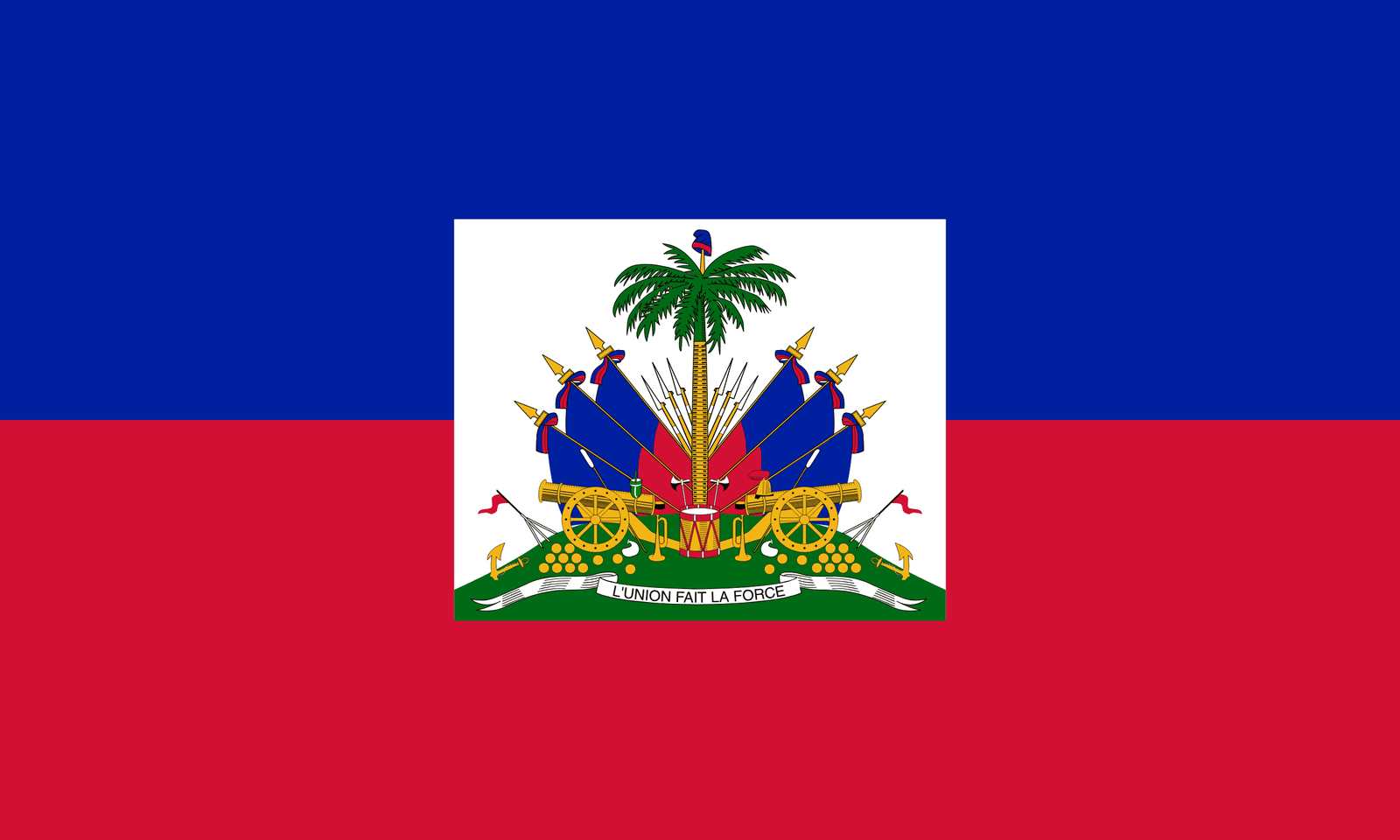
Haiti’s flag consists of two horizontal bands, blue and red, with a central white panel displaying the coat of arms. The blue represents the Black citizens, and red symbolizes the blood of those who fought for independence. The central emblem depicts a palm tree, cannons, and banners, symbolizing freedom and readiness to defend sovereignty. The flag’s origins date to 1803 during the revolutionary period, with variations adopted over time to solidify national identity. It is flown on government buildings, schools, and during official ceremonies.
Flag flying days
| Date | Flag Position | Occasion or Reason |
|---|---|---|
| January 1 | Full-mast | Independence Day |
| May 18 | Full-mast | Flag Day |
| National Mourning Periods | Half-mast | Death of national leaders or major tragedies |
| October 17 | Full-mast | Haitian Revolution Commemoration |
| November 18 | Full-mast | Constitution Day |