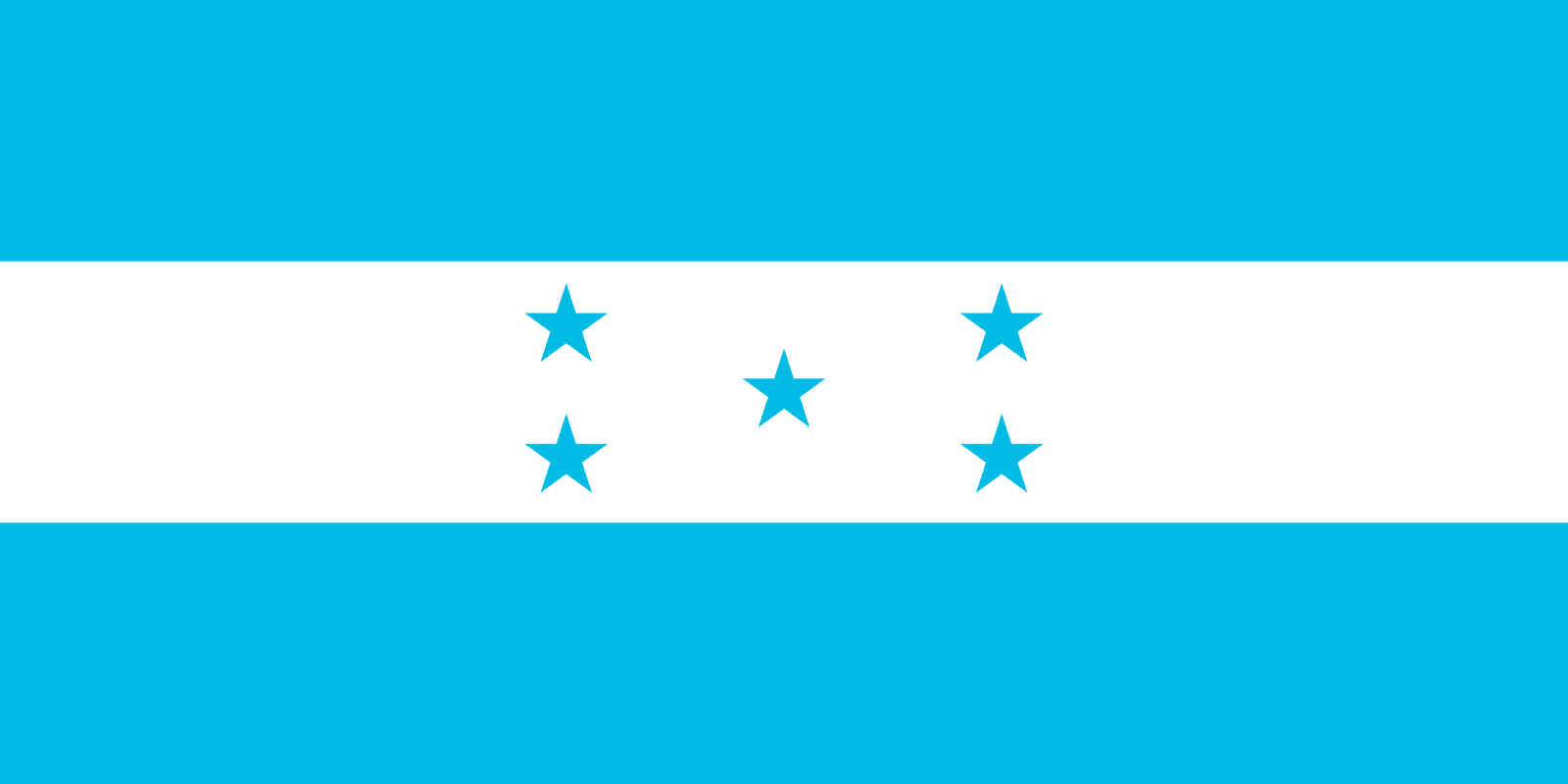
Flag of Honduras
| Legal Name | Republic of Honduras |
|---|---|
| Flag |
|
| Capital City |
Tegucigalpa |
| Total Area | 112,492 km² |
| Land Area | 111,890 km² |
| Water Area | 602 km² |
| Population | Approximately 10.7 million |
| Major Cities | Tegucigalpa (~1.2 million), San Pedro Sula (~900,000), La Ceiba (~250,000), Choloma (~230,000), El Progreso (~200,000) |
| Currency | Honduran Lempira (HNL) |
| GDP | Approximately USD 28 billion |
| GDP Per Capita | Approximately USD 2,600 (nominal) |
About of Honduras
Honduras is a Central American nation located between Guatemala, El Salvador, and Nicaragua, with coastlines along both the Caribbean Sea to the north and the Pacific Ocean via the Gulf of Fonseca to the south. The country’s terrain is largely mountainous, interspersed with narrow coastal plains and fertile valleys, making agriculture a key component of its economy. Honduras’ strategic location bridges Central and North America, serving historically as a transit region for commerce and culture.
Tegucigalpa, the capital and largest city, functions as the political, economic, and cultural hub. San Pedro Sula is the industrial and commercial center, hosting major manufacturing and export activities. Honduras has a diverse population, including Mestizo, Indigenous, and Afro-descendant communities, reflecting a complex cultural and ethnic heritage. Internationally, Honduras is recognized as a democratic republic and is a member of organizations such as the United Nations, the Organization of American States (OAS), and the Central American Integration System (SICA).
Etymology
The name “Honduras” is derived from the Spanish word hondura, meaning “depths,” referencing the deep waters off the northern coast observed by early Spanish explorers. Historical interpretations also suggest it relates to the region’s mountainous terrain and deep valleys. The name has remained unchanged since the early colonial period, representing both geographic features and the early European encounter with the region.
History
Prehistoric and Ancient Civilizations
Archaeological evidence indicates that Honduras was inhabited by indigenous groups as early as 10,000 BCE. Advanced civilizations, such as the Maya, flourished in western Honduras, leaving monumental architecture, cities, and hieroglyphic inscriptions.
Colonial Period
Christopher Columbus reached the northern coast of Honduras in 1502, and Spanish colonization began in the early 16th century. Honduras became part of the Captaincy General of Guatemala, serving as a colonial outpost focused on mining and agriculture. Indigenous populations were largely subjected to labor systems under Spanish rule.
Independence Movement
Honduras declared independence from Spain on September 15, 1821, joining the Federal Republic of Central America until its dissolution in 1838, after which Honduras became a sovereign nation. Political instability marked much of the 19th century, including frequent coups and territorial disputes.
Modern Political Developments
Throughout the 20th century, Honduras experienced periods of military rule, political unrest, and civil reform. Democratic governance was restored in the 1980s, with successive elections and constitutional reforms shaping contemporary Honduran politics. Natural disasters, economic challenges, and social inequality remain ongoing issues.
Government and Politics
Honduras is a presidential representative democratic republic. The President serves as both head of state and government, elected for a four-year term. The National Congress is a unicameral legislative body, while the judiciary operates independently with the Supreme Court as its highest authority.
The country is divided into 18 departments, each administered by a governor appointed by the national government. Honduras maintains active participation in regional organizations such as SICA and international bodies including the UN and OAS. The Honduran Armed Forces focus on national defense and disaster response, while policing and public security are managed by civilian law enforcement.
Economy
Honduras is classified as a developing economy with significant reliance on agriculture, manufacturing, and services. Key agricultural products include coffee, bananas, palm oil, and sugar. Manufacturing focuses on textiles, apparel, and food processing. The service sector, particularly finance, tourism, and telecommunications, has expanded in recent decades.
Natural resources include timber, gold, silver, zinc, and lead. Honduras’ main trade partners include the United States, Guatemala, El Salvador, and Mexico. Economic challenges include poverty, inequality, vulnerability to natural disasters, and dependence on agricultural exports. Efforts toward diversification and foreign investment aim to strengthen long-term economic stability.
Demographics
Honduras’ population is predominantly Mestizo, with Indigenous, Afro-descendant, and White minorities. Spanish is the official language, with Indigenous languages such as Garífuna, Miskito, and Lenca spoken in regional communities. The majority of the population practices Roman Catholicism, alongside Protestant denominations and small Indigenous spiritual traditions.
Urbanization is increasing, with a growing percentage of residents in Tegucigalpa, San Pedro Sula, and other cities. Population growth remains moderate, with social programs focusing on education, healthcare, and poverty alleviation.
Culture and Society
Honduran culture is shaped by a blend of Indigenous, Spanish, and Afro-Caribbean influences. National identity emphasizes community, family, and traditional customs. Music genres include punta, merengue, and folk rhythms, while literature and visual arts celebrate the country’s history and natural beauty. Culinary traditions feature staples such as beans, corn, plantains, and seafood.
Festivals such as the Feria Juniana in San Pedro Sula and Independence Day celebrations reflect Honduran heritage. Football (soccer) is the most popular sport, alongside baseball and traditional games. Social customs emphasize hospitality, respect for family, and community cohesion.
Education and Healthcare
Education is publicly funded and structured in primary, secondary, and tertiary levels. Literacy rates are improving but remain uneven across regions. Universities and technical institutes provide professional and vocational training.
Healthcare is delivered through public and private systems, focusing on primary care, disease prevention, and maternal health. Challenges include accessibility in rural areas, chronic disease management, and infrastructure development.
Geography and Climate
Honduras is characterized by mountainous interiors, narrow coastal plains, and fertile river valleys. Major rivers include the Ulúa, Patuca, and Aguán, while the Caribbean and Pacific coasts offer diverse marine ecosystems. The climate is tropical in lowlands and temperate in highlands, with wet and dry seasons. Natural hazards include hurricanes, floods, landslides, and occasional earthquakes. Environmental concerns center on deforestation, biodiversity loss, and water resource management.
Flora and Fauna
Honduras hosts a rich variety of ecosystems, from tropical rainforests to coral reefs. Native flora includes mahogany, ceiba, pine, and tropical fruit trees. Wildlife encompasses jaguars, howler monkeys, toucans, and sea turtles. Protected areas such as Pico Bonito National Park and Cusuco National Park preserve biodiversity and promote ecotourism.
Map of Honduras
Honduran national symbols include the flag, coat of arms, and national anthem, representing independence, unity, and sovereignty. National animals include the white-tailed deer and scarlet macaw, while flora like the national orchid (Brassavola digbyana) reflects natural heritage. Monuments such as the La Merced Church in Comayagua and colonial architecture honor historical legacy.
National Flag (Detailed Section)
The flag of Honduras features three horizontal stripes: two blue outer stripes representing the Pacific Ocean and Caribbean Sea, and a central white stripe symbolizing peace and prosperity. Five blue stars in an X pattern in the middle symbolize the hope of Central American unity. The flag reflects historical ideals from the former Federal Republic of Central America and has been in official use since 1866. It is flown on government buildings, national holidays, and ceremonial occasions
Flag flying days
| Date | Flag Position | Occasion or Reason |
|---|---|---|
| September 15 | Full-mast | Independence Day from Spain |
| May 1 | Full-mast | Labor Day |
| August 3 | Full-mast | Armed Forces Day |
| National Mourning Periods | Half-mast | Death of national leaders or public tragedies |
| November 21 | Full-mast | Día de la Paz y la Unidad |