Flag of Hungary
| Legal Name | Hungary |
|---|---|
| Flag |
|
| Capital City |
Budapest |
| Total Area | 93,030 km² |
| Land Area | Approximately 92,340 km² |
| Water Area | Approximately 690 km² |
| Population | ~9.6 million |
| Major Cities | Budapest (~1.7 million), Debrecen (~200,000), Szeged (~160,000), Miskolc (~155,000), Pécs (~140,000) |
| Currency | Hungarian Forint (HUF) |
| GDP | Approximately USD 200–210 billion |
| GDP Per Capita | Approximately USD 43,000 (PPP) |
About of Hungary
Hungary is a landlocked country located in Central Europe, situated within the Carpathian Basin. It occupies a strategic position at the crossroads of Western, Central, and Eastern Europe, which has historically influenced its political, cultural, and economic development.
The country shares land borders with Austria, Slovakia, Ukraine, Romania, Serbia, Croatia, and Slovenia, making it a key transit and trade hub within the European continent. Although landlocked, Hungary benefits from major rivers, particularly the Danube, which connects it to international waterways.
Budapest, the capital and largest city, is the political, economic, and cultural center of Hungary. Other major urban centers such as Debrecen, Szeged, and Pécs serve as regional hubs for education, industry, and culture. The population is predominantly urban, with a strong concentration along the Danube and in central regions.
Hungary is an internationally recognized sovereign state and a member of the European Union, NATO, the United Nations, and numerous other international organizations. Its geopolitical importance lies in its location within the EU’s eastern region, its role in regional energy transit, and its historical influence in Central Europe.
Etymology
The name Hungary originates from the medieval Latin term Hungaria. It is commonly associated with the Onogur tribal confederation, a group of Turkic peoples with whom the early Magyars were linked.
In the Hungarian language, the country is called Magyarország, meaning “Land of the Magyars.” The Magyars are the ethnolinguistic group that settled the Carpathian Basin in the late 9th century. Over time, foreign adaptations of the name evolved into the modern English form “Hungary,” while the native name remained rooted in Magyar identity.
History
Archaeological evidence indicates that the territory of modern Hungary was inhabited since prehistoric times. Celtic and later Roman populations occupied the region, with parts of western Hungary integrated into the Roman province of Pannonia.
In the late 9th century, Magyar tribes migrated into the Carpathian Basin, establishing the foundations of the Hungarian state. The Kingdom of Hungary was formally established in 1000 CE under King Stephen I, who introduced Christianity and centralized governance.
During the medieval period, Hungary became a major European kingdom. In the 16th century, the country was divided following Ottoman conquest, with central Hungary under Ottoman rule, western regions controlled by the Habsburgs, and Transylvania functioning as a semi-independent principality.
By the late 17th century, the Habsburg Empire expelled Ottoman forces, integrating Hungary into the Austrian monarchy. The Austro-Hungarian Compromise of 1867 created the Dual Monarchy, granting Hungary internal autonomy.
Following World War I, the Treaty of Trianon significantly reduced Hungary’s territory and population. After World War II, Hungary became a socialist state under Soviet influence. The peaceful transition to democracy began in 1989, leading to a modern republic and EU membership in 2004. Recent decades have seen evolving political dynamics and constitutional reforms.
Government and Politics
Hungary is a unitary parliamentary republic. The Constitution, known as the Fundamental Law of Hungary, came into force in 2012 and defines the legal framework of the state.
The executive branch is led by the Prime Minister, who exercises significant authority. The President serves as head of state with primarily ceremonial duties. Legislative power is vested in a unicameral National Assembly, while the judiciary operates independently.
Administratively, Hungary is divided into 19 counties and the capital city of Budapest, which has special status. Hungary maintains active foreign relations and is a member of the EU, NATO, the Visegrád Group, and other regional institutions. The Hungarian Defence Forces focus on national defense, NATO obligations, and peacekeeping missions.
Economy
Hungary is classified as a developed, high-income economy with a strong industrial base. Its economy is highly integrated into European supply chains, particularly in manufacturing and exports.
Key industries include automotive manufacturing, electronics, pharmaceuticals, food processing, and information technology. Agriculture remains important, producing grains, meat, wine, and specialty foods.
Hungary has limited natural resources but benefits from fertile land, thermal waters, and renewable energy potential. Major trade partners include Germany, Austria, Italy, and other EU states. Economic challenges include demographic decline, inflation management, and maintaining long-term competitiveness, while growth prospects are supported by industrial investment and regional trade.
Demographics
Hungary’s population is relatively homogeneous, with ethnic Hungarians forming the majority. Minority groups include Roma, Germans, Slovaks, Croats, and Romanians.
The official language is Hungarian, a Finno-Ugric language distinct from neighboring Indo-European languages. Christianity is the dominant religion, primarily Roman Catholic and Protestant, alongside a significant non-religious population.
Approximately 70% of the population lives in urban areas. Population growth has been negative in recent decades due to low birth rates and aging demographics.
Culture and Society
Hungarian culture reflects a blend of Central European, Balkan, and unique Magyar traditions. National identity is strongly tied to language, historical continuity, and cultural preservation.
Hungary has a rich artistic legacy in music, literature, and architecture. Traditional cuisine includes dishes such as goulash, paprikash, and various pastries. Social customs emphasize hospitality, family ties, and respect for historical heritage.
Public festivals include National Day (March 15), St. Stephen’s Day (August 20), and Revolution Day (October 23). Football, water polo, fencing, and swimming are among the most popular sports.
Education and Healthcare
Hungary provides compulsory education through secondary level, with a well-established network of public schools and universities. Literacy rates are high, and Hungarian universities attract international students.
The healthcare system is primarily public, funded through social insurance, with private services supplementing care. Public health challenges include cardiovascular disease and aging-related conditions, while achievements include widespread access to medical services.
Geography and Climate
Hungary’s landscape is dominated by plains, particularly the Great Hungarian Plain, with low mountains such as the Mátra range. The Danube and Tisza rivers are central geographic features.
The climate is continental, characterized by warm summers and cold winters. Natural hazards include flooding along major rivers. Environmental concerns focus on water management, air quality, and biodiversity protection.
Flora and Fauna
Hungary hosts diverse ecosystems, including wetlands, grasslands, and forests. Native plant species include oak, beech, and steppe grasses.
Wildlife includes deer, wild boar, foxes, and numerous bird species. National parks such as Hortobágy and Bükk play key roles in conservation and ecological research.
Map of Hungary
Hungary’s national symbols emphasize sovereignty and historical continuity. The flag, coat of arms featuring the Holy Crown, and the national anthem reflect the country’s medieval heritage and modern identity.
National Flag (Detailed Section)
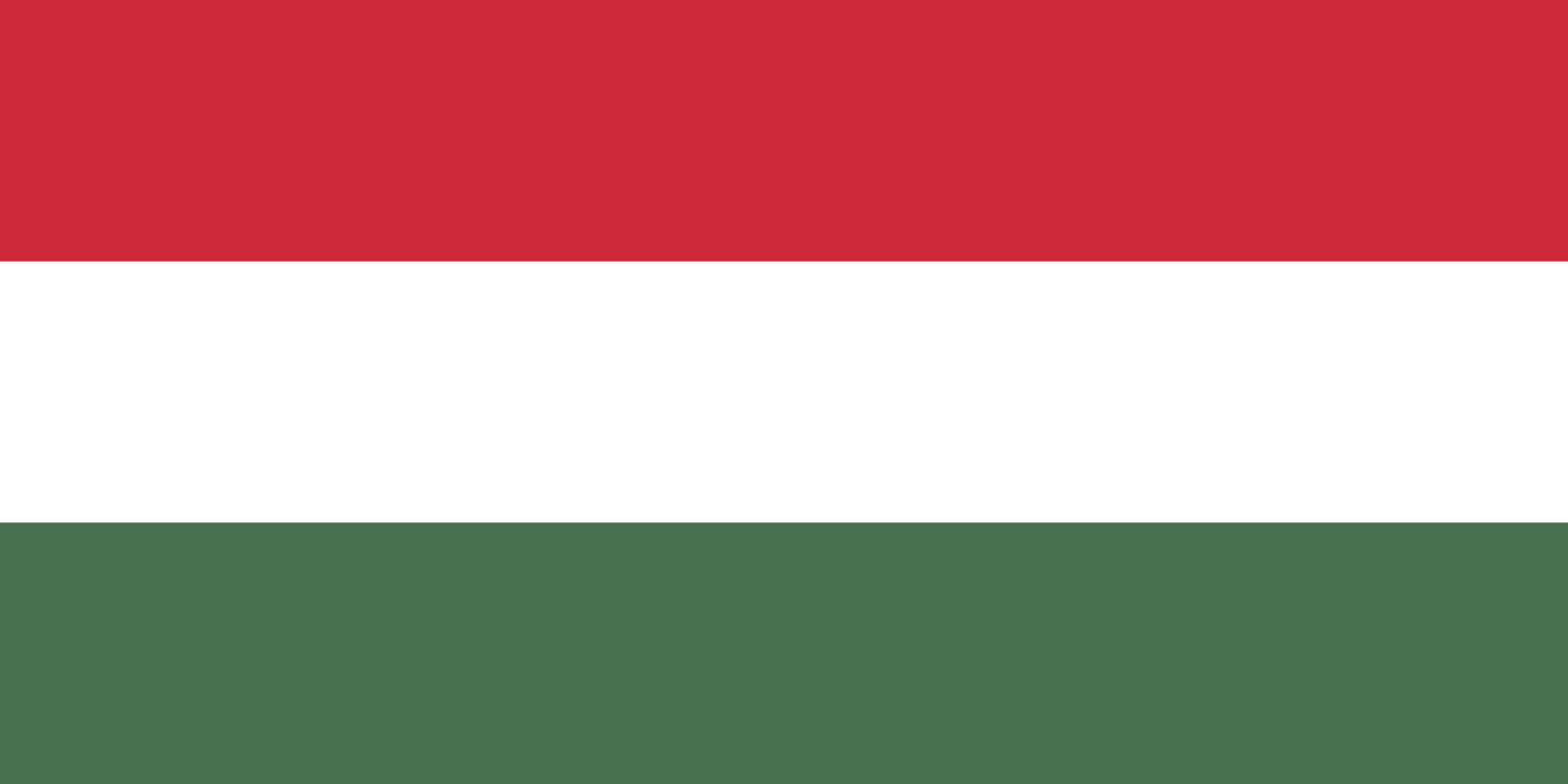
The Hungarian flag consists of three horizontal stripes: red, white, and green. The design dates back to the 19th century and was officially adopted during the 1848 revolution.
Red symbolizes strength and sacrifice, white represents faithfulness and freedom, and green signifies hope and the land. The flag is widely displayed on public buildings and during national celebrations, governed by established protocols.
Flag flying days
| Date | Flag Position | Occasion or Reason |
|---|
| March 15 | Full-mast | National Day (1848 Revolution) |
| August 20 | Full-mast | St. Stephen’s Day / State Foundation Day |
| October 23 | Full-mast | 1956 Revolution Memorial Day |
| National Mourning Days | Half-mast | State-declared mourning |