Flag of India
| Legal Name | Republic of India |
|---|---|
| Flag |
|
| Capital City |
New Delhi |
| Total Area | 3,287,263 km² |
| Land Area | Approximately 2,973,190 km² |
| Water Area | Approximately 314,070 km² |
| Population | ~1.43 billion |
| Major Cities | Mumbai (~20m), Delhi (~19m), Bengaluru (~13m), Chennai (~11m), Kolkata (~15m), Hyderabad (~10m), Ahmedabad (~8m) |
| Currency | Indian Rupee (INR) |
| GDP | Approximately USD 13.5 trillion |
| GDP Per Capita | Approximately USD 2,600 (nominal) / USD 9,500 (PPP) |
About of India
India is a vast country located in South Asia, occupying a central position between East Asia, Central Asia, the Middle East, and the Indian Ocean. It is the world’s most populous country and one of the largest by land area, encompassing an extraordinary range of landscapes, cultures, languages, and climates.
India shares land borders with Pakistan, China, Nepal, Bhutan, Bangladesh, and Myanmar, while maritime boundaries extend across the Arabian Sea, Bay of Bengal, and Indian Ocean. Its long coastline has historically facilitated trade, cultural exchange, and maritime influence across Asia, Africa, and Europe.
The capital city, New Delhi, serves as the political and administrative center, while Mumbai, the largest city, is the financial and commercial hub. Other major urban centers such as Bengaluru, Chennai, Hyderabad, and Kolkata play key roles in technology, manufacturing, education, and culture.
India is a sovereign state with full international recognition and a founding member of several global institutions. It holds significant geopolitical importance due to its population size, growing economy, strategic location in the Indo-Pacific region, and influence in global diplomacy, security, and trade.
Etymology
The name India is derived from the Indus River, historically known as Sindhu in Sanskrit. The term evolved through Persian usage as Hindu and later entered Greek and Latin as Indos and India.
Over time, “India” became the widely accepted international name for the subcontinent. Indigenous names such as Bharat, referenced in ancient Sanskrit texts, remain officially recognized and culturally significant, reflecting the country’s deep historical roots and continuity.
History
Human civilization in India dates back to prehistoric times, with early evidence of settlement and agriculture. One of the world’s earliest urban cultures, the Indus Valley Civilization, flourished around 2500 BCE, characterized by advanced city planning, trade networks, and social organization.
During the classical period, India witnessed the rise of influential empires such as the Maurya and Gupta Empires, which contributed significantly to governance, science, mathematics, philosophy, and art. This era laid foundations for Hinduism, Buddhism, and Jainism, which spread far beyond the subcontinent.
The medieval period saw the emergence of powerful kingdoms and the establishment of Islamic rule, culminating in the Mughal Empire, which left a lasting legacy in architecture, administration, and culture. European colonial powers arrived from the 16th century, with British rule eventually dominating most of the region.
India’s independence movement, led by figures such as Mahatma Gandhi, emphasized nonviolent resistance and mass mobilization. In 1947, India gained independence, followed by the adoption of a republican constitution in 1950. Post-independence history includes nation-building, economic reforms, technological growth, and evolving democratic institutions. Today, India is a major global actor navigating modernization alongside deep-rooted traditions.
Government and Politics
India is a federal parliamentary democratic republic governed by the Constitution of India, which is one of the longest written constitutions in the world. It guarantees fundamental rights, separation of powers, and federalism.
Executive authority rests with the Prime Minister and the Council of Ministers, while the President serves as head of state with largely ceremonial duties. Legislative power is vested in a bicameral Parliament consisting of the Lok Sabha and Rajya Sabha. The judiciary is independent, headed by the Supreme Court.
Administratively, India is divided into states and union territories, each with varying degrees of autonomy. India maintains active foreign relations and is a member of the United Nations, G20, BRICS, Commonwealth, and other international bodies. Its armed forces are among the world’s largest, contributing to national defense and peacekeeping operations.
Economy
India is classified as a developing and emerging economy, currently among the world’s largest by GDP. Economic growth has been driven by a mix of traditional sectors and modern industries.
Agriculture employs a significant portion of the population, producing grains, fruits, spices, and cash crops. Manufacturing ranges from textiles and automobiles to pharmaceuticals and electronics. The services sector, including information technology, finance, and telecommunications, is a major economic engine.
India is rich in natural resources such as coal, iron ore, bauxite, and limestone. Major exports include refined petroleum, software services, pharmaceuticals, machinery, and agricultural products. Challenges include income inequality, infrastructure gaps, and environmental sustainability, while future prospects focus on digitalization, manufacturing expansion, and green energy.
Demographics
India has a highly diverse population composed of numerous ethnic, linguistic, and cultural groups. It is home to hundreds of communities and social identities shaped by region, language, and history.
The country recognizes multiple official languages, with Hindi and English used at the national level. India is the birthplace of major religions including Hinduism, Buddhism, Jainism, and Sikhism, and also has large Muslim, Christian, and other religious communities.
Approximately one-third of the population lives in urban areas, with rapid urbanization underway. Population growth has slowed in recent decades but remains significant, influencing economic and social planning.
Culture and Society
India’s cultural heritage is among the world’s oldest and most diverse. National identity is shaped by shared historical experiences, constitutional values, and cultural pluralism.
Indian arts include classical and folk music, dance forms, literature, cinema, and architecture. Cuisine varies widely by region, featuring distinctive spices, cooking techniques, and dietary traditions. Social norms emphasize family, community ties, and respect for tradition, alongside increasing modernization.
Major festivals include Diwali, Holi, Eid, Christmas, and Pongal, reflecting religious and regional diversity. Sports such as cricket, hockey, football, and traditional games are widely followed.
Education and Healthcare
India has a large and complex education system, with compulsory schooling at the primary level and extensive public and private higher education institutions. Literacy rates have steadily improved, and the country hosts globally recognized universities and technical institutes.
Healthcare is delivered through a combination of public and private providers. While advanced medical services are available in urban centers, challenges remain in rural access, public health infrastructure, and disease prevention. Ongoing reforms aim to expand coverage and improve health outcomes.
Geography and Climate
India’s geography includes the Himalayan mountain range, fertile river plains, plateaus, deserts, tropical forests, and an extensive coastline. Major rivers such as the Ganges, Brahmaputra, and Indus are vital to agriculture and culture.
The climate ranges from alpine in the north to tropical in the south, with a dominant monsoon system shaping seasonal rainfall. Natural hazards include floods, cyclones, earthquakes, droughts, and heatwaves. Environmental challenges focus on pollution control, water management, and climate adaptation.
Flora and Fauna
India is one of the world’s mega-biodiverse countries, hosting thousands of plant and animal species. Its ecosystems range from rainforests and mangroves to alpine meadows and deserts.
Native wildlife includes tigers, elephants, rhinoceroses, lions, and a wide variety of birds and reptiles. Conservation efforts are supported by national parks, wildlife sanctuaries, and biodiversity reserves aimed at protecting endangered species.
Map of India
India’s national symbols reflect its heritage and values. These include the national flag, the Lion Capital of Ashoka as the state emblem, and the national anthem expressing unity and pride.
National Flag (Detailed Section)
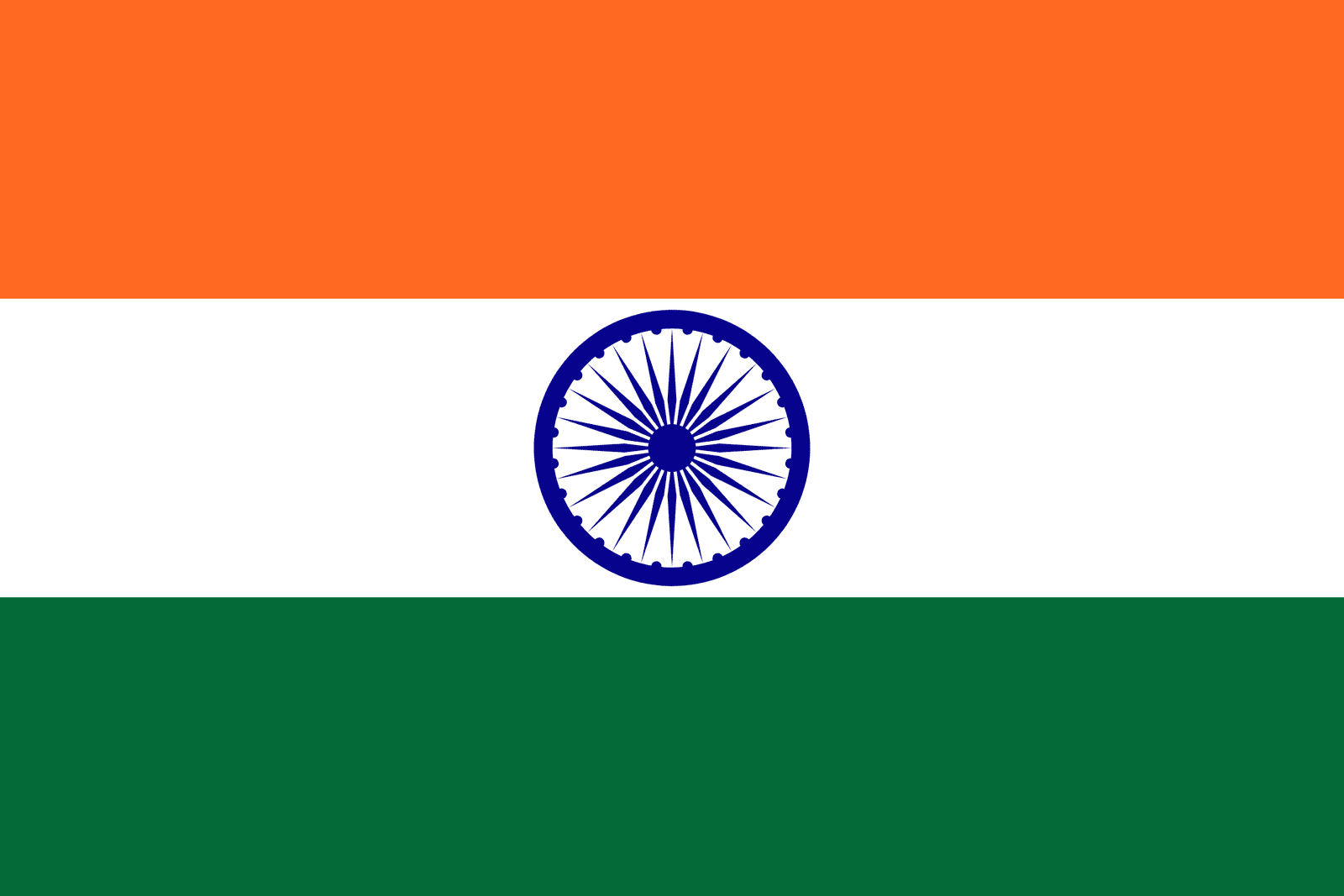
The Indian national flag, known as the Tiranga, consists of three horizontal bands: saffron at the top, white in the middle, and green at the bottom. At the center of the white band is the Ashoka Chakra, a navy-blue wheel with 24 spokes.
The flag evolved during the independence movement and was officially adopted in 1947. Saffron represents courage and sacrifice, white signifies peace and truth, green symbolizes growth and prosperity, and the Ashoka Chakra reflects law, motion, and righteousness. Strict protocols govern its display to ensure respect and dignity.
Realted Flags

Flag flying days
| Date | Flag Position | Occasion or Reason |
|---|
| January 26 | Full-mast | Republic Day |
| August 15 | Full-mast | Independence Day |
| October 2 | Full-mast | Gandhi Jayanti |
| State Mourning Days | Half-mast | Official national mourning |