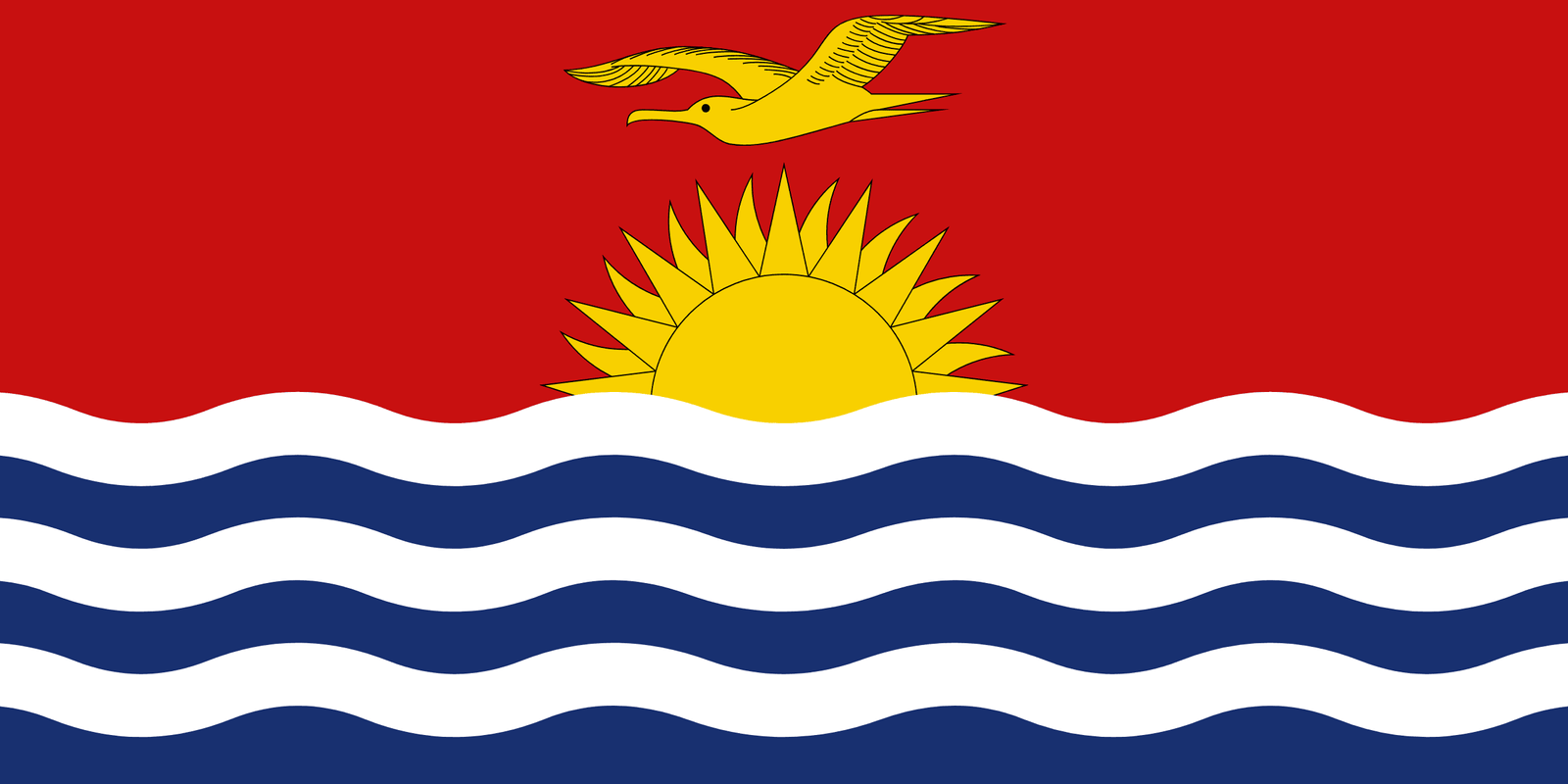
Flag of Kiribati
| Legal Name | Republic of Kiribati |
|---|---|
| Flag |
|
| Capital City |
South Tarawa |
| Total Area | Approximately 811 km² |
| Land Area | Approximately 811 km² |
| Water Area | Negligible (land area dispersed across vast ocean space) |
| Population | Approximately 135,000 |
| Major Cities | South Tarawa (65,000), Betio (15,000), Bairiki (10,000) |
| Currency | Australian Dollar (AUD) |
| GDP | Approximately USD 230 million |
| GDP Per Capita | Approximately USD 1,800 (Nominal) |
About of Kiribati
Kiribati is a small island nation located in the central Pacific Ocean, spanning the equator and extending across a vast area of ocean. It is composed of 33 low-lying coral atolls and reef islands scattered over more than 3.5 million square kilometers of ocean, making it one of the most geographically dispersed countries in the world. Despite its wide maritime reach, its total land area is extremely limited.
The country has no land borders, relying entirely on maritime boundaries. Its nearest neighbors include the Marshall Islands to the north, Tuvalu and Fiji to the south, Nauru to the west, and French Polynesia to the east. South Tarawa, the capital and largest urban center, serves as the political, economic, and administrative heart of the country and is home to nearly half of the population.
Kiribati has a predominantly Micronesian population and is internationally recognized as a sovereign state and a member of the United Nations. Strategically, its location across key Pacific sea lanes and its vast exclusive economic zone give it importance in regional maritime affairs, fisheries management, and climate change discussions, particularly as one of the countries most vulnerable to rising sea levels.
Etymology
The name “Kiribati” is the local Gilbertese pronunciation of “Gilberts,” referring to the Gilbert Islands, which form the core of the country. The name evolved during the colonial period when European explorers and administrators applied the English name “Gilbert Islands,” later adapted into the indigenous language. Over time, “Kiribati” became the official name upon independence, reflecting national identity and linguistic heritage.
History
Prehistoric and Ancient Settlement
Kiribati was first settled by Austronesian-speaking peoples thousands of years ago. These early settlers developed sophisticated navigation skills and a culture adapted to life on coral atolls with limited natural resources.
Traditional Society
Before European contact, Kiribati society was organized around kinship systems, village leadership, and customary law. Inter-island trade and voyaging were common, and social structure emphasized cooperation and resource sharing.
Colonial Period
European contact began in the 18th century, followed by increased missionary and trading activity. In 1892, the Gilbert Islands became a British protectorate and later a colony. During World War II, parts of Kiribati, including Tarawa, were sites of intense fighting between Allied and Japanese forces.
Path to Independence
After the war, movements toward self-governance gained momentum. The Gilbert Islands achieved internal self-rule in the 1970s, and on July 12, 1979, Kiribati became an independent republic.
Modern Developments
Since independence, Kiribati has focused on nation-building, managing limited resources, and advocating internationally on climate change. Political life has remained relatively stable, with peaceful transitions of power and active participation in regional Pacific institutions.
Government and Politics
Kiribati is a presidential republic with a unique political system combining elements of parliamentary democracy. The Constitution establishes the President as both head of state and head of government, elected nationally after nomination by the legislature.
Legislative authority rests with the unicameral House of Assembly. The judiciary is independent and based on common law principles. Administratively, the country is divided into island councils with local governance responsibilities.
Kiribati maintains diplomatic relations with a wide range of countries and is a member of international organizations including the United Nations, Pacific Islands Forum, and Commonwealth. It has no standing military, relying on police and maritime surveillance units for internal security and regional cooperation.
Economy
Kiribati is classified as a developing economy with significant structural constraints. Economic activity is limited by geographic isolation, small domestic markets, and limited natural resources. The economy relies heavily on public sector employment, fishing license revenues, remittances, and foreign aid.
Agriculture is primarily subsistence-based, focusing on coconuts, breadfruit, and pandanus. Manufacturing is minimal, while the service sector includes government services, retail, and transportation. Fisheries are the most valuable natural resource, with tuna stocks in the country’s exclusive economic zone generating important revenue.
Key economic challenges include unemployment, infrastructure limitations, and vulnerability to climate change. Future economic prospects depend on sustainable fisheries management, renewable energy development, and continued international cooperation.
Demographics
Kiribati’s population is predominantly Micronesian, with a strong sense of shared cultural identity. The official languages are Gilbertese and English. Christianity is the dominant religion, with Roman Catholicism and Protestant denominations being the most prevalent.
The population is increasingly urbanized, particularly in South Tarawa, leading to high population density and associated social and environmental pressures. Population growth remains relatively high compared to land availability, posing long-term sustainability challenges.
Culture and Society
Kiribati culture emphasizes community, respect for elders, and harmony with the environment. Traditional music, dance, and storytelling play important roles in preserving cultural heritage. Canoe building, navigation, and fishing traditions remain culturally significant.
Cuisine is based on seafood, coconut, and root crops, reflecting the island environment. Social customs value modesty, hospitality, and communal responsibility. Public holidays include Independence Day and major Christian observances. Sports such as football, volleyball, and traditional competitions are popular forms of recreation.
Education and Healthcare
Education in Kiribati follows a structured system from primary to secondary levels, with vocational and limited tertiary education opportunities. Literacy rates are relatively high, and education is compulsory at the primary level.
Healthcare is publicly provided, with hospitals and clinics serving major population centers. Public health challenges include overcrowding, non-communicable diseases, and limited medical infrastructure. Despite these challenges, vaccination coverage and basic health indicators have improved over time.
Geography and Climate
Kiribati consists entirely of low-lying coral atolls and reef islands, with no mountains or rivers. Its islands are spread across three main groups: the Gilbert, Phoenix, and Line Islands. The country lies in the tropical climate zone, experiencing warm temperatures year-round with wet and dry seasons.
Natural hazards include tropical storms, coastal erosion, and prolonged droughts. Climate change poses an existential threat, with rising sea levels and saltwater intrusion affecting freshwater supplies and habitability.
Flora and Fauna
Biodiversity in Kiribati is limited but specialized. Native plant species include coconut palms, pandanus, and breadfruit trees. Terrestrial wildlife is sparse, but the surrounding marine environment is rich in fish, corals, and seabirds.
Protected areas and marine reserves have been established to conserve biodiversity, including large-scale ocean conservation zones aimed at preserving fish stocks and marine ecosystems.
Map of Kiribati
Kiribati’s national symbols reflect its ocean-based identity and cultural values. The flag, coat of arms, and anthem emphasize unity, resilience, and the importance of the sea. The frigatebird and rising sun are recurring national motifs symbolizing freedom and hope.
National Flag (Detailed Section)
The national flag of Kiribati features a red upper field symbolizing courage and strength, and blue-and-white wavy stripes below representing the Pacific Ocean. A golden frigatebird flies above a rising sun with rays symbolizing the islands and the dawn of independence. Adopted in 1979, the flag is used in official ceremonies, government buildings, and national celebrations in accordance with established protocol.
Realted Flags
Flag flying days
| Date | Flag Position | Occasion or Reason |
|---|---|---|
| July 12 | Full-mast | Independence Day |
| National public holidays | Full-mast | Official celebrations |
| State ceremonies | Full-mast | Government and national events |
| Periods of national mourning | Half-mast | Officially declared mourning |