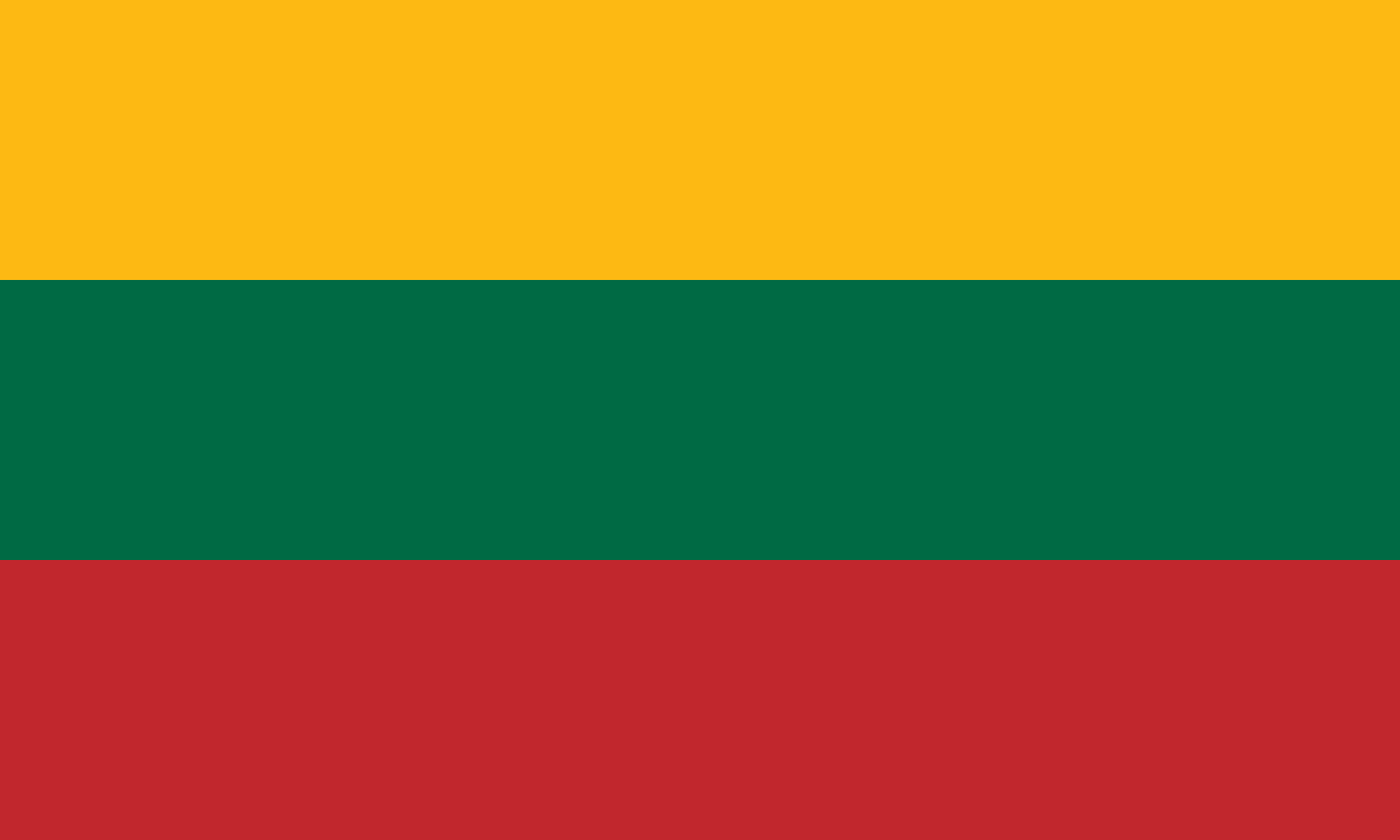
Flag of Lithuania
| Legal Name | Republic of Lithuania |
|---|---|
| Flag |
|
| Capital City |
Vilnius |
| Total Area | Approximately 65,300 km² |
| Land Area | Approximately 63,000 km² |
| Water Area | Approximately 2,300 km² |
| Population | Approximately 2.8 million |
| Major Cities | Vilnius (600,000), Kaunas (300,000), Klaipėda (150,000), Šiauliai (100,000), Panevėžys (95,000) |
| Currency | Euro (EUR) |
| GDP | Approximately USD 80 billion |
| GDP Per Capita | Approximately USD 28,500 |
About of Lithuania
Lithuania is a Baltic nation located in Northern Europe, bordered by Latvia to the north, Belarus to the east and south, Poland to the south, and the Russian exclave of Kaliningrad to the southwest. It has a short coastline along the southeastern shore of the Baltic Sea, near Klaipėda. As a member of the European Union, NATO, and the Schengen Area, Lithuania is politically and economically integrated with Western Europe while maintaining strategic regional influence in the Baltic region.
The capital, Vilnius, is the largest urban center, known for its historic old town, modern industries, and cultural significance. Other major cities like Kaunas and Klaipėda serve as industrial, educational, and maritime hubs. Lithuania has a predominantly urban population, although rural communities maintain traditional agriculture and forestry practices.
Lithuania is internationally recognized as a democratic republic with a strong rule of law, thriving economy, and active participation in European and transatlantic institutions. Its geographic position along the Baltic Sea grants strategic importance for trade, energy transit, and regional security.
Etymology
The name “Lithuania” is thought to derive from Lietava, the historical name of a small river near Kernavė, one of the earliest centers of Lithuanian settlement. The term evolved to denote the larger territory, and by the medieval period, it referred to the Grand Duchy of Lithuania. The name has endured through centuries of statehood, foreign rule, and modern independence.
History
Prehistoric and Ancient Civilizations
Archaeological evidence indicates human habitation in Lithuania dating back to 10,000 BC, with Mesolithic and Neolithic settlements. Early inhabitants were Baltic tribes, known for their distinct language and cultural practices.
Classical and Medieval Periods
By the 13th century, these tribes consolidated under emerging chieftains, forming the basis of the Grand Duchy of Lithuania. Lithuania became a major regional power in Eastern Europe, eventually forming a union with Poland in 1386, which expanded its influence and Christianized the population.
Major Empires and Dynasties
The Grand Duchy of Lithuania stretched from the Baltic to the Black Sea at its height, encompassing diverse peoples and territories. Dynastic unions, wars, and treaties shaped its borders, and it retained significant autonomy until its partition.
Colonial or Imperial Rule
In the late 18th century, Lithuania was absorbed into the Russian Empire during the partitions of the Polish–Lithuanian Commonwealth. Under Russian rule, Lithuania experienced cultural suppression and economic change.
Independence Movement
Lithuania first declared independence in 1918 following World War I. After brief periods of conflict, it maintained sovereignty until World War II, when it was occupied by the Soviet Union and Nazi Germany. In 1990, Lithuania was the first Soviet republic to declare independence, restored fully by 1991.
Modern Political Developments
Since independence, Lithuania has established democratic institutions, joined the European Union and NATO in 2004, and integrated into the Eurozone in 2015. It maintains a stable government, diversified economy, and active foreign policy.
Government and Politics
Lithuania is a parliamentary republic. The President serves as head of state, while the Prime Minister leads the government. The unicameral Seimas (Parliament) exercises legislative authority, and an independent judiciary upholds constitutional law. Administrative divisions include 10 counties, subdivided into municipalities.
Lithuania maintains active diplomacy with EU and NATO members and participates in regional initiatives like the Baltic Council and the Council of the Baltic Sea States. Defense focuses on territorial security, international cooperation, and contributions to NATO missions.
Economy
Lithuania is a high-income, developed economy with robust services, manufacturing, and technology sectors. Key industries include information technology, machinery, chemicals, food processing, and energy. Agriculture produces cereals, potatoes, dairy, and meat. The country relies on timber and mineral resources like peat.
Major trade partners include Germany, Poland, Latvia, and Russia. Economic challenges include demographic decline, rural depopulation, and energy dependence, but Lithuania continues to modernize its infrastructure, technology sector, and EU-integrated economy.
Demographics
Lithuania is ethnically homogeneous, with approximately 84% ethnic Lithuanians, alongside Poles, Russians, and other minorities. Lithuanian is the official language, with Russian and Polish spoken by minorities. Predominantly Roman Catholic, the country maintains religious and cultural traditions. Urbanization is high, with Vilnius and Kaunas accounting for a significant share of the population. Lithuania faces gradual population decline due to low birth rates and emigration.
Culture and Society
Lithuanian culture reflects Baltic roots blended with European influences. Folk music, dances, and traditional crafts remain central, and national identity emphasizes language, heritage, and resilience. Literature, arts, and theater are prominent, alongside culinary traditions featuring rye bread, potatoes, dairy, and fish.
National holidays include Independence Day (February 16), Restoration of Independence (March 11), and religious festivals. Sports such as basketball, football, and cycling are popular, supported by community and national programs.
Education and Healthcare
Lithuania offers free, compulsory primary and secondary education. Higher education includes universities in Vilnius, Kaunas, and Klaipėda, emphasizing science, technology, and social sciences. Literacy exceeds 99%.
Healthcare is universal, provided through public and private systems. Public health priorities include vaccination programs, preventive medicine, and addressing lifestyle-related diseases.
Geography and Climate
Lithuania’s terrain is largely flat, with lowlands, rolling hills, rivers, lakes, and a short Baltic coastline. Major rivers include the Nemunas and Neris. The country experiences a temperate climate with mild summers, cold winters, and moderate rainfall. Natural hazards include flooding and occasional severe winter storms. Environmental focus includes forest conservation, wetland protection, and sustainable agriculture.
Flora and Fauna
Lithuania hosts temperate forests with pine, spruce, oak, and birch trees. Wildlife includes deer, wild boar, elk, foxes, and numerous bird species. Protected areas such as Aukštaitija National Park conserve biodiversity and cultural landscapes, promoting ecotourism and ecological research.
Map of Lithuania
Flag: Horizontal tricolor of yellow, green, and red.
Coat of Arms: Vytis (the Chaser), a knight on horseback, symbolizing courage and national heritage.
National Anthem: Tautiška giesmė (“National Song”), emphasizing patriotism and resilience.
National Animals/Plants: Stork (bird), oak (tree), symbolizing strength and longevity.
National Flag (Detailed Section)
The Lithuanian flag’s horizontal bands of yellow, green, and red represent the sun, forests, and the blood of patriots. Adopted officially in 1918 and restored in 1989 after Soviet occupation, the flag is flown on national holidays, state events, and international occasions. Protocol includes raising the flag at full-mast for celebrations and half-mast during national mourning.
Flag flying days
| Date | Flag Position | Occasion or Reason |
|---|
| February 16 | Full-mast | Independence Day |
| March 11 | Full-mast | Restoration of Independence |
| National mourning | Half-mast | Death of prominent figures or national tragedies |
| Other public holidays | Full-mast | Commemorations, cultural events, or official ceremonies |