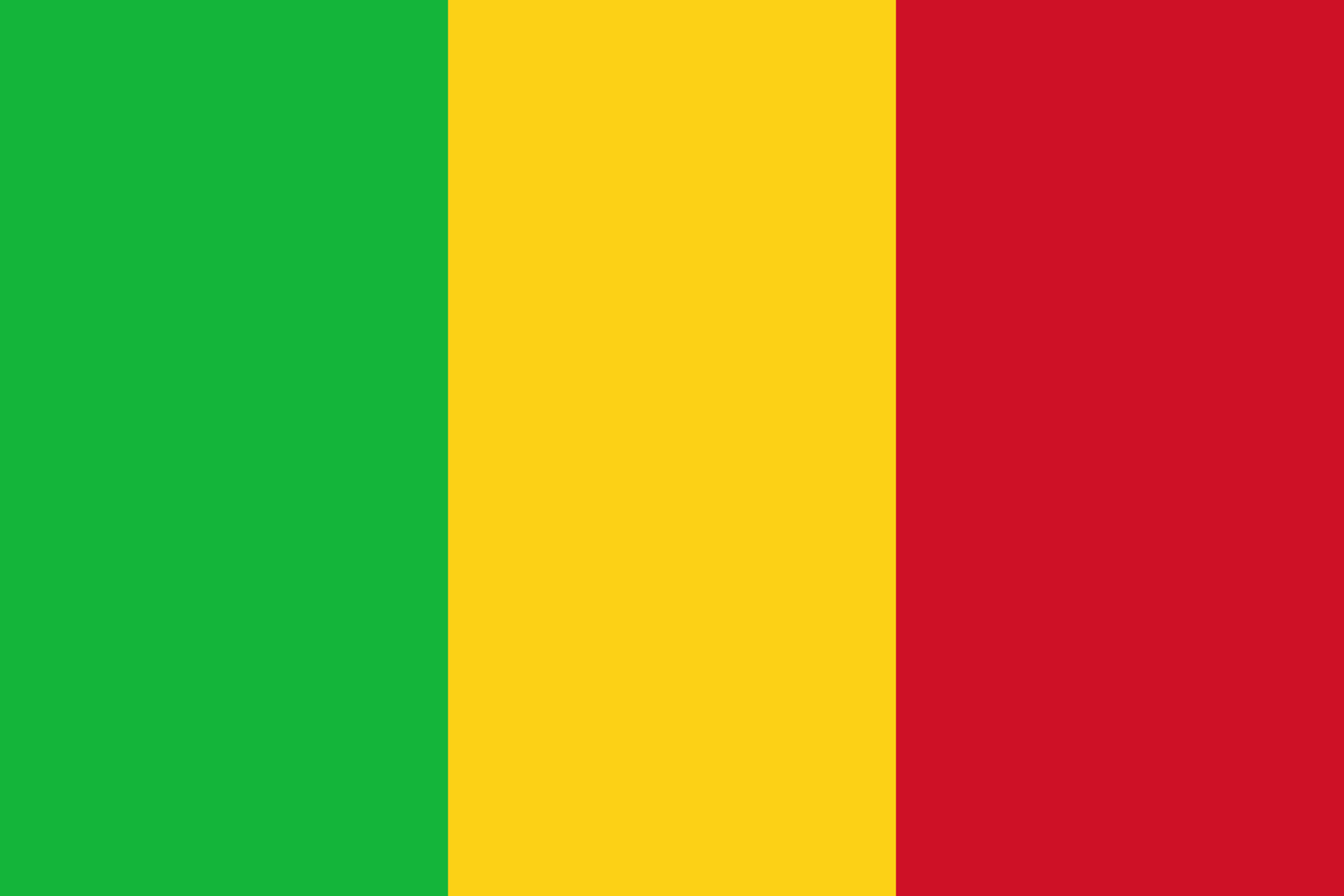
Flag of Mali
| Legal Name | Republic of Mali |
|---|---|
| Flag |
|
| Capital City |
Bamako |
| Total Area | 1,240,192 km² |
| Land Area | 1,240,192 km² |
| Water Area | Minimal, mostly rivers and seasonal lakes |
| Population | Approximately 23.5 million |
| Major Cities | Bamako (2.8 million), Sikasso (230,000), Mopti (115,000), Kayes (130,000), Gao (87,000) |
| Currency | West African CFA franc (XOF) |
| GDP | Approximately USD 23 billion |
| GDP Per Capita | Approximately USD 980 |
About of Mali
Mali is a landlocked country in West Africa, spanning over 1.2 million square kilometers, making it one of Africa’s largest nations by area. It is located at the heart of the Sahel, with its terrain ranging from the Sahara Desert in the north to the Niger River basin in the south. Mali shares borders with Algeria, Niger, Burkina Faso, Côte d’Ivoire, Guinea, Senegal, and Mauritania.
Bamako, Mali’s capital and largest city, serves as the political, economic, and cultural center of the country. Other urban centers such as Sikasso, Mopti, and Gao contribute to regional trade and cultural life. Mali’s population is diverse, comprising multiple ethnic groups, languages, and cultural traditions. Despite challenges, the country holds international recognition as a sovereign republic and is a member of the African Union, the United Nations, and the Economic Community of West African States (ECOWAS). Its strategic importance stems from its position as a cultural crossroads between North Africa and Sub-Saharan Africa, as well as its natural resources and riverine transportation networks.
Etymology
The name “Mali” is derived from the Manding language, in which “Mali” historically referred to a kingdom in the region. Linguistic roots link the term to “hippopotamus” or “place of the king,” symbolizing strength, authority, and wealth. Over centuries, the name evolved to denote the modern nation-state, preserving the historical and cultural identity of the Malian people.
History
Prehistoric and Ancient Civilizations
Archaeological evidence shows human habitation dating back thousands of years, with ancient settlements along the Niger River. Early societies practiced agriculture, fishing, and ironworking.
Classical and Medieval Periods
From the 9th to the 16th century, Mali was part of influential West African empires. The Ghana Empire preceded the Mali Empire, which flourished under rulers such as Sundiata Keita. The Mali Empire became legendary for its wealth, trade, and centers of learning such as Timbuktu, which hosted extensive libraries and Islamic scholarship.
Major Empires, Kingdoms, or Dynasties
The Songhai Empire rose in the 15th century, dominating the Niger River region. These empires facilitated trans-Saharan trade, gold mining, and Islamic culture.
Colonial or Imperial Rule
French colonization began in the late 19th century, integrating Mali into French Sudan. Colonial rule imposed new administrative structures, cash-crop economies, and European legal systems.
Independence Movement
Mali gained independence from France on September 22, 1960, initially as part of the Mali Federation with Senegal before becoming a sovereign republic.
Key Post-Independence Events
Post-independence Mali has experienced political instability, military coups, and regional conflicts. Secessionist movements in northern Mali and jihadist insurgencies have shaped modern security challenges.
Modern Political Developments
Mali remains a republic with periodic elections, though governance has been affected by military interventions and internal security crises. International cooperation continues through ECOWAS, UN missions, and peacekeeping efforts.
Government and Politics
Mali operates as a presidential republic, with executive authority vested in the President, who serves as head of state and government. The bicameral legislature includes the National Assembly, which enacts laws, while the judiciary maintains independence under the Constitution. Mali is divided administratively into ten regions and one capital district (Bamako), each with local governance structures.
Internationally, Mali maintains relations with African, European, and global partners, participating in ECOWAS, the African Union, and the United Nations. The Malian Armed Forces are responsible for national defense, counter-terrorism, and border security.
Economy
Mali is classified as a developing, low-income country. Agriculture dominates the economy, employing the majority of the population, with cotton, millet, rice, and livestock as key products. Mining is vital, particularly gold extraction, which is Mali’s largest export. Services, including trade and telecommunications, contribute to GDP growth. Manufacturing is limited but includes food processing, textiles, and construction materials.
Trade partners include France, China, India, and neighboring West African states. Economic challenges involve poverty, climate vulnerability, political instability, and reliance on subsistence farming. The long-term outlook emphasizes diversification, investment in infrastructure, and regional trade integration.
Demographics
Mali’s population is ethnically diverse. Major groups include the Bambara, Fulani (Peul), Dogon, Tuareg, and Songhai. French serves as the official language, while Bambara functions as a national lingua franca. Islam predominates, shaping social, legal, and cultural practices. Approximately 45% of the population resides in urban areas, with Bamako as the primary urban center. Population growth is high, driven by fertility rates and a young demographic profile.
Culture and Society
Malian culture reflects centuries of indigenous and Islamic influence. Oral tradition, music, and storytelling are central to social life, with griots serving as custodians of history. Malian music, especially the kora and balafon traditions, enjoys global recognition. Cuisine features millet, rice, sorghum, and peanut-based dishes. Social norms prioritize family and community cohesion. Festivals such as the Festival in the Desert celebrate music, culture, and heritage, while Islamic religious observances shape daily life.
Education and Healthcare
Education is structured into primary, secondary, and tertiary levels, with efforts to expand literacy and access in rural areas. Literacy rates remain moderate, with gender disparities. Higher education is concentrated in Bamako. The healthcare system faces resource constraints, with public hospitals, clinics, and NGOs providing care. Public health challenges include malaria, malnutrition, and waterborne diseases, though vaccination campaigns and international aid support improvements.
Geography and Climate
Mali’s geography ranges from the Sahara Desert in the north to the Niger River floodplain and savannas in the south. Key physical features include the Niger and Senegal rivers, the Adrar des Ifoghas mountains, and the Dogon cliffs. The climate is predominantly hot and dry, with a Sahelian zone in the south and arid desert conditions in the north. Seasonal hazards include droughts, flooding, and desertification. Environmental concerns focus on land degradation, deforestation, and water scarcity.
Flora and Fauna
Biodiversity varies with climate zones. Northern deserts have sparse vegetation, while southern savannas support acacia, baobab, and shea trees. Wildlife includes antelope, elephants, lions, hyenas, crocodiles, and migratory birds. Mali has established national parks, such as the Boucle du Baoulé and Bafing, to conserve endangered species and ecosystems.
Map of Mali
Flag: Vertical tricolor of green, gold, and red, symbolizing fertility, purity, and sacrifice.
Coat of Arms: Features a heraldic shield with a rising sun, mosque silhouette, and national motto emphasizing unity and progress.
National Anthem: Le Mali reflects patriotic pride and historical resilience.
National Animals/Plants: African elephant, baobab tree, and iconic Sahelian flora.
National Flag (Detailed Section)
The Malian flag consists of three equal vertical bands: green (hoist), gold, and red. Adopted in 1961, the colors reflect Pan-African symbolism: green represents fertility and agriculture, gold signifies purity and mineral wealth, and red honors the sacrifices made for independence. The flag is used at government buildings, schools, and during national ceremonies. It is flown at half-mast during periods of mourning.
Flag flying days
| Date | Flag Position | Occasion or Reason |
|---|---|---|
| September 22 | Full-mast | Independence Day |
| January 1 | Full-mast | New Year celebrations |
| National mourning | Half-mast | Death of national leaders or national tragedies |
| August 20 | Full-mast | Republic Day |