
Flag of Mexico
| Legal Name | United Mexican States |
|---|---|
| Flag |
|
| Capital City |
Mexico City |
| Total Area | Approximately 1,964,375 km² |
| Land Area | Approximately 1,943,945 km² |
| Water Area | Approximately 20,430 km² |
| Population | About 129 million |
| Major Cities | Mexico City (22M metro), Guadalajara (5.3M metro), Monterrey (5.3M metro), Puebla (3.3M metro), Tijuana (2.2M metro) |
| Currency | Mexican Peso (MXN) |
| GDP | Approximately USD 1.8 trillion |
| GDP Per Capita | Approximately USD 14,000 (nominal) |
About of Mexico
Mexico is a large and diverse country located in the southern portion of North America. It serves as a geographic and cultural bridge between the United States to the north and Central America to the south. The country is bordered by the United States, Guatemala, and Belize, while its extensive coastlines lie along the Pacific Ocean, the Gulf of Mexico, and the Caribbean Sea, giving it strategic maritime importance.
Mexico City, the capital and largest urban center, is one of the world’s largest metropolitan areas and functions as the political, economic, and cultural heart of the nation. Other major cities such as Guadalajara and Monterrey are important hubs for industry, technology, education, and culture. The country’s urban landscape is complemented by vast rural regions that preserve traditional lifestyles and agricultural practices.
Demographically, Mexico is one of the most populous countries in the world, characterized by a young and increasingly urban population. It is internationally recognized as a sovereign federal republic and plays a key role in regional and global affairs through its economic influence, diplomatic reach, and cultural impact. Mexico’s geopolitical importance is reinforced by its proximity to the United States, its role in global trade, and its participation in international organizations.
Etymology
The name “Mexico” originates from the Nahuatl word Mēxihco, which referred to the heartland of the Aztec Empire in the Valley of Mexico. The term is traditionally associated with the Mexica people, the dominant ethnic group of the Aztec civilization, whose capital city was Tenochtitlán.
Linguistically, the name has been interpreted in several ways, including references to the moon, a central place, or a legendary leader named Mexi. Over time, the term evolved from describing a specific region to representing the entire country following Spanish colonization and independence. Today, “Mexico” symbolizes both the ancient heritage and the modern national identity of the state.
History
Human habitation in Mexico dates back thousands of years, with early hunter-gatherer societies eventually giving rise to advanced agricultural civilizations. Among the most influential ancient cultures were the Olmecs, often considered the “mother civilization” of Mesoamerica, followed by the Maya, Zapotec, Teotihuacan, and Toltec civilizations, each contributing to architecture, astronomy, writing, and governance.
By the late medieval period, the Aztec Empire emerged as the dominant power in central Mexico, establishing a sophisticated political and economic system. In 1519, Spanish explorers arrived, leading to the fall of Tenochtitlán in 1521 and the incorporation of the region into the Spanish Empire as New Spain. Spanish rule lasted nearly three centuries, profoundly shaping Mexico’s language, religion, and social structure.
Mexico’s independence movement began in 1810 and culminated in independence from Spain in 1821. The 19th century was marked by political instability, territorial losses, and foreign interventions. The Mexican Revolution of 1910–1920 reshaped the nation, leading to social reforms and the modern constitutional framework. In recent decades, Mexico has transitioned toward a more pluralistic political system, strengthened democratic institutions, and expanded its global economic presence.
Government and Politics
Mexico is a federal presidential republic governed under a constitution enacted in 1917. The political system is based on the separation of powers among the executive, legislative, and judicial branches. The President serves as both head of state and head of government and is elected for a single six-year term.
The legislative branch consists of a bicameral Congress made up of the Senate and the Chamber of Deputies. The judiciary is headed by the Supreme Court of Justice, which ensures constitutional interpretation and legal oversight. Mexico is divided into 31 states and one federal entity, Mexico City, each with its own local government.
Internationally, Mexico maintains active diplomatic relations and is a member of numerous global and regional organizations. The country does not maintain a large expeditionary military but focuses on national defense, disaster response, and internal security.
Economy
Mexico is classified as an emerging, upper-middle-income economy with a diversified industrial base. It is one of the world’s largest exporters and has strong manufacturing, energy, tourism, and agricultural sectors. The automotive, electronics, aerospace, and food-processing industries are central to economic growth.
Agriculture remains important, particularly in the production of maize, avocados, tomatoes, and coffee. Mexico is rich in natural resources, including oil, silver, and other minerals. Its trade is heavily oriented toward North America, with strong export ties to the United States and Canada.
Economic challenges include income inequality, regional disparities, and reliance on external markets. However, continued investment, industrial modernization, and demographic advantages support long-term growth prospects.
Demographics
Mexico’s population is ethnically diverse, with a majority identifying as mestizo, alongside significant Indigenous communities and smaller populations of European, African, and Asian descent. Spanish is the dominant language, while dozens of Indigenous languages are officially recognized.
The majority of Mexicans identify as Roman Catholic, though religious diversity has increased in recent decades. Urbanization is high, with most people living in cities, while rural populations continue to decline. Population growth has slowed, reflecting demographic transition trends.
Culture and Society
Mexican culture reflects a blend of Indigenous traditions and Spanish influences. National identity is expressed through music, art, literature, and cuisine, which are globally celebrated. Traditional foods such as tortillas, tacos, and mole hold cultural significance.
Social customs emphasize family, hospitality, and community. Major festivals include Independence Day, Day of the Dead, and religious observances. Sports, particularly football, play an important role in daily life.
Education and Healthcare
Mexico operates a structured public education system providing free primary and secondary education. Literacy rates are high, and the country hosts numerous universities and research institutions. Healthcare is delivered through a mix of public and private systems, with ongoing reforms aimed at improving access and quality.
Public health challenges include regional inequality and chronic diseases, though significant progress has been made in life expectancy and healthcare coverage.
Geography and Climate
Mexico’s geography is highly varied, featuring mountain ranges, plateaus, deserts, tropical forests, and extensive coastlines. The country experiences diverse climates, from arid deserts in the north to tropical conditions in the south.
Natural hazards include earthquakes, hurricanes, and volcanic activity. Environmental concerns focus on deforestation, air pollution, and water management.
Flora and Fauna
Mexico is one of the world’s most biodiverse countries, hosting thousands of plant and animal species. Native flora ranges from desert cacti to tropical rainforests, while wildlife includes jaguars, wolves, and a wide array of bird species.
Numerous national parks and protected areas support conservation efforts and ecological research.
Map of Mexico
Mexico’s national symbols reflect its history and values. The national flag and coat of arms are central to state identity, while the national anthem is widely regarded as one of the most stirring in the world. The golden eagle and native plants such as the cactus hold symbolic importance.
National Flag (Detailed Section)
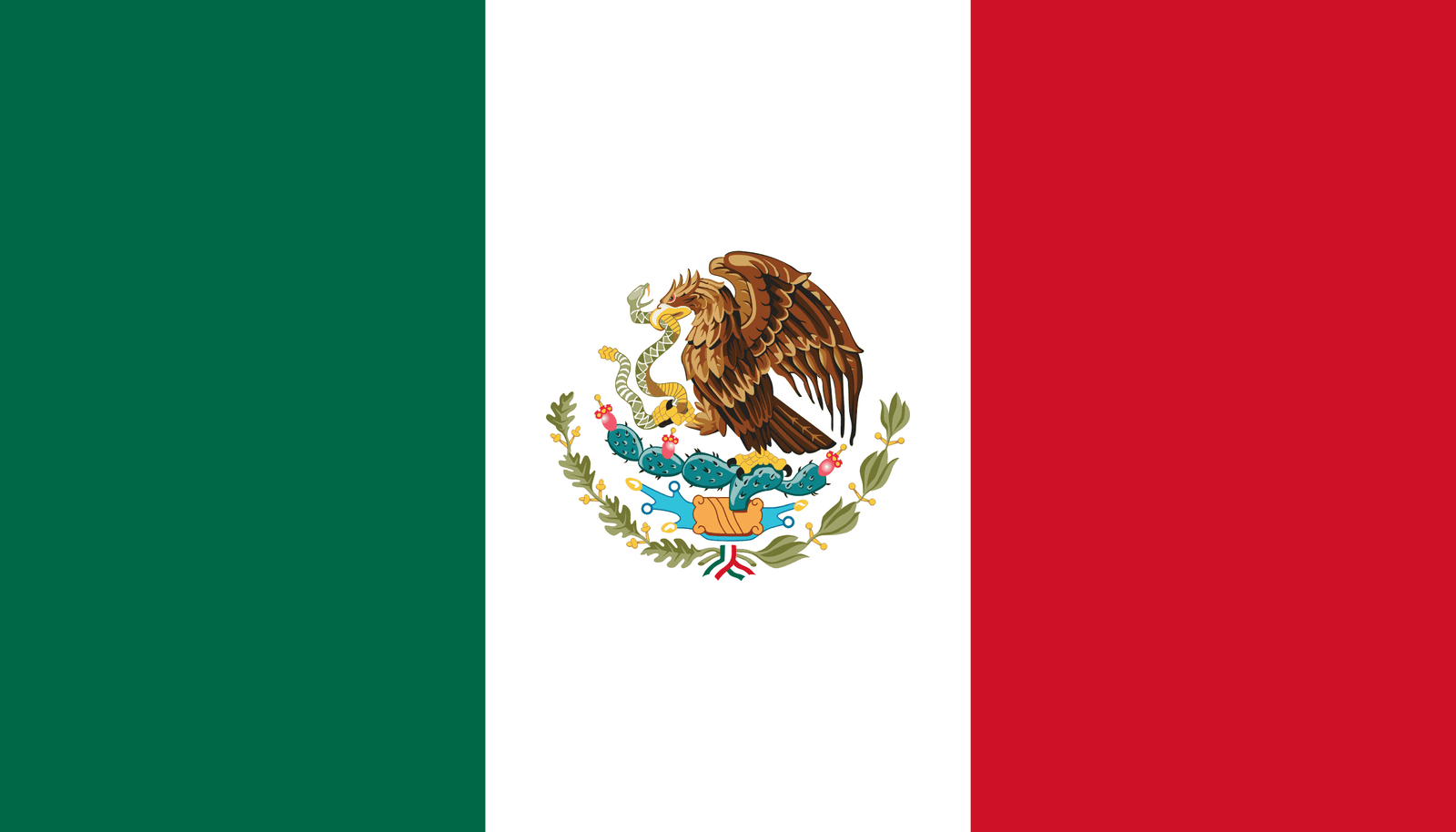
The Mexican flag features three vertical stripes of green, white, and red, with the coat of arms in the center. The design evolved during the independence era and has undergone refinements over time.
Green symbolizes hope and independence, white represents unity and peace, and red signifies the blood of national heroes. The central emblem depicts an eagle devouring a serpent atop a cactus, rooted in Aztec legend.
Flag protocol is strictly observed, with formal rules governing display and respect.
Realted Flags
Flag flying days
| Date | Flag Position | Occasion or Reason |
|---|
| February 24 | Full-mast | Flag Day |
| September 16 | Full-mast | Independence Day |
| November 20 | Full-mast | Revolution Day |
| National Mourning Days | Half-mast | Official periods of mourning |