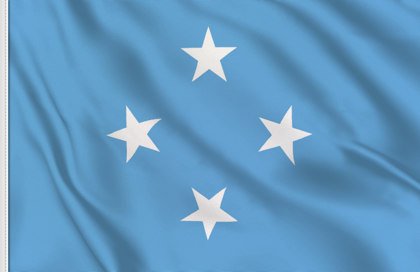
Flag of Micronesia
| Legal Name | Federated States of Micronesia |
|---|---|
| Flag |
|
| Capital City |
Palikir |
| Total Area | Approximately 702 km² |
| Land Area | Approximately 702 km² |
| Water Area | Negligible (territorial land area only; vast maritime zone) |
| Population | Approximately 115,000 |
| Major Cities | Weno (≈ 15,000), Kolonia (≈ 6,000), Tofol (≈ 5,000), Palikir (≈ 6,000) |
| Currency | United States Dollar (USD) |
| GDP | Approximately USD 400–450 million |
| GDP Per Capita | Approximately USD 3,500–4,000 |
About of Micronesia
The Federated States of Micronesia (FSM) is an island nation located in the western Pacific Ocean, northeast of Papua New Guinea and east of the Philippines. It is part of the broader Micronesia region of Oceania and consists of hundreds of small islands scattered across a vast area of ocean, giving the country one of the largest exclusive economic zones relative to its land size in the world.
Micronesia is composed of four states—Yap, Chuuk, Pohnpei, and Kosrae—each with its own cultural traditions and local government. The capital city, Palikir, is situated on the island of Pohnpei, while the largest urban center by population is Weno in Chuuk State. Settlement patterns are primarily coastal, with communities closely tied to the sea.
The country is fully sovereign and internationally recognized, having gained independence in 1986 under a Compact of Free Association with the United States. Micronesia’s strategic importance lies in its location along key Pacific sea lanes and its extensive maritime territory, which is significant for fisheries, regional security, and environmental conservation.
Etymology
The name “Micronesia” originates from the Greek words mikros (small) and nēsos (island), meaning “small islands.” The term was coined in the 19th century by European scholars to describe the region’s many small islands scattered across the Pacific Ocean. Over time, the name came to represent both the cultural region and, eventually, the modern federated state.
History
Prehistoric and Ancient Civilizations
Micronesia was settled thousands of years ago by Austronesian-speaking peoples who developed advanced navigation skills. These early inhabitants established complex societies, particularly evident in archaeological sites such as Nan Madol on Pohnpei, a monumental stone city built on artificial islets.
Classical and Medieval Periods
For centuries, Micronesian societies flourished independently, organized around clan systems, chiefly authority, and inter-island trade. Navigation by stars, currents, and wave patterns was central to cultural life.
Colonial Rule
European contact began in the 16th century with Spanish explorers. Spain claimed the islands, later selling them to Germany in 1899. After World War I, Japan administered Micronesia under a League of Nations mandate, significantly expanding infrastructure and settlement.
Post–World War II Administration
Following World War II, Micronesia became part of the Trust Territory of the Pacific Islands under United States administration, overseen by the United Nations.
Independence and Modern Developments
In 1986, the Federated States of Micronesia became an independent nation in free association with the United States. Since then, Micronesia has focused on nation-building, regional cooperation, and sustainable development while maintaining close ties with the U.S.
Government and Politics
Micronesia operates as a federal republic under a constitution adopted in 1979. The President serves as both head of state and government and is elected by the national Congress from among its members. The legislature is a unicameral Congress with representatives apportioned by population and state equality.
Judicial authority is vested in a Supreme Court with trial and appellate divisions. Each of the four states maintains its own constitution, government, and legislature, reflecting strong local autonomy.
Micronesia conducts foreign relations independently and is a member of the United Nations, Pacific Islands Forum, and other international organizations. Defense responsibilities are handled by the United States under the Compact of Free Association, and Micronesia does not maintain a standing military.
Economy
Micronesia is classified as a developing small island economy. Economic activity is dominated by services, public administration, and subsistence agriculture and fishing. Financial assistance under the Compact of Free Association plays a major role in government revenue.
Agriculture focuses on root crops, coconuts, breadfruit, and bananas, largely for local consumption. Manufacturing is minimal, while fisheries—particularly tuna—are among the most valuable natural resources and export earners.
Key economic challenges include geographic isolation, limited private-sector development, vulnerability to climate change, and dependence on external aid. Long-term economic prospects are tied to sustainable fisheries management, tourism, and improved infrastructure.
Demographics
Micronesia’s population is predominantly indigenous Micronesian, with distinct ethnic and linguistic groups across the four states. English is the official language, while numerous local languages are spoken and actively preserved.
Christianity is the dominant religion, with Roman Catholicism and Protestant denominations widely practiced. The population is largely rural, though urban centers have grown gradually. Population growth is modest, with migration—especially to the United States—affecting demographic trends.
Culture and Society
Micronesian culture is deeply rooted in the sea, navigation, and extended family structures. Traditional customs emphasize respect for elders, communal decision-making, and land and ocean stewardship.
Arts include weaving, carving, canoe-building, and traditional dance. Oral storytelling and music preserve history and cultural values. Cuisine centers on fish, taro, breadfruit, coconut, and other locally sourced foods.
Public holidays often combine national events with Christian observances. Canoeing, fishing, and football (soccer) are popular recreational activities.
Education and Healthcare
Education is compulsory at the primary level, with secondary schools available in each state. The College of Micronesia–FSM serves as the main institution of higher education. Literacy rates are relatively high, reflecting long-standing emphasis on schooling.
Healthcare is publicly funded, with hospitals in each state capital and smaller clinics in outer islands. Major challenges include non-communicable diseases, access to specialized care, and the high cost of medical services due to remoteness.
Geography and Climate
Micronesia consists of high volcanic islands and low-lying coral atolls spread across a vast ocean area. There are no rivers or deserts, and coastlines dominate the landscape.
The climate is tropical, characterized by warm temperatures year-round, high humidity, and significant rainfall. The country is vulnerable to typhoons, droughts linked to El Niño events, and rising sea levels.
Flora and Fauna
Micronesia’s biodiversity includes tropical rainforests, mangroves, coral reefs, and seagrass beds. Native plant species include coconut palms, pandanus, and breadfruit trees.
Wildlife is largely marine, with abundant fish, turtles, and reef species. Conservation efforts focus on marine protected areas, sustainable fishing, and climate adaptation initiatives.
Map of Micronesia
National Flag: Light blue with four white stars
Coat of Arms: Features a shield, stars, and traditional symbols
National Anthem: Patriots of Micronesia
National Symbols: Canoes, breadfruit, and the ocean
National Flag (Detailed Section)
The national flag of the Federated States of Micronesia features a light blue field symbolizing the Pacific Ocean and sky. Four white stars arranged in a diamond represent the four states—Yap, Chuuk, Pohnpei, and Kosrae. Adopted in 1979, the flag reflects unity, peace, and Micronesia’s maritime identity. It is flown on government buildings and during official events in accordance with national flag protocol.
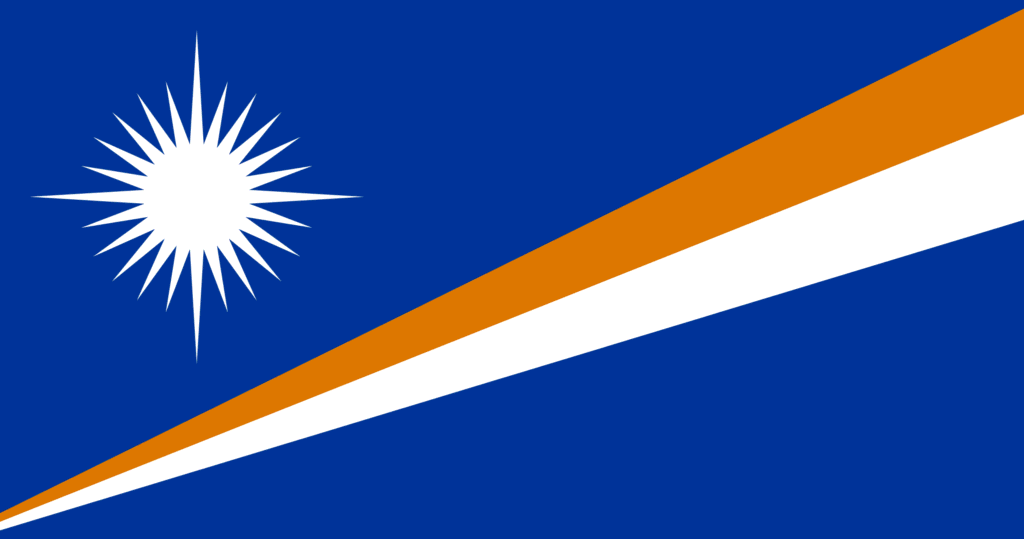
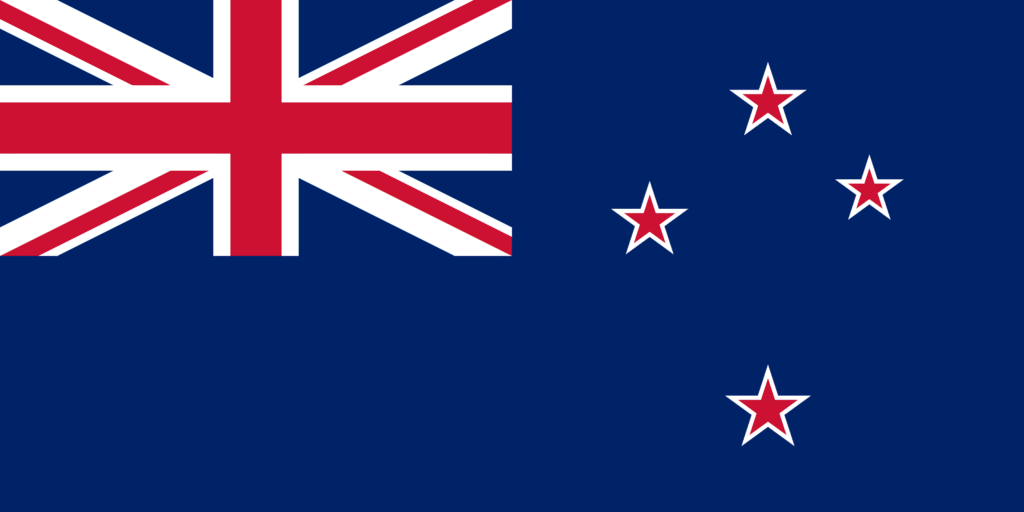
Realted Flags
Flag flying days
| Date | Flag Position | Occasion or Reason |
|---|
| May 10 | Full-mast | Constitution Day |
| November 3 | Full-mast | Independence Day |
| Official State Ceremonies | Full-mast | National and government events |
| National Mourning Periods | Half-mast | Official mourning observances |