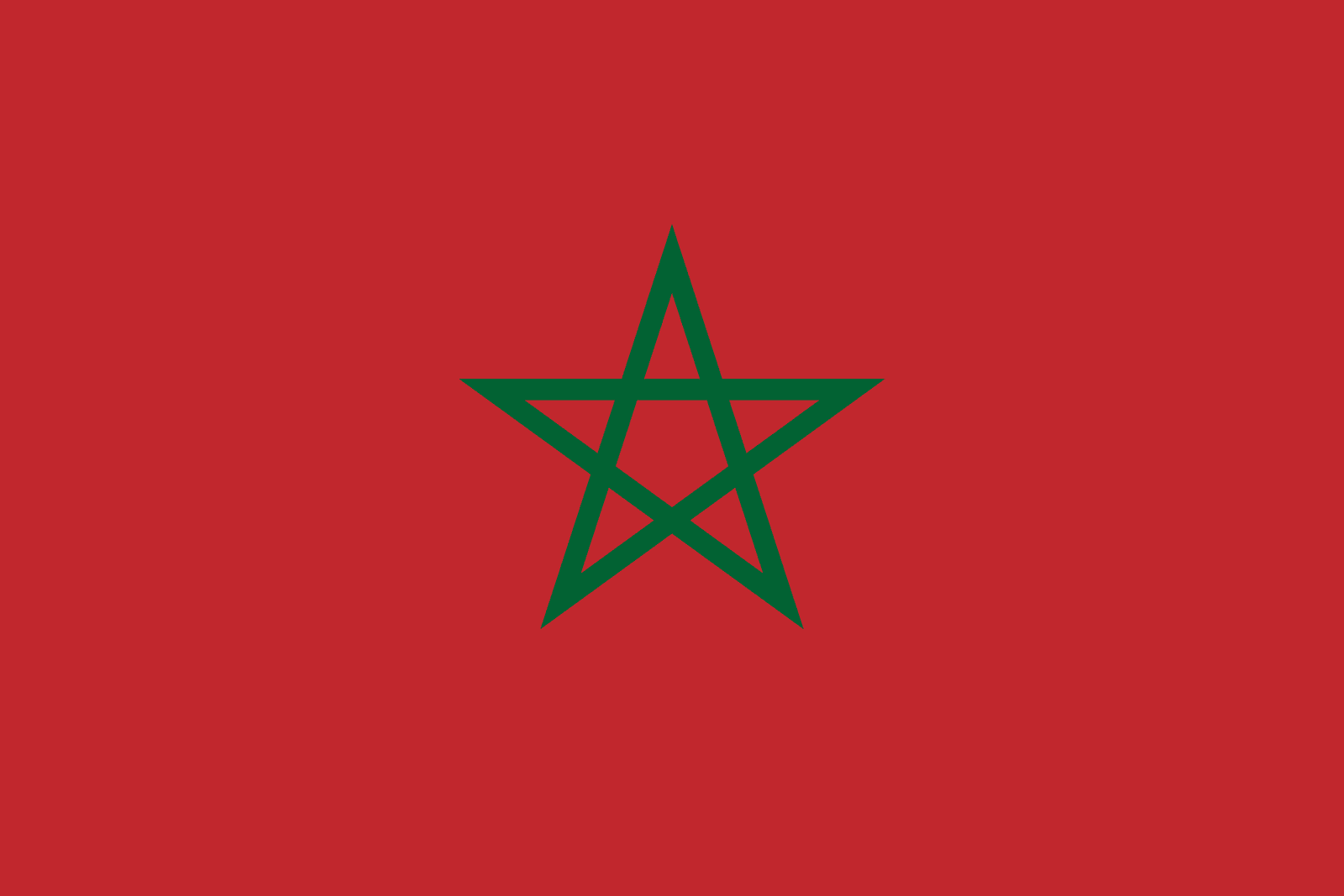
Flag of Morocco
| Legal Name | Kingdom of Morocco |
|---|---|
| Flag |
|
| Capital City |
Rabat |
| Total Area | Approximately 710,850 km² |
| Land Area | Approximately 446,550 km² (excluding Western Sahara) |
| Water Area | Approximately 250 km² |
| Population | Approximately 37 million |
| Major Cities | Casablanca (3.7 million), Rabat (580,000), Fes (1.1 million), Marrakesh (1.0 million), Tangier (1.2 million), Agadir (600,000) |
| Currency | Moroccan Dirham (MAD) |
| GDP | Approximately USD 140–145 billion |
| GDP Per Capita | Approximately USD 3,900 (nominal) |
About of Morocco
Morocco is a North African country strategically located at the crossroads of Africa and Europe, with coastlines on both the Atlantic Ocean and the Mediterranean Sea. It lies just 14 kilometers from Spain across the Strait of Gibraltar, giving it exceptional geographic and geopolitical importance. Morocco’s landscape ranges from fertile coastal plains to the rugged Atlas Mountains and the vast Sahara Desert in the south.
The country shares land borders with Algeria to the east and southeast, and maritime borders with Spain across the Mediterranean and Atlantic. Its capital city, Rabat, is the political and administrative center, while Casablanca is the economic powerhouse and largest urban area. Other major cities such as Marrakesh, Fes, Tangier, and Agadir play key cultural, historical, and commercial roles.
Morocco has a diverse population rooted in Arab, Amazigh (Berber), African, and Mediterranean influences. It is internationally recognized as a sovereign constitutional monarchy and maintains strong diplomatic relations across Africa, Europe, the Middle East, and the Americas. Its strategic location, political stability, and economic reforms have made it a key regional actor in North Africa and a bridge between continents.
Etymology
The name “Morocco” originates from the medieval name of Marrakesh, one of the country’s former imperial capitals. European languages adopted variations of this name—such as Morocco, Maroc, and Marruecos—to refer to the entire kingdom. In Arabic, the country is known as Al-Mamlaka al-Maghribiya, meaning “The Western Kingdom,” reflecting its position at the western edge of the Islamic world. Historically, the term Maghreb has been used to describe the broader region of northwest Africa.
History
Prehistoric and Ancient Civilizations
Morocco has been inhabited since prehistoric times, with archaeological evidence of early human presence dating back hundreds of thousands of years. Indigenous Amazigh populations established early societies based on agriculture, trade, and pastoralism.
Classical and Medieval Periods
Phoenicians and later Carthaginians established coastal trading posts, followed by Roman control over northern regions, which became part of the province of Mauretania Tingitana. After the decline of Rome, various Berber kingdoms emerged.
Major Empires, Kingdoms, or Dynasties
Islam reached Morocco in the 7th century, leading to the rise of powerful Islamic dynasties such as the Idrisids, Almoravids, Almohads, Marinids, Saadians, and Alaouites. These dynasties transformed Morocco into a major political, cultural, and religious center, with influence extending into Andalusia and sub-Saharan Africa.
Colonial or Imperial Rule
In the early 20th century, Morocco became a French protectorate, with Spain controlling northern and southern zones. Colonial rule introduced modern infrastructure but also fueled nationalist resistance.
Independence Movement
Morocco regained independence in 1956 under King Mohammed V, leading to the restoration of full sovereignty and the unification of most colonial zones.
Key Post-Independence Events
Post-independence Morocco focused on state-building, territorial integration, and economic development. The Green March of 1975 asserted Moroccan control over Western Sahara, a matter that continues to shape regional politics.
Modern Political Developments
Under King Mohammed VI, who ascended the throne in 1999, Morocco has pursued political reforms, economic modernization, and social development while maintaining monarchical stability.
Government and Politics
Morocco is a constitutional monarchy where the King serves as head of state, religious authority, and supreme commander of the armed forces. The constitution, revised in 2011, strengthened the role of elected institutions while preserving significant royal powers.
The executive branch includes the King and a government led by a Prime Minister. The legislative branch is bicameral, consisting of the House of Representatives and the House of Councillors. The judiciary operates independently, with the Constitutional Court ensuring constitutional oversight.
Administratively, Morocco is divided into 12 regions, further subdivided into provinces and prefectures. Morocco maintains active diplomatic relations worldwide and is a member of the United Nations, African Union, Arab League, Organization of Islamic Cooperation, and other international bodies. Its armed forces are among the most capable in the region and play a key role in national defense and peacekeeping missions.
Economy
Morocco is classified as an emerging economy with a diversified economic base. Agriculture remains important, employing a large portion of the population and producing cereals, olives, citrus fruits, and vegetables. Manufacturing has expanded significantly, particularly in automotive assembly, aerospace, textiles, and electronics.
The services sector dominates the economy, driven by tourism, banking, logistics, and telecommunications. Morocco holds some of the world’s largest phosphate reserves, making mining a strategic industry. Major exports include automobiles, phosphates, agricultural products, textiles, and electrical equipment.
Key trade partners include the European Union, the United States, China, and Gulf countries. Economic challenges include unemployment, regional inequality, water scarcity, and climate vulnerability, while future growth prospects are supported by renewable energy investments, infrastructure development, and industrial expansion.
Demographics
Morocco’s population is composed mainly of Arab and Amazigh communities, with strong cultural intermixing. Arabic and Amazigh are official languages, while French is widely used in business and administration, and Spanish and English are also spoken.
Islam is the predominant religion, with a small Jewish and Christian minority. Urbanization has increased rapidly, though rural communities remain significant. Population growth has slowed in recent decades, reflecting improved education and healthcare access.
Culture and Society
Moroccan culture is a rich fusion of Amazigh, Arab, African, Andalusian, and Mediterranean influences. Traditional music styles include Andalusian classical music, Gnawa, and Amazigh folk traditions. Moroccan cuisine is internationally renowned for dishes such as couscous, tagine, and pastilla.
Social norms emphasize hospitality, family ties, and respect for tradition. Religious and national festivals such as Eid al-Fitr, Eid al-Adha, Throne Day, and Independence Day are widely celebrated. Football is the most popular sport, followed by athletics and traditional equestrian events.
Education and Healthcare
Morocco’s education system includes primary, secondary, and tertiary levels, with compulsory primary education. Literacy rates have improved significantly, and universities and vocational institutes play an increasing role in workforce development.
Healthcare is delivered through a mix of public and private systems. Morocco has made notable progress in maternal and child health, vaccination coverage, and life expectancy, while continuing to address challenges related to access, rural healthcare, and non-communicable diseases.
Geography and Climate
Morocco features diverse geography, including the Rif and Atlas mountain ranges, fertile plains, deserts, and extensive coastlines. Major rivers include the Sebou, Oum Er-Rbia, and Draa.
The climate varies from Mediterranean in the north to arid desert in the south, with Atlantic influences moderating coastal temperatures. Natural hazards include earthquakes, droughts, and floods. Environmental concerns focus on water scarcity, desertification, and climate change adaptation.
Flora and Fauna
Morocco hosts diverse ecosystems ranging from cedar forests and Mediterranean woodlands to desert habitats. Native plant species include Atlas cedar, argan trees, and cork oak.
Wildlife includes Barbary macaques, gazelles, foxes, and numerous bird species. National parks such as Toubkal, Ifrane, and Souss-Massa protect biodiversity and promote conservation.
Map of Morocco
National Flag: Red flag with a green pentagram
Coat of Arms: Features a shield supported by lions and topped with a royal crown
National Anthem: Cherifian Anthem
National Symbols: The lion, argan tree, and historic monuments such as the Hassan Tower
National Flag (Detailed Section)
The Moroccan flag consists of a red background symbolizing strength, valor, and sacrifice, with a green five-pointed star representing Islam and unity. The design was officially adopted in 1915 during the Alaouite dynasty. The flag is used in all official state functions and public institutions and is treated with strict protocol as a symbol of national sovereignty.
Flag flying days
| Date | Flag Position | Occasion or Reason |
|---|---|---|
| July 30 | Full-mast | Throne Day |
| November 18 | Full-mast | Independence Day |
| November 6 | Full-mast | Green March Day |
| May 1 | Full-mast | Labour Day |
| National Mourning Periods | Half-mast | Death of national leaders or major national tragedies |