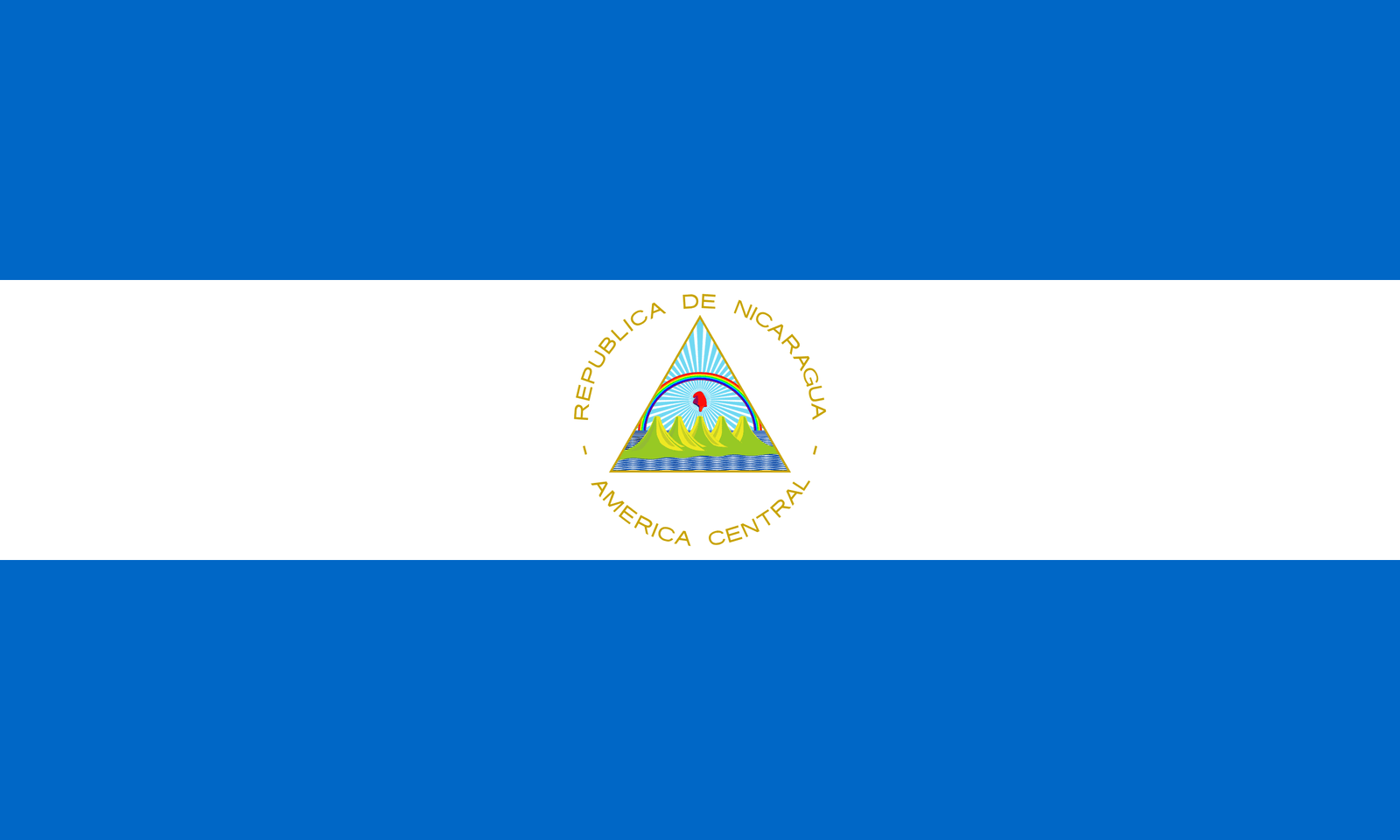
Flag of Nicaragua
| Legal Name | Republic of Nicaragua |
|---|---|
| Flag |
|
| Capital City |
Managua |
| Total Area | Approximately 130,375 km² |
| Land Area | Approximately 130,000 km² |
| Water Area | Approximately 375 km² (lakes, rivers) |
| Population | About 7.3 million |
| Major Cities | Managua (1.2M), León (200K), Masaya (150K), Chinandega (140K), Matagalpa (120K) |
| Currency | Nicaraguan córdoba (NIO) |
| GDP | Approximately USD 14 billion |
| GDP Per Capita | Approximately USD 1,920 (nominal) |
About of Nicaragua
Nicaragua is the largest country in Central America, situated between Honduras to the north and Costa Rica to the south, with coastlines along the Caribbean Sea to the east and the Pacific Ocean to the west. Its strategic location provides access to both oceans, making it a historically significant route for trade and proposed canal projects.
The capital and largest city, Managua, serves as the political, economic, and cultural hub of the nation. Other notable urban centers include León, Granada, and Masaya, which are key for education, tourism, and commerce. Nicaragua has a predominantly young population, with a significant proportion living in rural areas and relying on agriculture as a primary livelihood.
Internationally, Nicaragua is recognized as a sovereign nation and participates in organizations such as the United Nations, Organization of American States, and Central American Integration System (SICA). Its geopolitical importance is linked to its potential as a transoceanic trade route and its rich natural resources, including fertile volcanic soils and freshwater lakes.
Etymology
The name “Nicaragua” is believed to derive from Nicarao, the name of a local indigenous chief in the region at the time of Spanish contact, combined with the Spanish word “agua” meaning water. The name thus reflects both the presence of native populations and the country’s abundant lakes and rivers, particularly Lake Nicaragua, the largest lake in Central America.
History
Prehistoric and Ancient Civilizations
Evidence of human settlement in Nicaragua dates back thousands of years, with archaeological sites showing early agricultural societies and pottery cultures. Indigenous groups, including the Nicarao, Chorotega, and Miskito, established complex communities with trade and agricultural practices.
Classical and Colonial Periods
During the 16th century, Nicaragua was colonized by Spain. The colonial period introduced European governance, Christianity, and the encomienda system. Cities like León and Granada became cultural and administrative centers during Spanish rule.
Independence Movement
Nicaragua joined other Central American provinces in declaring independence from Spain in 1821, initially becoming part of the Federal Republic of Central America. It later emerged as an independent republic in 1838 after the federation dissolved.
Post-Independence Events
Nicaragua’s history has been marked by internal political struggles, including liberal and conservative conflicts, foreign interventions, and civil wars. Key 20th-century events include the Sandino rebellion, the Somoza dynasty, and the Sandinista revolution in 1979, which ousted the Somoza regime. The 1990s saw the establishment of democratic governance, though political tensions continue.
Modern Political Developments
Currently, Nicaragua is governed by President Daniel Ortega and the Sandinista-led government. Political developments are influenced by domestic economic challenges, social programs, and regional diplomatic relations with Central American neighbors and international actors.
Government and Politics
Nicaragua is a presidential republic, with a multi-party system. Its 1987 Constitution defines the legal framework and separation of powers.
Executive Branch: President serves as head of state and government; cabinet appointed by the president.
Legislative Branch: Unicameral National Assembly, members elected to five-year terms.
Judiciary: Independent system, including the Supreme Court, overseeing constitutional and legal matters.
Nicaragua is divided into 15 departments and 2 autonomous regions, each with local governance structures. The country maintains foreign relations with Latin America, the United States, China, and Europe, participating in UN, OAS, and SICA initiatives. Defense is provided by the Nicaraguan Armed Forces, focusing on internal security and disaster response.
Economy
Nicaragua is classified as a developing economy, with agriculture, manufacturing, and services forming its economic base. Key sectors include:
Agriculture: Coffee, sugarcane, bananas, beef, and seafood.
Manufacturing: Textiles, food processing, and small-scale industrial goods.
Services: Tourism, banking, and commerce.
The country is rich in volcanic soil, freshwater resources, and geothermal potential. Trade partners include the United States, Central American neighbors, and the European Union. Economic challenges include poverty, inequality, political instability, and vulnerability to natural disasters, while future prospects focus on tourism expansion, renewable energy, and agricultural modernization.
Demographics
Nicaragua has a population of approximately 7.3 million, predominantly mestizo, with Indigenous and Afro-descendant minorities. Main ethnic groups include Mestizo, Creole, Indigenous (Miskito, Mayagna), and Garifuna. Spanish is the official language, with indigenous languages recognized regionally. The dominant religion is Roman Catholicism, though Protestant communities are significant.
The population is mostly rural, with urban growth centered in Managua and other cities. Fertility rates remain moderate, contributing to gradual population growth.
Culture and Society
Nicaraguan culture reflects a blend of Indigenous, Spanish, and African influences. Literary traditions are prominent, with figures like Rubén Darío shaping Latin American literature. Music, dance, and folklore thrive in festivals, particularly in León and Granada. Cuisine includes gallo pinto, vigorón, and nacatamales.
Social norms emphasize family, community, and religious values. Festivals such as Independence Day (September 15), Holy Week, and San Jerónimo celebrations in Masaya are culturally significant. Sports include soccer, baseball, and traditional boat races in coastal communities.
Education and Healthcare
The education system includes primary, secondary, and tertiary levels, with several universities in Managua and León. Literacy rates are around 82%, with ongoing efforts to improve rural access.
Healthcare is delivered through public hospitals, clinics, and private facilities, facing challenges like malaria, dengue, and limited rural access. Public health initiatives focus on vaccination campaigns, maternal health, and disease prevention.
Geography and Climate
Nicaragua features volcanic mountain ranges, coastal plains, lakes, and rivers, including Lake Nicaragua and the San Juan River. The country experiences a tropical climate, with wet (May–October) and dry (November–April) seasons.
Natural hazards include volcanoes, earthquakes, hurricanes, and floods. Environmental concerns involve deforestation, soil erosion, and freshwater management.
Flora and Fauna
Nicaragua hosts diverse ecosystems, from rainforests to wetlands:
Flora: Tropical hardwoods, orchids, and mangroves.
Fauna: Jaguars, tapirs, monkeys, sea turtles, and numerous bird species.
Conservation efforts: Protected areas include Bosawás Biosphere Reserve, Indio Maíz Biological Reserve, and Isla de Ometepe.
Map of Nicaragua
Flag: Blue-white-blue horizontal stripes with the coat of arms in the center.
Coat of Arms: Triangle with volcanoes, rising sun, rainbow, and Phrygian cap, representing liberty, unity, and peace.
National Anthem: Salve a ti, Nicaragua
National Animals/Plants: Guardabarranco (national bird), gold-striped frog, and royal palm.
National Flag (Detailed Section)
The flag consists of three horizontal stripes: blue (top and bottom) symbolizing the Pacific Ocean and Caribbean Sea, and white (center) representing peace and purity. The coat of arms in the center reflects freedom, unity, and the natural wealth of the country. The flag was adopted in 1908, with minor modifications over time.
Flag protocol mandates display on government buildings, schools, and public holidays, reflecting national pride and historical heritage.
Flag flying days
| Date | Flag Position | Occasion / Reason |
|---|---|---|
| September 15 | Full-mast | Independence Day |
| July 19 | Full-mast | Sandinista Revolution Anniversary |
| August 15 | Full-mast | Assumption of Mary (national religious observance) |
| National Mourning | Half-mast | Death of national leaders or significant tragedy |